Infineon, Megmeet Pair CoolSiC G2 With 800 VDC AI Power Work
Megmeet will use Infineon's CoolSiC MOSFET G2 in its three-phase AI power shelf as the two work on 800 VDC architectures; Megmeet claims efficiency above 80 PLUS Ruby peak, but gives no kW rating, price or customer.
3 min read
Infineon's CoolSiC silicon carbide family visual from its product page; the image is a brand rendering, not a photo of Megmeet's power shelf.
Image: Infineon Technologies
Source · Press image from the Infineon Technologies website, used for news reporting.
Infineon Technologies and Shenzhen Megmeet Electrical said on Nov. 19 that Megmeet will use Infineon's CoolSiC MOSFET G2 silicon carbide devices in its three-phase power shelf for AI, and the two companies will jointly advance 800 volt direct current (VDC) data-center architectures, according to the companies' announcement as carried by eeNews Europe and Semiconductor Today.
Megmeet says the shelf reaches a system efficiency "well above" the peak efficiency requirement of the 80 PLUS Ruby certification. That is Megmeet's own claim, and neither outlet reports a measured efficiency percentage, an output rating in kW or a test report. The collaboration also covers server power supply units (PSUs), intermediate bus converters (IBCs) and solid-state transformers (SSTs), the building blocks of an 800 VDC distribution chain.
Megmeet's three-phase power shelf is the stage that uses CoolSiC G2; the SST, server PSUs and IBCs are in the collaboration's scope.
Graphic: Voltgrid News
The shelf is the box in the rack that converts incoming power for the servers, so its losses leave as heat inside the hall. Infineon says its silicon carbide devices cut switching and conduction losses, and that its .XT interconnect technology lowers thermal resistance, which helps heat leave the device. These are vendor statements. Every point of conversion loss that does not occur is heat the liquid or air cooling system does not have to remove, but no source puts a number on that saving here.
What the Megmeet shelf is built on
Infineon's Dr. Peter Wawer, chief technology officer of its Power Systems Division, said the two companies will jointly advance 800 VDC architectures for data centers, aiming at higher power density, optimized energy use and robust power delivery. Infineon also says the G2 devices help keep power delivery stable as AI server loads change quickly.
The deal builds on an existing supply relationship. Megmeet already uses Infineon's CoolMOS 8 superjunction MOSFETs and OptiMOS 6 MOSFETs in single-phase AI server power supplies, according to eeNews Europe, so the new shelf moves the same customer to a three-phase design and to silicon carbide.
Where it fits in Infineon's 800 VDC work
On Oct. 21 Infineon said it was extending its work with NVIDIA, as Voltgrid reported, putting gallium nitride in the intermediate bus converter stage that steps 800 V down to 50 V, 12 V or 6 V. That release dealt with the board-level conversion stage and used GaN, while the Megmeet shelf is a different stage and uses silicon carbide, so the two announcements cover different parts of the same 800 VDC chain.
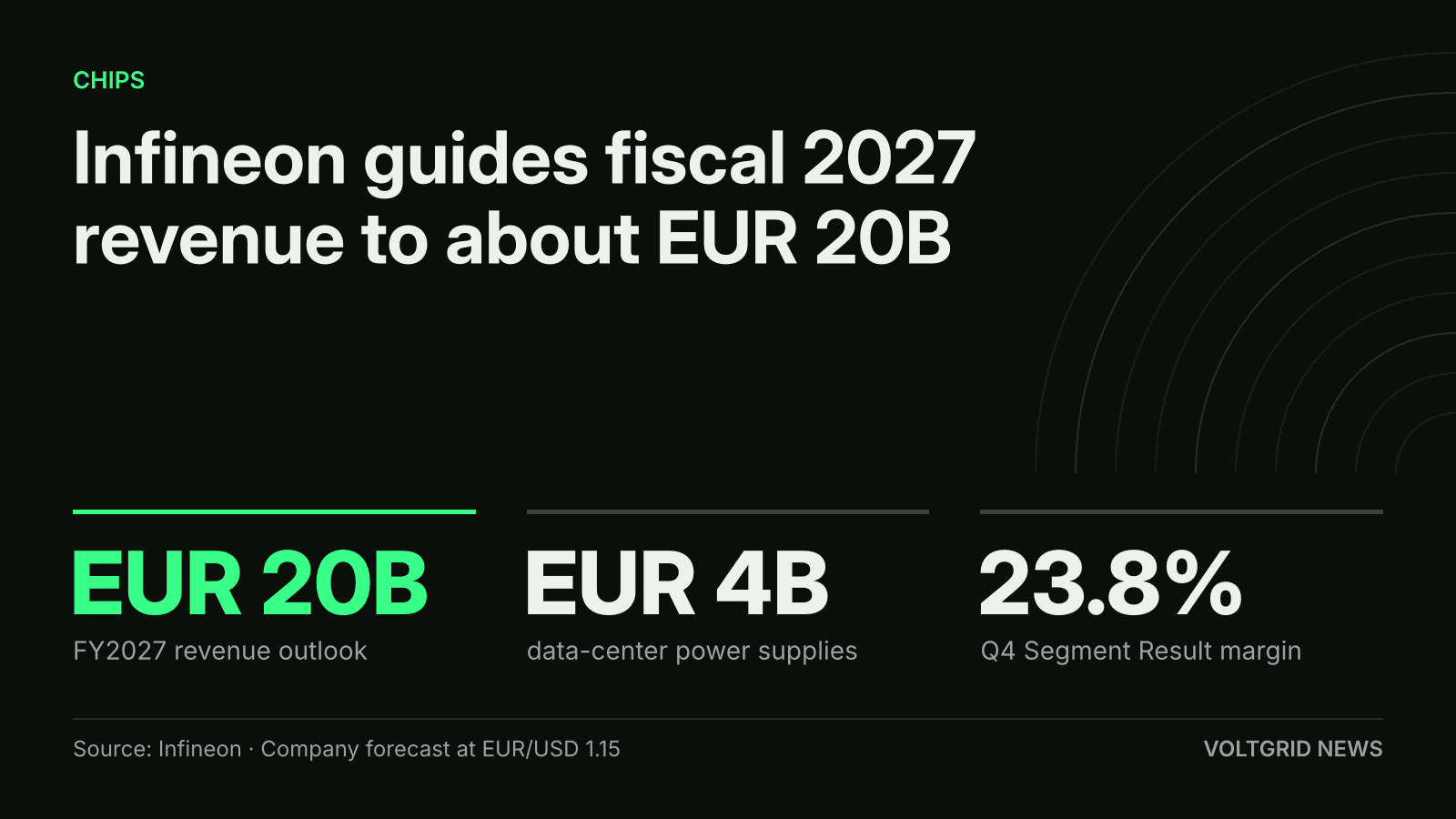
The commercial weight is visible in Infineon's guidance. The company forecast fiscal 2027 revenue of about €20 billion with data-center power supplies near €4 billion, as Voltgrid reported on Nov. 10. Neither the Megmeet announcement nor the NVIDIA one gives an order size or volume, so the link between these partnerships and that revenue figure is not quantified.
What is not confirmed yet
Infineon's own press release could not be retrieved from its newsroom when this story was written, so the figures here come from the companies' announcement as reported by eeNews Europe and Semiconductor Today, which agree with each other. Voltgrid searched Infineon's press list and Megmeet's English news page on Nov. 20 and found no release on this collaboration.
Neither outlet gives the shelf's kW rating, its efficiency in percent or the 80 PLUS Ruby tier it was measured against, a launch date, a customer or a price. It is also not stated whether the shelf targets NVIDIA's 800 VDC rack designs. Those details will decide whether the shelf becomes an installed product or stays a reference design.
Sources
- Published
- Sources
- 2 cited