Italy Battery-Shifted Solar, Wind at €106-122/MWh vs €210 for Gas
Ember, Energy Square and Cleantech for Italy put battery-shifted solar and wind at €106-122/MWh against €210/MWh for gas, but contracted storage still trails Terna's 2035 need.
3 min read
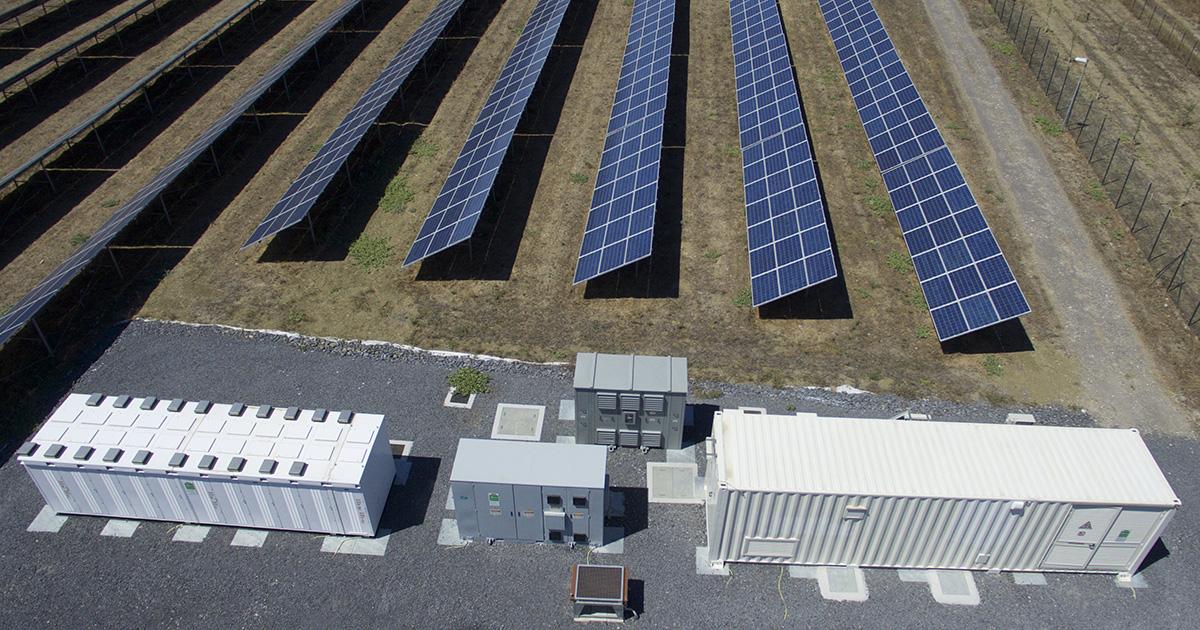
Battery storage units next to a solar field, in an Enel image. Enel owns over 85% of Italy's operating grid-scale storage, according to Ember.
Image: Enel
Source · Press image from the Enel newsroom, used for news reporting.
Battery-shifted solar and wind power in Italy could cost €106-122 per megawatt hour (MWh), up to 49% below the €210/MWh of gas power, Ember said on Nov. 26.
Ember's model puts stored solar and wind at EUR 106-122/MWh against EUR 210/MWh for gas power; the figures are modelled, not observed prices.
Graphic: Voltgrid News
The figures come from a joint analysis by the think tank with Energy Square and the Cleantech for Italy coalition, and Euronews carried them on Nov. 28. The gas price is the October 2026 level. Ember assumes charging power at €57/MWh for solar and €73/MWh for wind, the averages of Italy's 2025 renewable auctions, and battery costs in line with the first MACSE auction, which implies a storage cost of €49/MWh. Where midday prices fall below €20/MWh, Ember says stored power could cost as low as €64/MWh. The 49% gap belongs to the €106 end of the range; at €122/MWh the gap is about 42%, by Voltgrid arithmetic.
The consequence is for evening prices. Batteries met an average 2.8% of Italy's evening peak demand in the first half of 2026, against 1.3% a year earlier, while fossil power supplied 40%, according to the study. Ember argues that more batteries narrow the gap between cheap and dear hours and push out the least efficient gas plants. It attaches two conditions: solar and wind must keep growing, and battery operators must compete, including in MACSE secondary auctions and merchant projects.
How the MACSE auctions could pay for themselves
MACSE is the grid operator Terna's auction scheme for grid-scale storage. Winners get a fixed annual premium, and Terna sells the pooled capacity to generators and traders as time-shifting contracts. Any shortfall is recovered through a levy on bills. As Voltgrid reported, Terna awarded all 16 GWh in its second round on Nov. 24 at €11,382/MWh-year, 12% below the first.
Ember published two days after that round. It estimates the first auction, which bought 10 GWh for 2028 at a weighted average of about €13,000/MWh-year against a €37,000 cap, costs consumers nothing if the spread between solar and non-solar hours stays at 2026 levels and the batteries complete at least 200 cycles a year. Four-hour grid-scale systems typically manage about 440, according to the study.
Volume is the gap. Italy had 19 GWh (7.7 GW) of batteries in June 2026, of which 7 GWh is grid-scale and Enel owns over 85% of what operates. Auctions lift grid-scale capacity to at least 38 GWh by 2029, but Terna and Snam put the need at 76-96 GWh by 2035, and Ember says it could reach 134 GWh at gas near €32/MWh. Bulgaria's fleet reached 16 GWh by August 2026, ahead of Italy's, and Ember says Australian batteries set the price in 48% of dispatch intervals in the third quarter, with wholesale prices 27% lower year on year. Voltgrid covered Australia's side in the AEMO summer outlook.
Italy's cell factories against its storage needs
Ember notes that MACSE sets no origin rules, so contracted batteries lean on Chinese cells, and China makes over 98% of the world's lithium iron phosphate (LFP) cells. Planned plants at Teverola (Seri Industrial) and Brindisi (Eni with Seri Industrial) are meant to reach 16 GWh a year of LFP cells by 2030, above the 11 GWh a year of storage Italy is expected to add. The Termoli project adds about 685 MWh a year, backed by over €200 million. LFP was 0.2% of EU cell capacity in 2024.
The authors ask for a multi-year auction calendar, joint purchase agreements and European-origin requirements introduced gradually. Brazil took a different lever on Nov. 26, cutting its Fundo Clima rate to 3% for storage with locally made packs, as Voltgrid reported.
What is not confirmed yet
These are modelled estimates, not observed prices, and they depend on October 2026 gas prices and 2025 auction levels. The no-cost finding is conditional on spreads holding, and covers the first auction; the study as read does not run the same test on the second round. Batteries from both rounds are not yet built, and the factories are plans, not output. Terna has not commented in the reports Voltgrid read.
Sources
- Published
- Sources
- 2 cited