Brazil Cuts Fundo Clima Rate to 3% for Locally Made Battery Storage
Brazil's National Monetary Council cut the Fundo Clima rate from 6.5% to 3% a year for storage with Brazilian-made packs, days before the Dec. 2 and Dec. 4 LRCAP battery auctions.
2 min read
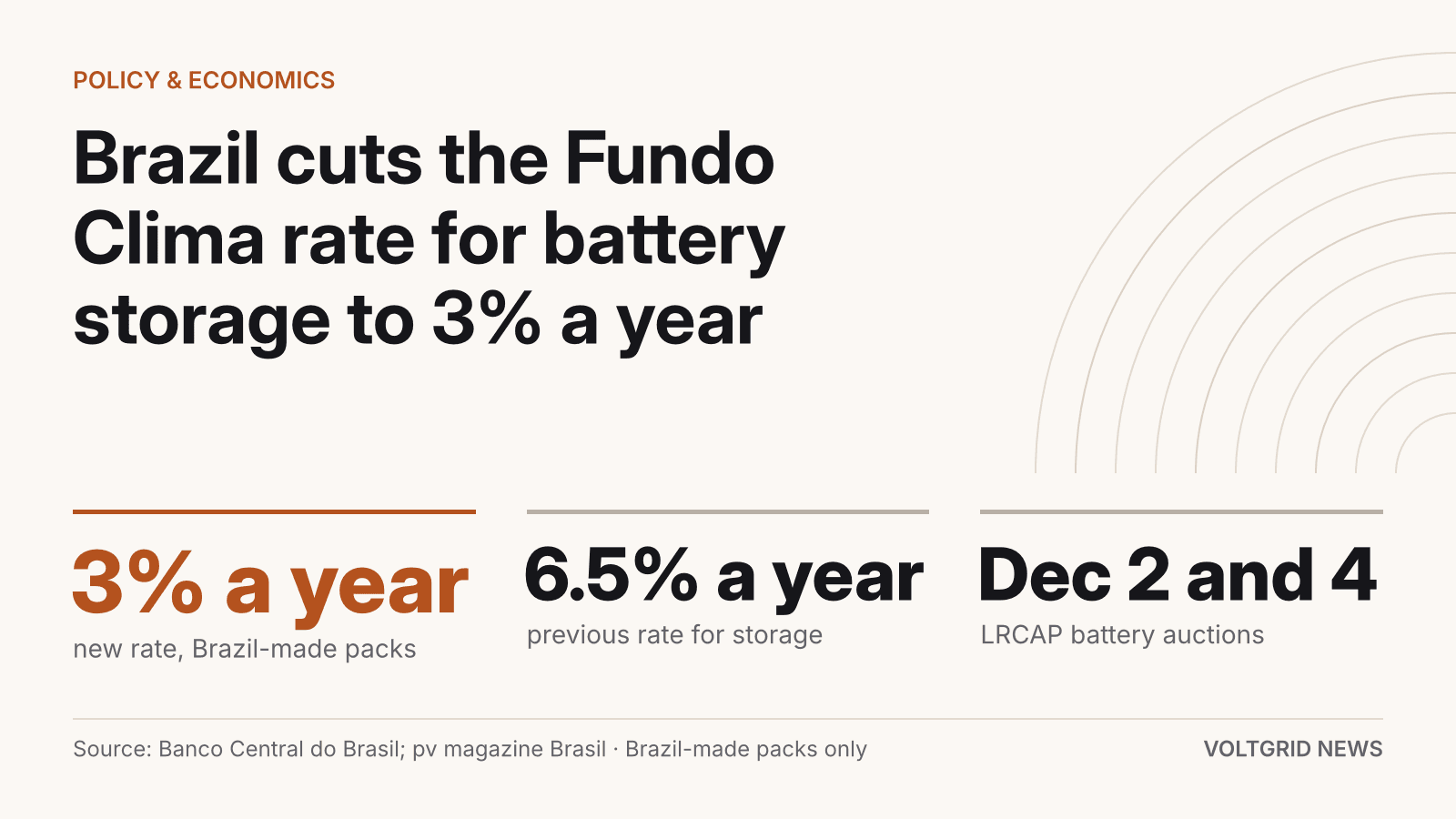
The Fundo Clima rate for storage with Brazil-made packs is 3% a year, down from 6.5%, ahead of the LRCAP battery auctions on Dec. 2 and Dec. 4.
Graphic: Voltgrid News
Brazil's National Monetary Council (CMN) cut the Fundo Clima financing rate for battery storage from 6.5% to 3% a year on Nov. 26, but only for systems that use battery packs made in Brazil.
The decision is Resolution CMN 5.353, which amends Resolution 5.095 of Aug. 24, 2023, the rule on loans from the National Climate Change Fund. According to the text on the central bank's normative database, the 3% rate applies to storage systems with a locally produced pack that meet the nationalization criteria set by the development bank BNDES. Every other specific purpose stays at 6.50% a year, and the resolution takes effect on publication.
The timing matters. The cut came less than a week before the LRCAP capacity-reserve auctions for batteries on Dec. 2 and Dec. 4, according to pv magazine Brasil. The Dec. 2 round is limited to systems that meet BNDES local-content criteria. The Dec. 4 round has no nationalization requirement, but projects using systems that fit the bank's methodology can also draw Fundo Clima money, pv magazine reported.
What the cut changes in numbers
Adding BNDES's minimum remuneration of 1.3% a year, pv magazine Brasil calculated that the nominal cost of Fundo Clima credit falls from 7.88% to 4.34% a year, a drop of 3.54 percentage points, for projects on nationalization routes 2, 3 and 4, which require different stages of local battery manufacturing. For those routes, the outlet said, all BNDES financing can come from the fund.
pv magazine Brasil calculated that the nominal cost of Fundo Clima storage credit falls from 7.88% to 4.34% a year on routes 2, 3 and 4.
Graphic: Voltgrid News
Route 1, which requires no local manufacturing, is treated differently, according to pv magazine. There, 80% of the credit comes from the fund at 6.5% plus the bank's margin, and the other 20% is priced on the long-term rate TLP, which in November equals the IPCA inflation index plus 7.72% a year, plus a minimum spread of 1.1%. BNDES can finance up to 80% of total project investment, Canal Solar reported.
Who gains and how others compare
BNDES president Aloizio Mercadante said the cheaper credit should attract new manufacturers and raise local production and technology capacity, as eixos and Canal Solar quoted him. pv magazine noted that WEG has announced R$330 million for a storage-system plant in Itajaí (Santa Catarina) with planned capacity of 4 GWh a year. BNDES said it will structure project finance and corporate credit for selected LRCAP projects with national content.
Other storage markets lean on different tools. Voltgrid News covered China's storage plan, with its 300 GW target for 2030, and India's battery incentive scheme, which has yet to pay an incentive. Brazil's lever is a cheaper loan tied to local content.
What is not confirmed yet
Access to the cheaper money depends on the Fundo Clima budget for 2027 and on the volume of investment contracted in the auctions, pv magazine reported, and none of the outlets gives a ceiling in reais. No auction results exist yet, so the effect on bids is unknown. Voltgrid read the resolution through the central bank's database and did not read BNDES's own release, whose statements are cited here as carried by Canal Solar and eixos.
Sources
- 01CMN reduz taxa do Fundo Clima para baterias nacionaiseixoseixos.com.br
- 02Conselho Monetário Nacional reduz taxa de juros para projetos com bateriasCanal Solarcanalsolar.com.br
- 03CMN reduz juros do Fundo Clima de 6,5% para 3% para baterias fabricadas no Brasilpv magazine Brasilpv-magazine-brasil.com
- 04Resolução CMN nº 5.353: Fundo Clima rate of 3% a year for battery storage with Brazilian-made packsBanco Central do Brasilbcb.gov.br
- Published
- Sources
- 4 cited