JinkoSolar Perovskite-Silicon Tandem Cell Certified at 35.24%
JinkoSolar said on Nov. 19 that CAS SIMIT certified 35.24% for its perovskite-silicon tandem lab cell, 0.26 points under Longi's 35.5%. No module data came with it.
2 min read
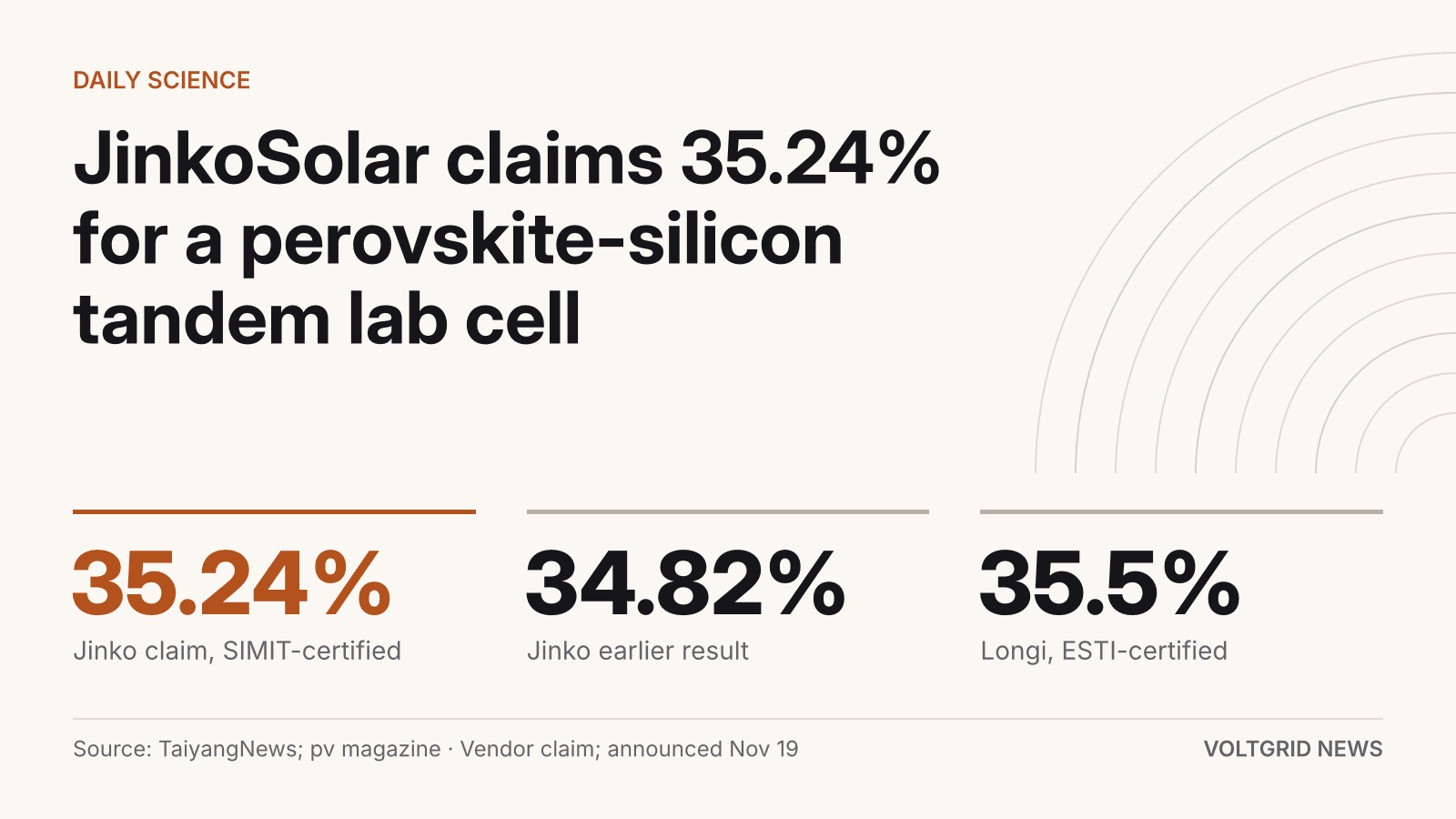
JinkoSolar's claimed 35.24% tandem lab cell, announced Nov. 19, set against its earlier 34.82% and Longi's ESTI-certified 35.5%.
Graphic: Voltgrid News
JinkoSolar said on Nov. 19 that its perovskite-silicon tandem solar cell reached 35.24% efficiency, certified by the Shanghai Institute of Microsystem and Information Technology (SIMIT) of the Chinese Academy of Sciences.
This is a single laboratory cell, not a solar module and not a product on sale. TaiyangNews republished Jinko's release on Nov. 19, and Perovskite-Info and pv magazine carried the news on Nov. 20. None of the three gives a cell area, a module plan or a sale date, and pv magazine noted that Jinko disclosed no further technical details about the cell.
What a perovskite-silicon tandem is
A perovskite-silicon tandem cell combines a perovskite cell with a silicon cell in one device. Jinko builds its version on an N-type TOPCon silicon cell. The company credits four advances for the gain: selective passivation of the textured silicon surface in the TOPCon cell, a method for controlling how the multi-component perovskite layer crystallizes, nanoscale interface passivation materials and improved light management.
How 35.24% compares with Longi and Jinko's earlier cell
Jinko's previous result for the same cell type was 34.82%, so the new figure is 0.42 percentage points higher after five months, according to Jinko. The company counts it as its 34th record for cell efficiency and module power. Perovskite-Info noted that Jinko's research and development director had presented a 34.76% cell in May, which differs from the 34.82% the company cites.
The overall tandem record is still Longi's. pv magazine reports that Longi reached 35.5% in July 2026 with a two-terminal tandem cell certified by the European Solar Test Installation (ESTI). That is 0.26 percentage points above Jinko's figure, and the two results come from different certifiers. Longi also reported a 34.3% efficiency for a large-area tandem cell of 261 cm², and Trinasolar reached 32.6% on a large-area cell in January 2026, certified by Fraunhofer ISE, according to pv magazine.
Jinko's claimed 35.24% sits just below Longi's 35.5%; the certifiers and cell sizes differ, and Jinko's cell area is not disclosed.
Graphic: Voltgrid News
The gap between small and large cells is the number to watch. Jinko says the result marks progress in moving perovskite-silicon tandems from laboratory efficiency toward industrial application, which is the company's reading, not a measured change in what is on sale. For anyone planning solar supply, nothing in the three reports puts a tandem module on a price list.
What is not confirmed yet
The certificate itself was not available to Voltgrid; the 35.24% figure rests on Jinko's statement, and the certifying institute is named by the company. The sources give no cell area, so the result cannot be compared with Longi's 261 cm² cell. They also give no stability or durability data and no manufacturing-scale figures for the 35.24% cell, which are the open questions between a lab record and a product. Jinko describes the tandem route as steadily maturing, and that is a company assessment. As of Nov. 23, Voltgrid found no newer announcement from Jinko or Longi on tandem efficiency.
Sources
- 01Jinko Solars perovskite/TOPCon tandem cell reaches 35.24% efficiencyPerovskite-Infoperovskite-info.com
- 02JinkoSolar claims 35.24% efficiency for perovskite-silicon tandem solar cellpv magazinepv-magazine.com
- 0335.24%! JinkoSolar Sets a New World Record for Perovskite/TOPCon Tandem Cell EfficiencyTaiyangNewstaiyangnews.info
- Desk
- Science Desk
- Published
- Sources
- 3 cited