Google Willow Quantum Chip Wins Magic-Square Game, 98.3% vs 88.9%
Google's Willow quantum chip beat the classical limit in a contextuality game, Google Quantum AI said Nov. 19. The tests also expose chip errors, though the paper claims no general quantum advantage.
2 min read
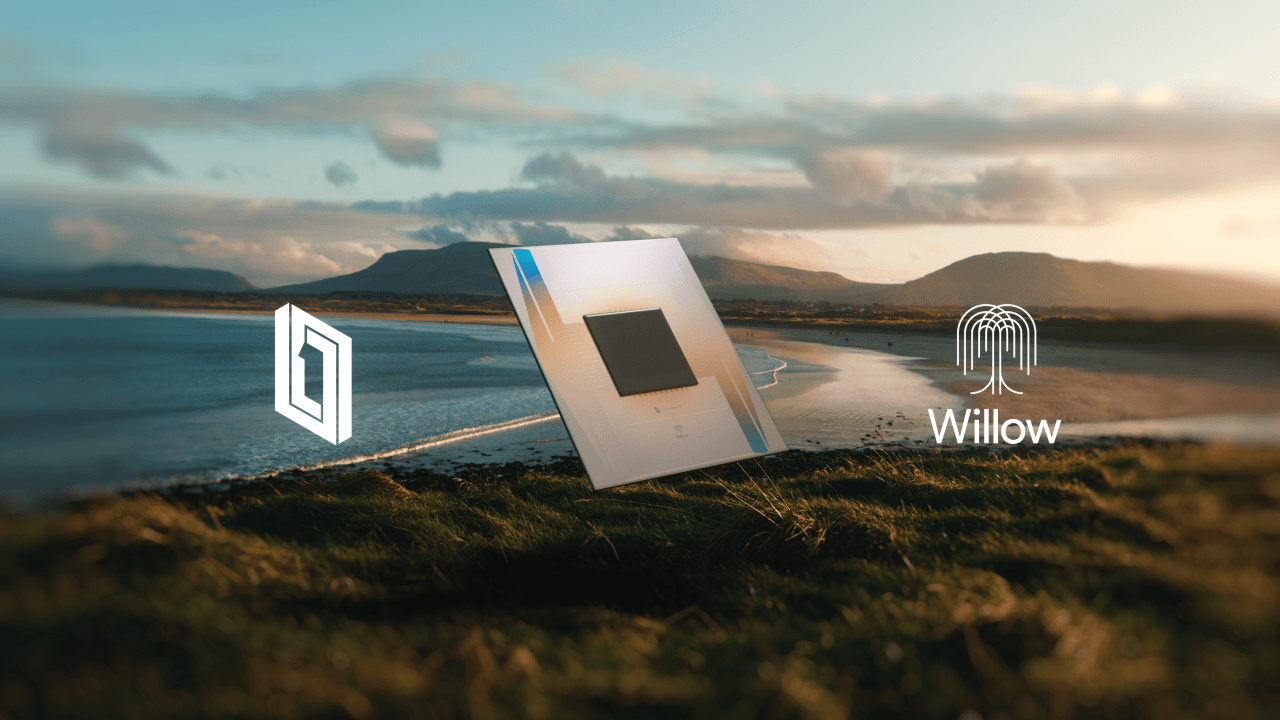
Google's Willow chip, in an image from Google's Willow announcement; the Science experiments ran on Willow.
Image: Google
Source · Press image from the Google blog, used for news reporting.
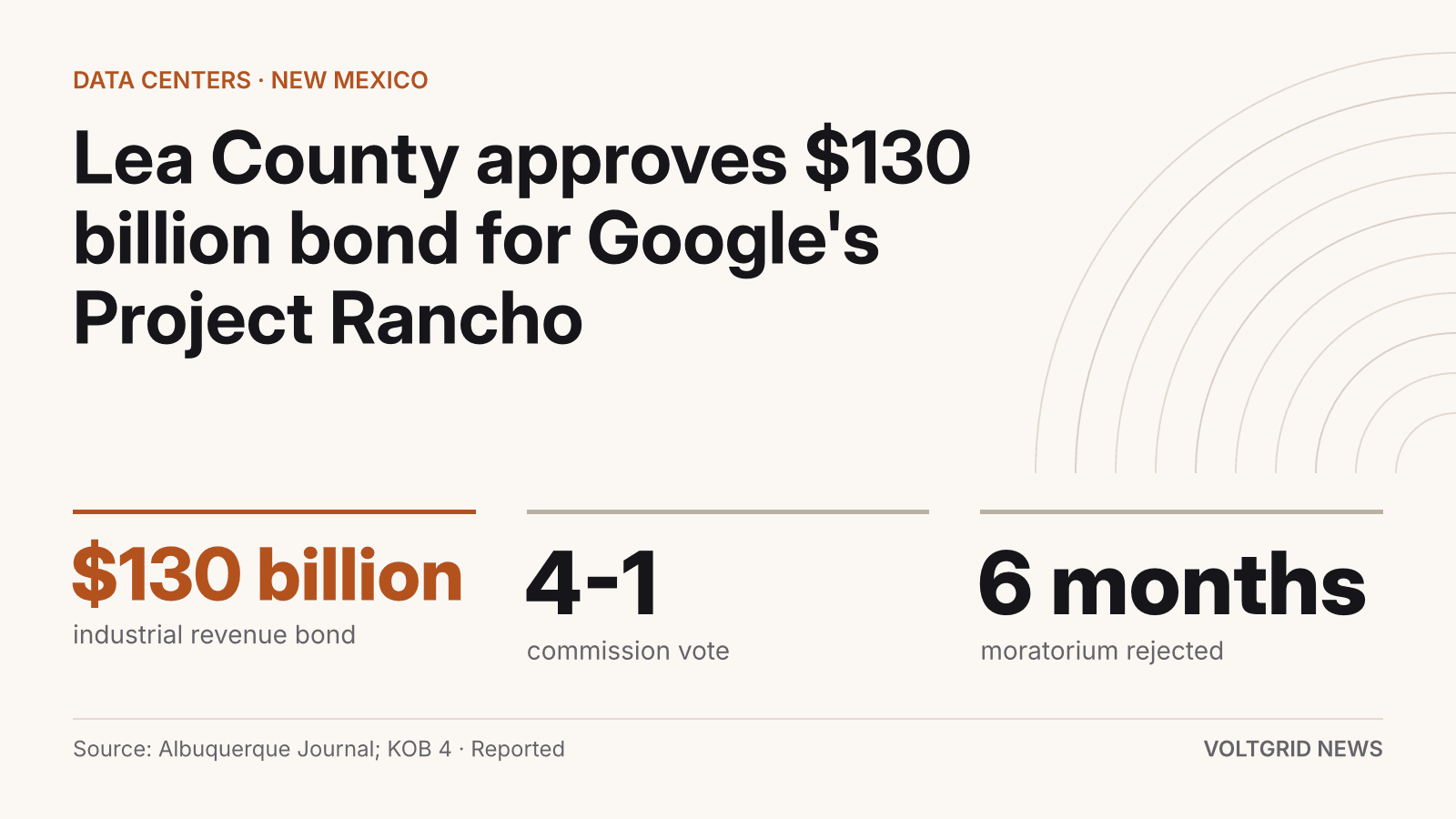
Google Quantum AI said on Nov. 19 that its Willow chip won a four-qubit coordination game 98.3% of the time, beating the 88.9% ceiling for any classical strategy, in a paper on the cover of Science.
Willow's 98.3% win rate sits above the 88.9% ceiling for any classical strategy in the magic-square game.
Graphic: Voltgrid News
The game is the Mermin-Peres magic square. Two players, who cannot talk once the game starts, each get a line of a three-by-three grid from a referee: one a row, the other a column. Each fills in three squares with +1 or -1, the row needing an even number of minus signs and the column an odd number. They win if they put the same value in the one square the lines share. Agreeing a fixed answer sheet in advance always breaks somewhere, so the best classical play wins eight of nine assignments, or 88.9%. According to The Quantum Insider, Google gave each player one qubit from each of two entangled pairs and ran each of the nine assignments 100,000 times.
What contextuality means
The test probes a property called contextuality. In Google's words, a quantum system's properties are not fixed in advance: what a measurement returns depends on which other compatible measurements are made alongside it. Theory suggests this, more than entanglement alone, may power certain quantum algorithms. Until now it had mostly been shown on a few particles. A second measurement on the same grid scored 5.59, against a maximum of 4 for any model with fixed values and an ideal quantum score of 6. The team put the gap down to experimental errors, The Quantum Insider reported.
Larger tests, and the caveat
A cooperative game for up to 71 players beat the classical limit, though the margin shrank as qubits were added. A separate hidden-linear-function task ran on up to 105 qubits and returned valid answers more than half the time. The classical cost of that task rests on a conjecture, so the size of any advantage there is an open question. The paper states that it is no unconditional proof that quantum computers beat classical ones in general, according to TNW, which also noted that the work first appeared as a preprint in December 2025.
Why it matters for hardware
For computing hardware, the practical result is diagnostic. Google says the tests are a sensitive way to catch subtle hardware errors, and The Quantum Insider reported that the larger experiments found errors that tests built on randomly chosen operations had missed. The researchers propose using the games to track chip progress, with the narrower margin at 71 qubits as one measure of the gap to close. Google says this could help pave the way for chemistry and materials science, but the experiments did not simulate either. The sources give no figures on power draw, cooling or cost.
None of this shows a quantum machine doing a useful job faster than a classical one. The 105-qubit classical benchmark is unproven, and the 71-qubit margin is shrinking. For the wider field, see Voltgrid's look at IBM's quantum reality check.
Sources
- 01Google Quantum AI tests quantum contextuality on up to 105 qubitsTNWthenextweb.com
- 02Google's Quantum Chip Beats Classical Limits in Tests of TeamworkThe Quantum Insiderthequantuminsider.com
- 03Testing quantum contextuality at scale on Google processorsGoogleblog.google
- 04Quantum-Classical Separation in Bounded-Resource Tasks Arising from Measurement ContextualityarXivarxiv.org
- Desk
- Science Desk
- Published
- Sources
- 4 cited