MIT Superconducting Memory Cell Hits Diode Efficiency Above 60%
MIT physicists built a three-layer superconducting memory cell that keeps a bit without power and works as a diode above 60% efficiency, but only at cryogenic temperatures.
2 min read
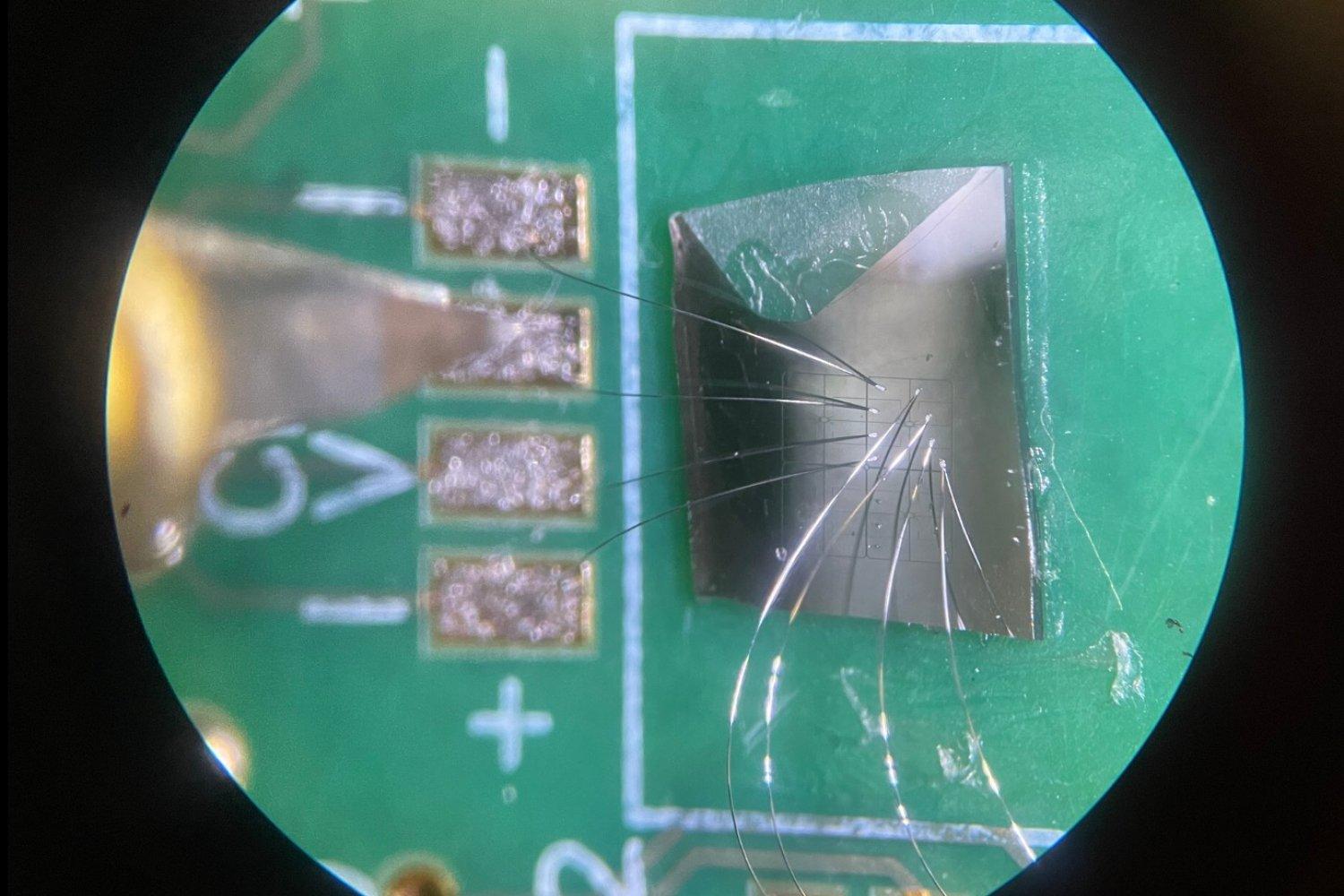
The MIT PSFC three-layer superconducting memory device under a microscope, wired to a circuit board for testing.
Image: Jagadeesh Moodera, MIT News
Source · Press image from MIT News, used for news reporting.
MIT's Plasma Science and Fusion Center built a three-layer superconducting memory cell that keeps a bit without power, MIT News said on Nov. 20. The same structure also works as a superconducting diode, and the study reports a diode efficiency above 60%.
The device is a sandwich. An ultrathin vanadium film, 6 to 8 nm thick in the paper, sits between two 5 nm layers of europium sulfide, a magnetic insulator, according to the arXiv version of the study. The team, led by senior research scientist Jagadeesh Moodera with postdoc Josep Ingla-Aynés as first author, published it in Physical Review Letters (volume 137, article 157001) in October 2026.
The memory cell is a 6-8 nm vanadium film between two 5 nm europium sulfide layers, per the arXiv version of the study.
Graphic: Voltgrid News
How the sandwich stores a bit
The two magnetic layers decide whether the film superconducts, meaning it carries current with no resistance. When their magnetization points in opposite directions, current passes. When both point the same way, the film turns resistive. A computer can read those two states as a 0 or a 1.
To write a bit, the researchers apply a small magnetic field and an electrical pulse that briefly heats the chosen cell, which makes its magnetization easier to flip. The setting then stays put without a continuing pulse or field, so the memory is nonvolatile. The researchers say writing takes less energy than in traditional semiconductor cells, but they have not yet measured how much.
They also switched one cell without disturbing its neighbor, which any usable memory needs. At a lower temperature, the same structure works as a superconducting diode, letting current pass without resistance in one direction while resisting it in the other. In the paper, a diode measured at 2.3 K showed efficiency above 60% with no applied magnetic field.
Why superconducting computers need it
Superconducting processors promise fast logic with little heat, but they lack dense memory that works at the same cold temperatures. The paper names that gap as the limit on the technology, and cites the power demands of AI data centers as one motive for closing it. A memory cell and a signal-routing diode in one layered structure points toward a superconducting chip that holds data and steers pulses without a separate part for each job.
This is a lab device, not a product. The cells are micrometer-scale, the device must stay extremely cold, and the MIT release says the next steps are to make the cells smaller, combine them into arrays and quantify the energy savings in a system built from them. No commercial timeline is given. For other recent materials work on superconductors, see our report on cuprate pairing.
What is not confirmed yet
No array has been built, so capacity, read speed and the system-level energy saving are all open. The sub-nanosecond writing times and the small cell footprint in the paper are proposals for a miniaturized design, not measurements. The MIT release says the cells could also serve the supporting electronics of quantum computers, but only as a possibility, since the devices store ordinary bits rather than qubits. For another cold-chip result, see the Cornell trapped-ion laser-cooling chip.
Sources
- Desk
- Science Desk
- Published
- Sources
- 2 cited