Tohoku Aluminum-Manganese Anode Foil Hits 81% First-Cycle Efficiency
Tohoku University and UACJ say 1 at% manganese stops aluminum-foil battery anodes from losing lithium, but the cells are lab coin cells and cycle life still falls short.
2 min read
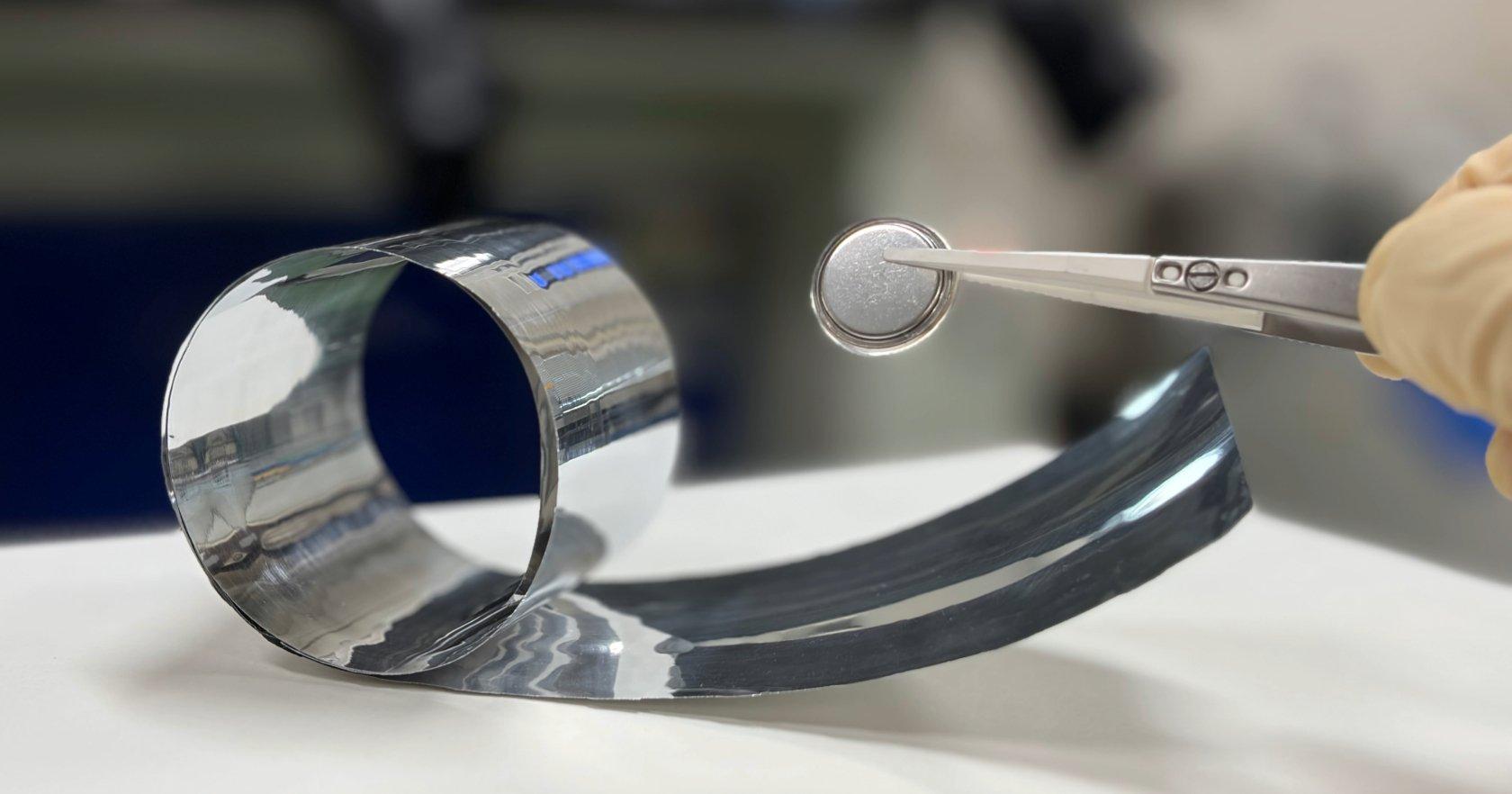
The aluminum-manganese foil anode next to a coin cell used for testing. The foil is both the active material and the current collector, according to Tohoku University.
Image: Tohoku University / Yuki Nakata et al.
Source · Press image from the Tohoku University newsroom, used for news reporting.
Researchers at Tohoku University and UACJ Corporation reported on Nov. 19 that adding 1 atomic percent manganese to aluminum-foil battery anodes kept first-cycle Coulombic efficiency at 81%, against 56% for silicon-doped foil.
Coulombic efficiency is the share of lithium put into the electrode on charging that comes back out on discharge. In the paper's half-cell tests, pure aluminum scored 80%, so manganese matched it while improving how well the foil survives cycling. The study appeared in Communications Materials on Oct. 23, 2026 (DOI 10.1038/s43246-026-01377-6), and Tohoku University issued its release on Nov. 19.
Manganese-doped foil matched pure aluminum at 81% versus 80% in first-cycle efficiency, while silicon-doped foil reached 56%, per the Communications Materials paper.
Graphic: Voltgrid News
Why aluminum foil is attractive for batteries
In a conventional lithium-ion cell the anode is a coating on copper foil. An aluminum foil anode is one sheet that both stores lithium and carries current, so the copper, the binder and the coating step could be dropped, according to the university. Voltgrid News has also covered another lab battery result on cycle life, in a different chemistry.
The problem is delithiation, the removal of lithium on discharge. Once lithium leaves the surface, a lithium-poor aluminum layer forms and blocks lithium deeper in the foil. The foil then cracks and turns porous, and capacity fades. Silicon reduces the damage but traps lithium deep inside, which is why its efficiency fell to 56%.
How the new foil works
Manganese barely reacts with lithium and dissolves evenly in aluminum. The researchers say it slows lithium's movement slightly, so the lithium-aluminum domains stay small and the foil forms many fine grain boundaries that act as fast lanes for lithium. In their microscope images the manganese foil returned to about 9 micrometres thick after full delithiation, matching the expected original thickness, while pure aluminum stayed 13 to 16 micrometres thick because of voids.
Under heavy current the gap widened. At 7.5 mA per square centimetre, the manganese foil held a Coulombic efficiency of 98%. Pure aluminum fell to 78% and silicon-doped foil to 82%.
In a full cell paired with a lithium iron phosphate (LFP) cathode and no pre-lithiation, the manganese anode averaged about 99.3% Coulombic efficiency and retained roughly 0.25 mAh per square centimetre after 200 cycles. Pure aluminum failed within a few cycles, and the silicon version fell below 0.2 mAh per square centimetre within 10 cycles. That full-cell test used a concentrated ether electrolyte, which the authors say stabilises the surface layer, so it is not directly comparable with the half-cell data. As Voltgrid reported on a Surrey catalyst, lab cycle counts like these are early evidence, not product specifications.
What is not confirmed yet
All results are from laboratory coin cells and test cells, and neither the paper nor the release names a commercial cell, a cost or a date. The team says the foil's lifespan must be extended further to meet the demands of commercial batteries, and it plans to test improved alloy designs and protective surface coatings. Yuki Nakata, an assistant professor at Tohoku University's Institute for Materials Research, said the approach is a low-cost strategy because the useful microstructure forms during battery operation, without pre-built nanostructures.
For battery makers, the open question is whether a rolled aluminum-manganese foil can reach the multi-year durability that electric vehicles and grid storage expect, a gap the team itself says remains.
Sources
- Desk
- Science Desk
- Published
- Sources
- 2 cited