Cornell Polymer Fiber Forest Runs 17°C Cooler Than a Commercial Thermal Pad
Cornell's Zylon polymer fiber forest kept a test surface 17°C cooler than a commercial pad at about 1.2 W, but the result is lab-scale and the release gives no product date.
3 min read
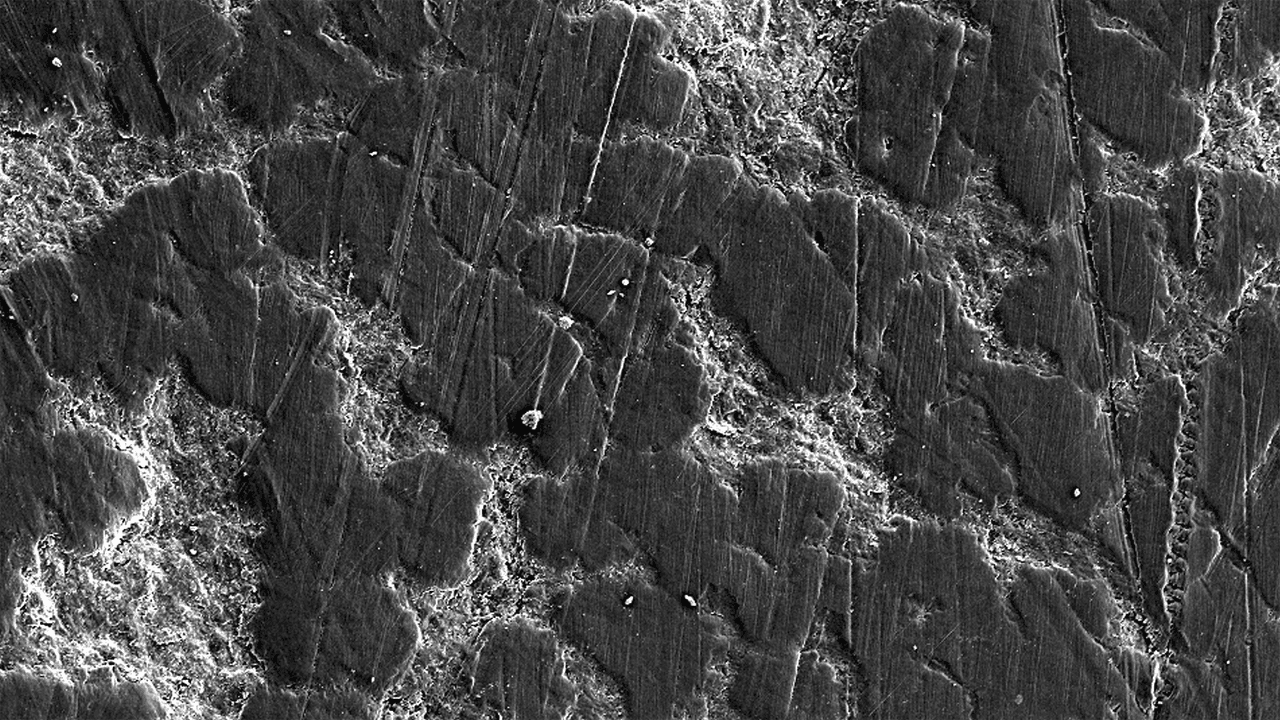
Vertically aligned Zylon nanofibers (darker patches) seen from above; higher Zylon concentration versus epoxy (lighter patches) improves heat transport. Cornell's ZT Group.
Image: ZT Group/Provided, Cornell Chronicle
Source · Press image from the Cornell Chronicle newsroom, used for news reporting.
Cornell University engineers have built a thermal interface material from thousands of upright polymer fibers that kept a heated test surface 17°C cooler than a commercial ceramic-filled silicone pad, according to a Cornell Chronicle release published on Nov. 18, 2026.
The material is called a "polymer fiber forest". Its fibers stand vertically, so they give heat a direct path from a computer chip toward a cooling system, while the material around them stays electrically insulating. The team, led by Zhiting Tian, John Brancaccio Professor in Cornell's Sibley School of Mechanical and Aerospace Engineering, describes it in a paper published Nov. 14 in the journal Materials Today Physics.
The test ran at a heating power of about 1.2 watts. In a laboratory rig that simulated heat moving from a chip to a heat sink, the epoxy-based forest held the heated surface 17°C below the commercial pad, a 25% reduction in temperature, Cornell said.
Why thermal interface materials matter for chips
A thermal interface material fills the tiny gaps between a chip, a heat spreader and a heat sink, because no two surfaces are perfectly smooth. It has to move heat well and keep contact with both surfaces. The trade-off Tian's group targets is a familiar one: materials that conduct heat well often conduct electricity too, which risks short circuits, while good electrical insulators such as many polymers conduct heat poorly.
Polymers can conduct heat far better when their long molecular chains are lined up, Tian said. Her group had stretched bulk polymer bars to align the chains in a 2025 study, but those bars had cross-sections of only square millimeters, which limited the area that could carry heat. Multiplying the fibers into a "forest" was the way around that limit.
How the fiber forest is built
The researchers used Zylon, a strong polymer fiber that conducts heat unusually well along its length. They packed bundles of fibers into a mold layer by layer, filled the gaps with a polymer, and let it harden. Turning the block 90 degrees left the fibers standing upright. The same method can make blocks of different sizes to fit a particular device.
Two versions were tested. With epoxy around the fibers, the material reached a thermal conductivity of 16.8 watts per meter-kelvin. With PDMS, a softer silicone-like polymer, it reached 12.0 watts per meter-kelvin, and the PDMS version was considerably softer. Cornell says that shows the mechanical feel can be tuned without giving up the basic heat path.
The epoxy version of Cornell's polymer fiber forest conducted heat at 16.8 W/m-K; the softer PDMS version reached 12.0 W/m-K.
Graphic: Voltgrid News
What it could mean for data-center cooling
Heat leaving a chip has to cross this interface layer before liquid or air can take it away, so gains here add to whatever the cooling hardware does. Voltgrid News has followed other chip-cooling research, including a University of Waterloo hybrid cooling design that dropped a chip hotspot by 17°C in 15 seconds, and the interface layer is the part this Cornell work targets. Tian said the forest design could also take other heat-conducting fibers and surrounding materials, so engineers could tailor it to different uses.
What is not confirmed yet
This is a laboratory result. The release reports one test at about 1.2 watts against one commercial pad, which says little yet about the much larger heat loads of AI accelerators. It gives no figures on long-term durability, cost or manufacturing volume, and no date for a product. The work was supported by the Semiconductor Research Corporation and the Defense Advanced Research Projects Agency. Mirage News carried the same account the same day.
Sources
- Desk
- Science Desk
- Published
- Sources
- 2 cited