Seoul Test: 4 of 5 Fully Charged Lithium-Ion Cells Ignite Under Pressure
Seoul's fire headquarters crushed lithium-ion cells like those in power banks at 30% to 100% charge: none ignited at 50% or below. It says that does not make 50% a safe level.
2 min read
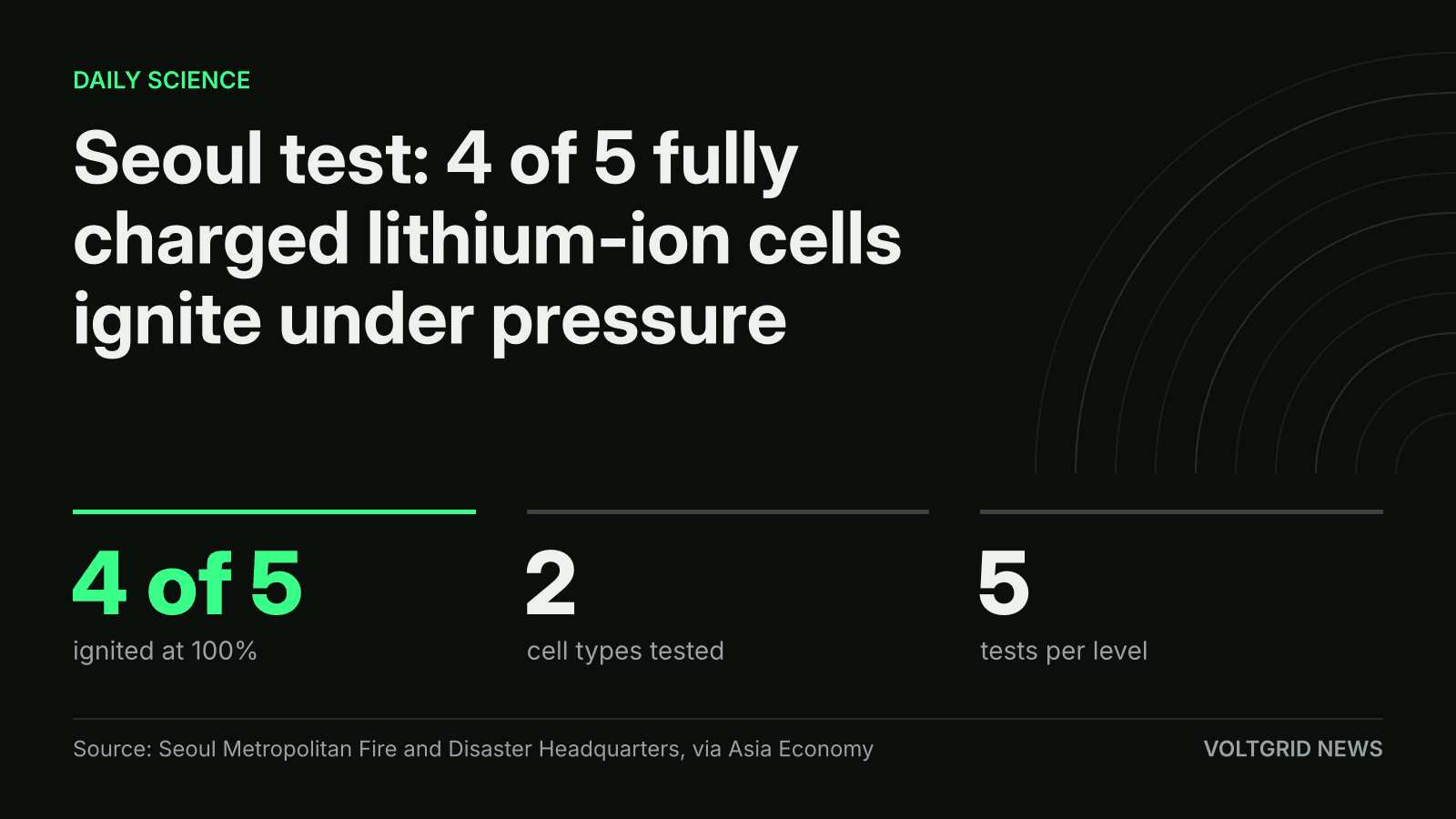
Seoul Metropolitan Fire and Disaster Headquarters tested two cell types, five tests per charge level; 4 of 5 ignited at 100% charge.
Graphic: Voltgrid News
The Seoul Metropolitan Fire and Disaster Headquarters said on Nov. 16, 2026 that fully charged lithium-ion cells were far likelier to go into thermal runaway and catch fire under pressure, with 4 of 5 cells of each type igniting at 100% charge.
Thermal runaway is a self-feeding overheating reaction: a damaged cell heats up, the heat drives more chemical reactions, and the temperature climbs within moments. The agency's Fire Investigation Research Center ran the experiment on two commercially sold cell types, a cylindrical 18650 cell and a pouch-type lithium-ion polymer cell, according to Financial News. Asia Economy described them as the kind of lithium-ion batteries used in power banks.
How the cells were tested
Researchers set each cell type to a state of charge (SOC, the share of full capacity currently stored) of 30%, 50%, 70% or 100%. A pneumatic press then pushed on the middle of the cell, and the team tracked voltage changes, temperature rise, venting (gas escaping from inside the cell) and whether the cell went into thermal runaway or ignited. Each charge level was tested 5 times per cell type, according to Financial News.
What happened at each charge level
At 100%, 4 of the 5 cylindrical cells and 4 of the 5 pouch cells went into thermal runaway and ignited, Asia Economy reported. At 70%, both types vented. The cylindrical cell went into thermal runaway at that level, while the pouch cell showed a weak flame. At 50% and 30%, neither type went into thermal runaway or ignited.
At 100% charge, 4 of 5 cells of each type ignited; at 50% and 30% neither type went into thermal runaway, though Seoul says that does not prove 50% is safe.
Graphic: Voltgrid News
The headquarters said the result comes from a limited set of cell types and one specific pressure condition, so it cannot be treated as proof that 50% or below is a safe standard, according to Financial News. Each group held only 5 cells, and the figures have not been published as a peer-reviewed paper that Voltgrid News could find.
Why storage charge levels matter
The agency said it ran the work after a July fire at a distribution warehouse in Incheon, to see whether charge level should be managed while batteries are shipped and stored. South Korea has no rule limiting the charge of batteries in distribution, and products charged to 80% to 90% are commonly stored with ordinary goods, the reports said. For air freight, by contrast, international rules set a 30% or lower charge limit for some ways of shipping lithium-ion batteries.
The tests did not cover finished power banks: the press was applied to bare cells, so the result says nothing yet about a particular product. Voltgrid News has also covered a battery health check that screens each cell in under 3 minutes, a separate effort to spot weak cells.
What is not confirmed yet
The headquarters and the National Fire Agency plan to talk with other ministries about safety standards, including charge-level management in distribution and storage. No limit has been proposed, and the reports give no timeline. Hong Young-geun, head of the Seoul headquarters, said the test confirmed that a battery's charge state can affect fire risk and that the agency will keep building evidence for practical safety rules.
Sources
- Desk
- Science Desk
- Published
- Sources
- 2 cited