Space-Based Data Centers Could Leave More Satellites Than Stars
Space-based data centers built as announced would raise low Earth orbit satellites more than 50-fold, says a Columbia-led working paper released Nov. 12. It is not peer reviewed.
3 min read
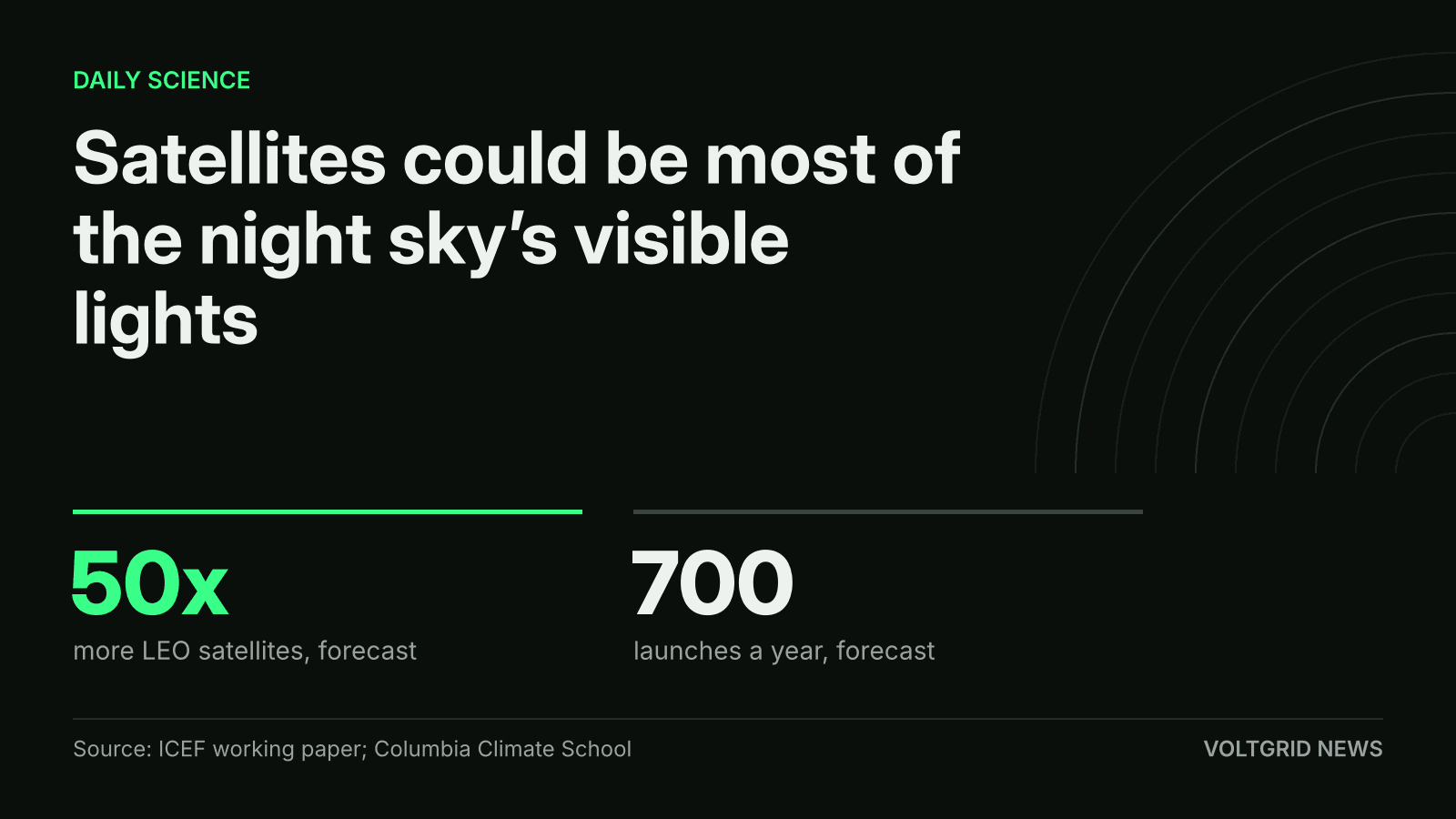
The report authors forecast more than 50 times today's low Earth orbit satellite count if announced plans are fully built. Working paper, not peer reviewed.
Graphic: Voltgrid News
A working paper led by Columbia University's David Sandalow, released Nov. 12, warns that if announced plans for space-based data centers are fully built, most visible points of light in the night sky over much of the world could be satellites rather than stars. Columbia Climate School publicized the paper on Nov. 12, and Axios reported the findings on Nov. 15.
The paper, "Space-Based Data Centers Roadmap: The Case for Caution," was prepared for the Innovation for Cool Earth Forum (ICEF), a Japanese government-backed climate technology conference, by Sandalow and nine co-authors from Columbia, Georgetown, Northwestern, Lawrence Livermore National Laboratory and elsewhere. The authors call it a working paper that has not been peer reviewed. The report counts about 19,000 satellites in orbit and says full implementation of the proposed plans would raise the number in low Earth orbit by more than 50 times.
Why the satellites would be bright
The report ties the brightness to size. SpaceX's AI1 satellite has a 70-meter wingspan, more than twice that of a Starlink satellite, and some experts expect data-center satellites to reach 100 meters tip to tip. SpaceX asked the US Federal Communications Commission in January 2026 for permission to operate up to one million of them. The report says four other companies have since filed for several hundred thousand more, including a Starcloud constellation of 88,000, an application from a company called Orbital for up to 100,000, and Blue Origin's Project Sunrise at up to 51,600, according to Axios.
SpaceX's request for up to 1,000,000 data-center satellites dwarfs the other filings and proposals; none is reported approved or launched.
Graphic: Voltgrid News
Heat is the second cause. In space a computer can shed waste heat only by radiating it, so each megawatt-class satellite is by design a megawatt-scale infrared source, the authors write. The coatings that reflect sunlight to keep a radiator cool also make it bright in visible light. Darkening the radiator cuts that glare but makes it absorb more sunlight and cool less well, and the infrared output cannot be removed because it is the waste heat itself.
What it means for orbital compute plans
The cooling chapter, by Columbia Climate School dean Alexis Abramson, argues that the best design runs AI chips as hot as they safely can, because a hotter radiator sheds far more heat and keeps panels small and launch mass low. That is the trade the night-sky chapter says brightness limits would squeeze. The authors also estimate that serving 10% of projected 2030 AI data-center demand from orbit would take at least 700 Starship-sized launches a year, about two a day, in perpetuity.
Their policy list includes brightness limits, pre-launch impact assessments, caps on satellite numbers and international standards, plus phased deployment with licenses renewed each year on brightness, deorbit and emissions performance. Sandalow told Axios there are still "unknown unknowns" and that if this is going to happen, "it should happen slowly and with care." Voltgrid has covered the other side of the build-out, from Google's Project Suncatcher test to Cowboy Space's 2028 launch target and SpaceX's more than $74B ground campuses.
What is not confirmed yet
Many of the filings may never be flown. Caleb Henry, research director at Quilty Space, told Axios that companies may be asking for more satellites than they expect to launch and that people are "tallying paper filings as if they are substantive and real." Quilty Space put investment tied to orbital data centers at about $197 million in 2025 and $1.11 billion so far in 2026, per Axios.
The brightness findings describe a full build-out, not a prediction of timing, and they depend on satellite design details that operators have not published. The American Astronomical Society has called SpaceX's plan an "unprecedented threat to the visual integrity of the night sky" in its filing, which the report quotes. Neither the paper nor Axios reports a decision by the FCC on the application.
Sources
- 01New Report Urges Caution in the Race for Space-Based Data CentersColumbia Climate Schoolnews.climate.columbia.edu
- 02Space data centers could end stargazing as we know itAxiosaxios.com
- 03Space-Based Data Centers Roadmap: The Case for Caution (working paper, November 2026)Innovation for Cool Earth Forumicef.go.jp
- Desk
- Science Desk
- Published
- Sources
- 3 cited