UCL Zinc-Iodine Battery Keeps 96% Capacity After 1,000 Cycles
UCL's Nature paper lets iodine carry four electrons, not two, in a water-based zinc-iodine cell that held 94% after 2,000 cycles, but it is a lab result with no product date yet.
2 min read
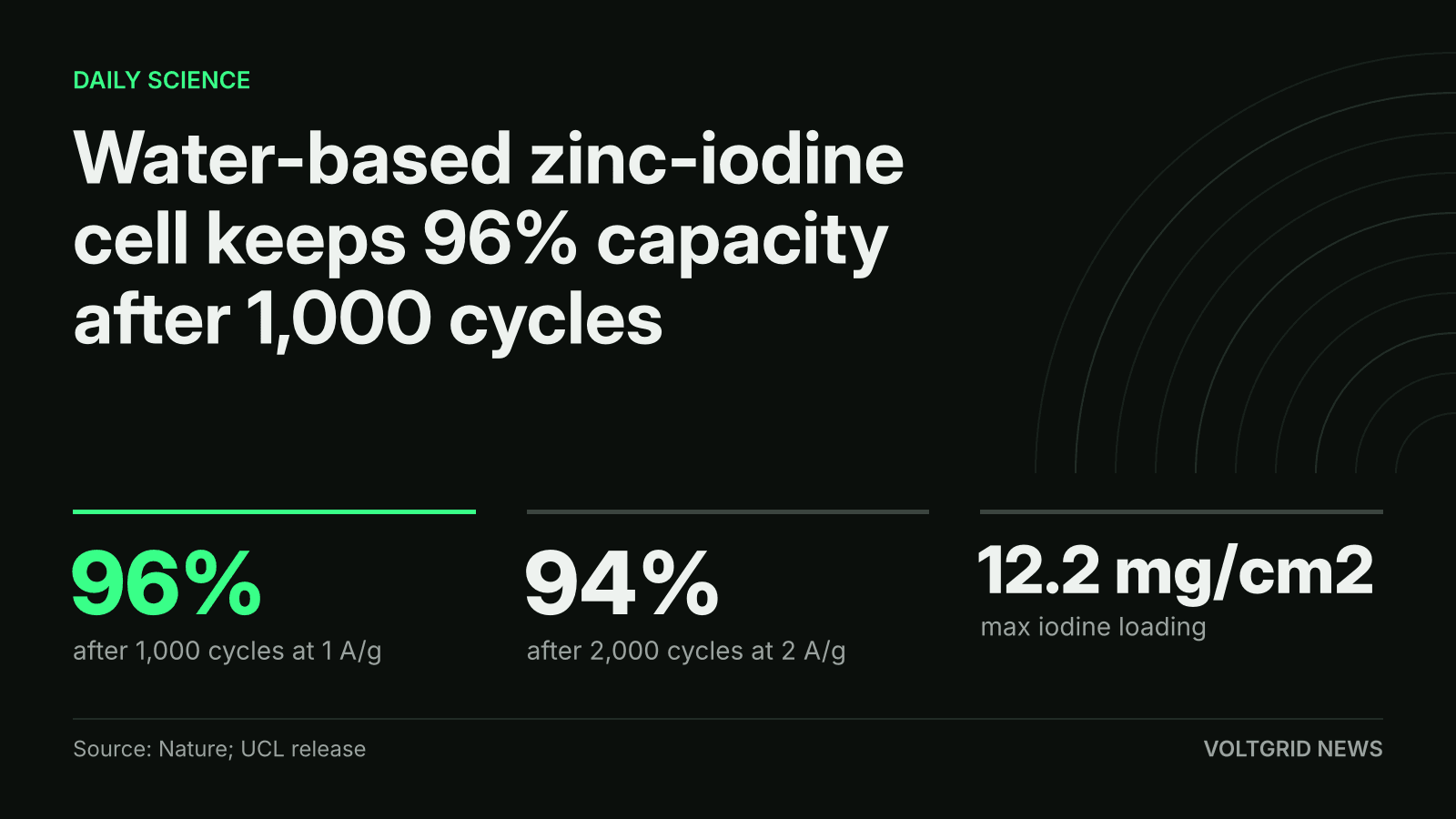
Cycling results reported in the Nature paper by the UCL-led team.
Graphic: Voltgrid News
A University College London (UCL)-led team reported in Nature on Nov. 11 a water-based zinc-iodine cell that kept 96% of its capacity after 1,000 charge-discharge cycles.
According to the paper, the zinc-iodine cells kept that capacity at a current of 1 ampere per gram and still held 94% after 2,000 cycles at 2 amperes per gram. In a Nov. 13 news release, UCL said the design worked in both pouch cells, the flat packs used in phones and laptops, and coin cells, the small discs used in low-power devices.
The gain is in how much charge each gram of iodine can hold. The paper puts the theoretical capacity of conventional two-electron iodine chemistry at 211 mAh per gram and of the four-electron version at 422 mAh per gram. UCL says aqueous batteries are a safer, more sustainable alternative to the lithium-ion packs that now fill battery farms, which can carry a fire risk, but their low energy density has limited their use.
The four-electron route has a theoretical capacity of 422 mAh/g, against 211 mAh/g for two electrons (Nature).
Graphic: Voltgrid News
How iodine carries four electrons instead of two
In a normal iodine battery, iodine goes through one step that moves two electrons. The new electrolyte lets it go through a second step, which is like filling a tank in two pours instead of one. The catch is that the iodine formed in the second step, a positively charged ion written I+, is highly reactive in water and tends to set off unwanted reactions.
Earlier work protected it with highly concentrated electrolytes containing halogens, which UCL describes as corrosive, costly and hard to manufacture. The UCL team instead redesigned the liquid right around the iodine. According to the release, some molecules keep water away from the iodine while others bind to its reactive forms. The paper says the approach also works in aluminium-iodine cells.
Why grid storage is the target
Battery farms soak up surplus wind and solar power and release it when generation drops. Voltgrid News reported earlier on CATL's sodium-ion Tener storage block, another non-lithium-ion route, with overseas delivery due in summer 2027. The UCL cell has no such date. The paper's cost case rests on a techno-economic analysis under standardised modelling assumptions, which it says shows theoretical cost-reduction potential from avoiding concentrated halogen electrolytes and costly current collectors.
What is not confirmed yet
This is a laboratory result. The paper's methods describe a pouch cell of 1.1 amp-hours, a size far below a grid battery, and the sources Voltgrid read give no energy density per kilogram, cell cost or product date. The paper also says capacity fading in these cells involves a partly irreversible loss of iodine that becomes more pronounced at higher iodine loading.
Professor Guanjie He, the corresponding author from UCL Chemistry, said the next steps include testing at a larger scale and improving performance under realistic operating conditions. The work was supported by a European Research Council Starting Grant.
Sources
- 01Breakthrough opens new possibilities for safer, water-based batteriesUCL news release via EurekAlerteurekalert.org
- 02Water-based zinc-iodine battery keeps nearly all its capacity over 1,000 cyclesInteresting Engineeringinterestingengineering.com
- 03Non-halogen aqueous electrolytes for four-electron iodine conversionNaturenature.com
- Desk
- Science Desk
- Published
- Sources
- 3 cited