IAEA World Fusion Outlook 2026 Counts 26 Planned Fusion Plants
The IAEA's World Fusion Outlook, launched Nov. 12, lists 26 planned fusion plants with power targets from the early 2030s to the 2050s; FusionX says $80B more private capital could be needed.
2 min read
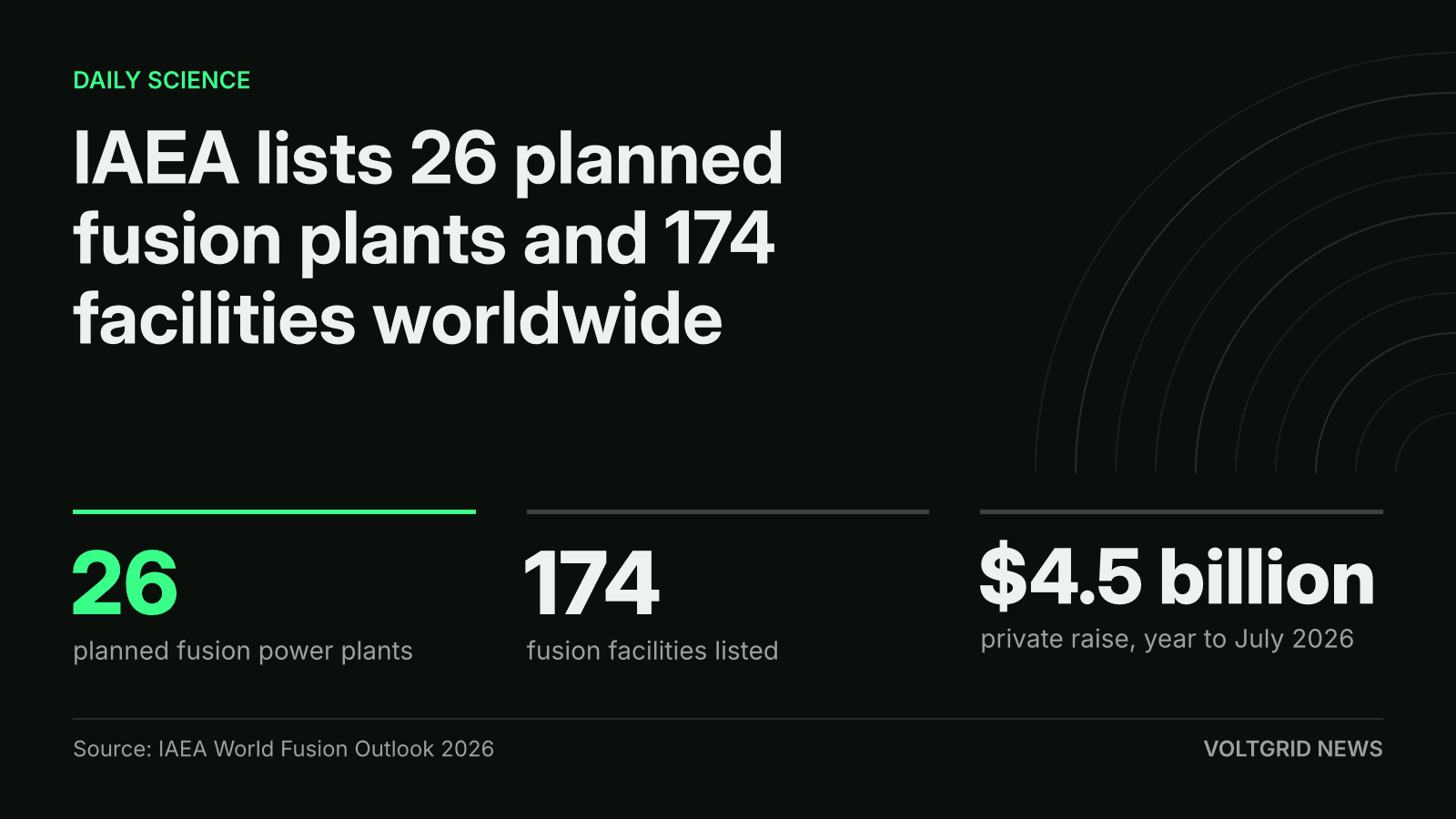
The IAEA's fourth World Fusion Outlook lists 26 planned fusion power plants and 174 fusion facilities.
Graphic: Voltgrid News
The International Atomic Energy Agency (IAEA) listed 26 planned fusion power plants and 174 fusion facilities worldwide in its fourth World Fusion Outlook, launched Nov. 12 in Vienna.
The 128-page report came out at the third high-level meeting of the IAEA's World Fusion Energy Group. According to the IAEA, the 26 plants have announced electricity targets running from the early 2030s to the 2050s. The American Nuclear Society (ANS), which summarised the report, counts eight plants aimed at the early 2030s, nine at the late 2030s, two at the 2040s and one at the 2050s, with six that have no operating date yet.
By ANS's reading of the IAEA report, the earliest announced electricity targets are in the early 2030s; the dates are announced plans.
Graphic: Voltgrid News
For anyone planning power supply, the dates are the story. On the report's own timeline, the earliest announced electricity targets are in the early 2030s. Voltgrid's ledger of Big Tech nuclear deals counts fission only, at 17,856 MW announced as of Nov. 12, and finds that the only new supply of disclosed size targeted before 2030 is up to 1,450 MW from two reactor restarts. Fusion is a question for the next decade's capacity, not this one's.
Who is paying for it
The IAEA says private fusion companies attracted a record $4.5 billion in new funding in the 12 months to July 2026, and spent more than $530 million with suppliers in 2025. FusionX, a fusion investment group that wrote a chapter for the report, puts committed private capital at $21.9 billion, more than 90% of it raised in the past five years.
FusionX also estimates that a further $80 billion in private capital could be required over the next 20 years for the industry to reach commercialisation. That estimate draws on data covering 92 private fusion companies, and the group argues the money will have to come from different sources and forms of investment, with industry consolidation along the way, according to the IAEA and ANS.
How much of the world's power fusion could supply
A study by EUROfusion, the body that coordinates fusion research for the European Commission, was adapted for the report. It gives scenarios, not a forecast: depending on the timing of technology availability, capital costs, deployment rates and the integration of renewables, fusion could supply only a few percent of global electricity by the end of the century, or as much as 15% to 20%. EUROfusion's conclusion, as the IAEA presents it, is that the pace of deployment and scale-up will matter more than when the first commercial plants start.
What is not confirmed yet
None of the 26 plants is built, and the target dates are developers' and governments' announced plans, not commitments. The $80 billion is FusionX's own estimate of what "could be required", not an IAEA figure. The IAEA's highlights page gives the 174-facility total, which it says covers operating, under-construction and planned devices. The split of 111 public and 63 private facilities, with 85 public and 13 private ones operating, comes from ANS's quotation of the report; Voltgrid has not checked it against the full 128 pages.
Sources
- Desk
- Science Desk
- Published
- Sources
- 2 cited