UNSW Battery Health Check Takes Under 3 Minutes per Cell, Over 90% Accurate
UNSW Sydney says its pulse-based prototype grades a battery cell in under three minutes with over 90% lab accuracy, but 500-battery field tests have yet to start.
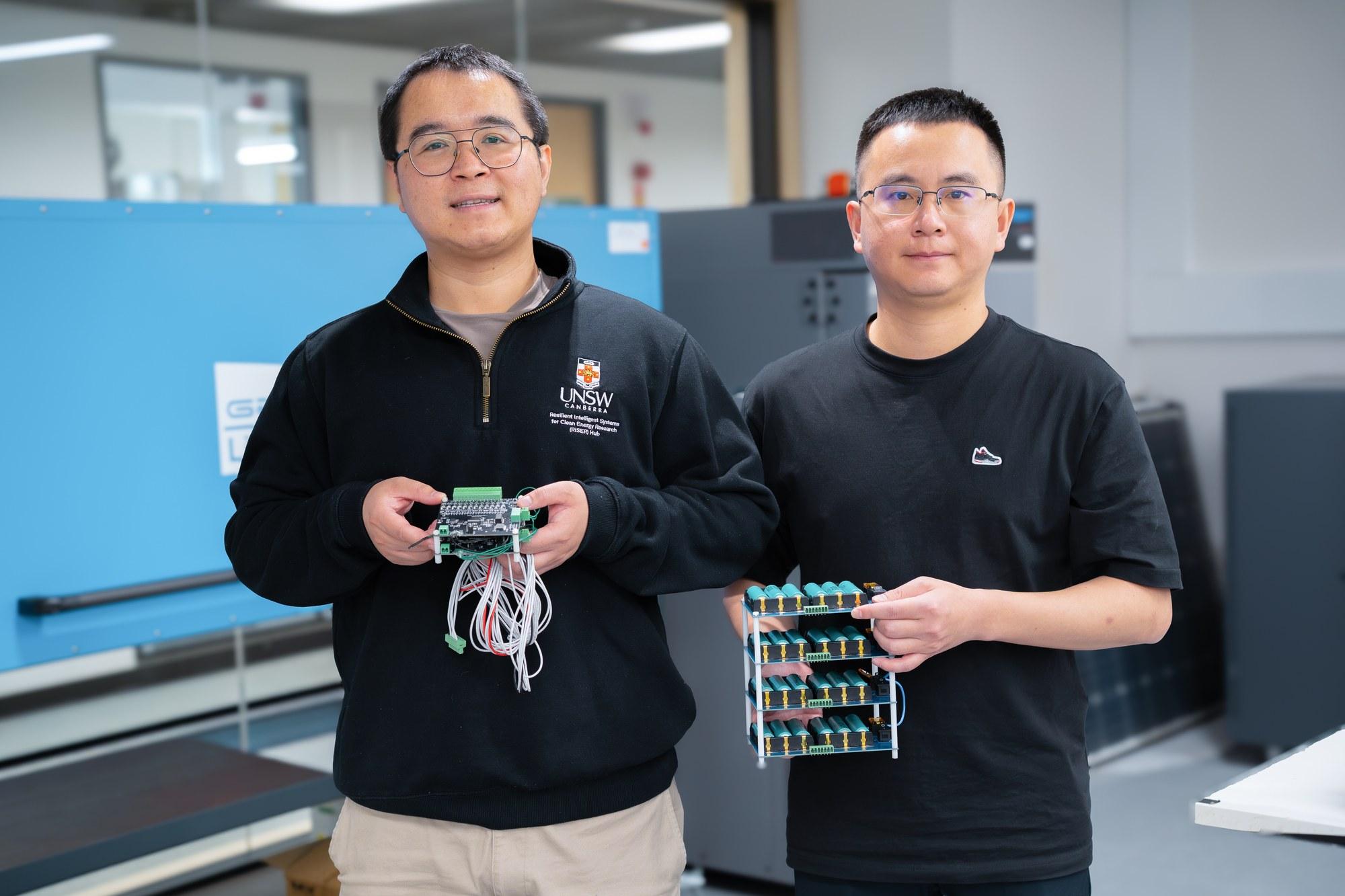
UNSW researchers Associate Professor Huadong Mo and Dr Ziyang Lyu with their battery testing prototype.
Image: UNSW Sydney
Source · Press image from the UNSW Sydney newsroom, used for news reporting.
Researchers at UNSW Sydney have built a prototype that estimates the health of a battery cell in under three minutes, where today's full charge-discharge test takes about 10 hours, the university said on Nov. 10 and pv magazine Australia reported on Nov. 13.
Lab testing showed more than 90% accuracy, according to the UNSW release. The team is led by Dr Ziyang Lyu of the School of Mathematics and Statistics and Associate Professor Huadong Mo of the School of Systems and Computing. Neither the release nor pv magazine Australia cites a peer-reviewed paper, so the accuracy figure is the researchers' own.
How the three-minute test works
The standard check pushes a used battery through a full charge and discharge. UNSW says that takes around 10 hours, costs about $120 per EV battery pack in its own figures, which are given without a currency label, and can cause overheating or fire if a damaged battery endures hours of high-stress cycling.
UNSW's pulse test is reported to take under 3 minutes per cell against about 10 hours per pack for a full test; figures are the researchers' own.
Illustration (AI-generated)
The prototype instead sends short electrical pulses through each cell and measures how the cell responds. Statistical models then turn that response into a health estimate. Think of tapping a cup and judging from the sound whether it is cracked, instead of filling it and draining it to find out. The team says the system is built to handle lithium iron phosphate (LFP), nickel cobalt aluminium (NCA) and nickel manganese cobalt (NMC) cells, the three main lithium-ion chemistries in EVs and energy storage.
pv magazine Australia puts the gain at 95.5% faster and more than 80% cheaper than existing testing. The release states a cost aim of below $25 per pack. The time figure is given per cell and the old 10-hour figure per pack, so Voltgrid reports each number on the basis its source uses.
What it could change for recycling and grid batteries
A recycler rarely receives a tidy batch. Lyu said one day brings LFP cells and the next a mix of nickel-based chemistries from different makers, and the models are designed for that variety. Fast, cheap grading matters because a cell that still holds most of its capacity could serve in stationary storage, while a weak one goes to recycling. Mo said up to 95% of a battery's components can be recovered, yet only a small fraction of lithium-ion batteries in Australia are collected for recycling today.
The same sorting step could apply to grid batteries as the fleet grows. Lyu said the technology may help manage reuse and recycling of Australia's expanding stationary storage systems, and the release expects around 250 million electric cars on the road by 2030. Voltgrid's earlier look at real-world battery health in Ford's Mustang Mach-E shows why a quick, trustworthy state-of-health reading is the missing piece for resale and reuse.
What is not confirmed yet
This is a prototype. UNSW and the recycling company DY New Energy have started a $1.3 million project, backed by the Australian government's Trailblazer for Recycling and Clean Energy (TRaCE) Lab to Market Fund, to test it on more than 500 batteries in real operating conditions. Only after that will it be piloted in recycling facilities and second-life storage systems.
The team will also develop an AI decision engine that recommends reuse or recycling, and a battery management module to feed the result into live systems. Lyu said lab results are promising but industry needs to see the technology work on the factory floor. No commercial date has been given. The earlier version of the method, from Mo's work under the Australian Economic Accelerator Ignite program, cut testing time to five minutes.
Sources
- Desk
- Science Desk
- Editor
- Ege Erten
- Published
- Sources
- 2 cited
- Standards
- AI-assisted