Samsung Reportedly to Make Starlink Chips at Austin in $1.9B Expansion
Samsung is reportedly set to build STMicroelectronics' 18nm STM32V8 microcontroller, used in SpaceX's Starlink satellites, at its Austin fab by 2030, Seoul Economic Daily reports; Samsung has not confirmed the customer.
3 min read
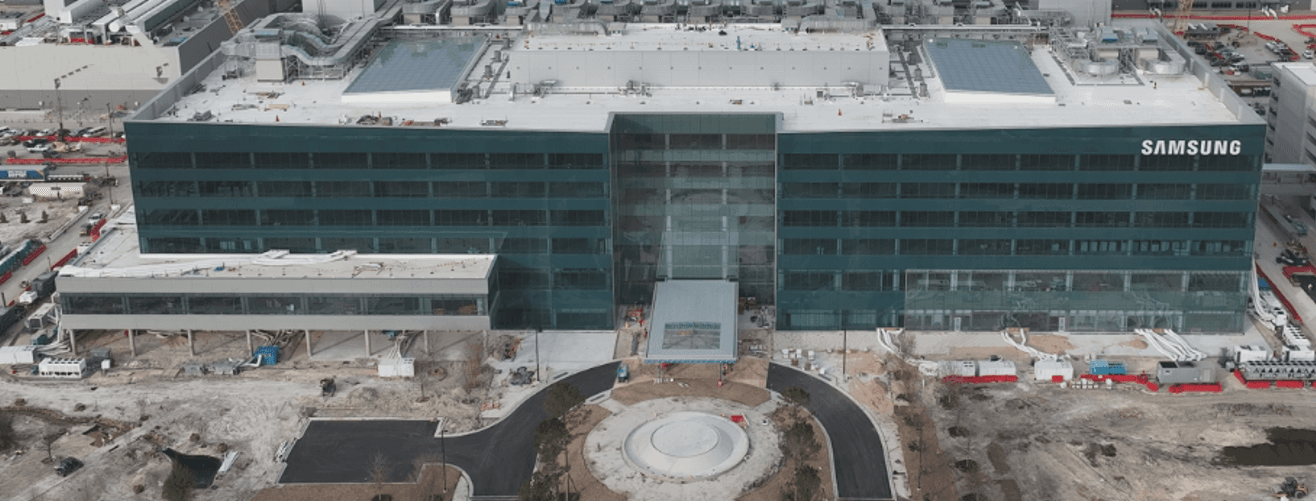
Samsung's Taylor, Texas site, shown in a 2024 photo. The reported Starlink chip work would be at Samsung's Austin fab, not Taylor.
Image: Samsung (via NIST CHIPS for America)
Source · Press image credited to Samsung on the NIST CHIPS for America project page, used for news reporting.
Samsung Electronics plans to make the STM32V8 satellite microcontroller used in SpaceX's Starlink network at its Austin, Texas fab, with operations targeted for 2030 and a $1.9 billion (about 2.7 trillion won) expansion behind it, Seoul Economic Daily reported on Nov. 15, 2026.
The newspaper cites unnamed chip industry sources and project materials from the U.S. Commerce Department. Samsung told the paper it cannot officially confirm contracts with individual customers, and neither SpaceX nor STMicroelectronics had commented in anything Voltgrid read. The Austin site would take on volumes that STMicroelectronics now builds at its 300 mm fab in Crolles, France, with Samsung Foundry taking part in manufacturing.
This is a small-die story with a large geographic point. The STM32V8 is a microcontroller, not an AI accelerator: it runs an Arm Cortex-M85 core at up to 800 MHz on an 18-nanometer fully depleted silicon-on-insulator (FD-SOI) process, and no volume, wafer count or price has been given. What would change is where a part inside Starlink's laser links is made. A second source in Texas, near SpaceX's headquarters, would reduce reliance on one French fab.
What the Commerce filings do and do not show
Commerce Department materials on the CHIPS program back the process side of the report. NIST, the department's standards agency, lists a Samsung award of up to $4.745 billion in direct funding for more than $37 billion of Texas investment across Taylor and Austin. For Austin it describes an expansion of existing facilities to produce FD-SOI process technology for aerospace, defense and automotive customers, with commitments to work with the Department of Defense, and says all facilities are expected to be operational by 2030.
The page does not name SpaceX, does not mention the $1.9 billion figure and does not split the subsidy by site. Those details rest on Seoul Economic Daily alone. The paper describes the Austin fab as running mature processes from 65 nm to 14 nm, so an 18 nm FD-SOI line would be a new capability for the site rather than more of the same.
STMicroelectronics' own announcement on Nov. 18, 2025 ties the chip to SpaceX. It said SpaceX selected the STM32V8 for the mini laser system that links Starlink satellites in low Earth orbit, and that the part is made in Crolles and in collaboration with Samsung Foundry. Michael Nicolls, SpaceX's vice president of Starlink engineering, said in that release the chip's computing performance and embedded memory met the system's real-time processing needs.
Austin for space, Taylor for AI
Seoul Economic Daily frames the move as a two-track Texas plan. Taylor takes advanced logic: the paper says Samsung is investing to make Tesla's AI5 chip on a 2-nanometer process, with the next-generation AI6 also slated for Taylor and Tesla targeting 2027 for AI5 and 2028 for AI6. Austin would carry the specialty and FD-SOI work.
Reported plan: Austin would carry the 18 nm FD-SOI STM32V8 work by 2030 while Taylor takes Tesla's 2nm AI5 and AI6; Samsung has not confirmed SpaceX as an Austin customer.
Graphic: Voltgrid News
Voltgrid has followed the Taylor side. On Oct. 23 it reported ZDNet Korea's account of tool orders to take Taylor Fab 1 to 20,000 2nm wafers a month in the second half of 2027, and on Nov. 8 that Taylor trial runs reportedly could start in December. The Austin plan is a separate and later track, aimed at 2030.
It also shows SpaceX buying chips from several places. On Nov. 4 Voltgrid reported that SpaceX picked Qualcomm's 64T64R chips for Starlink Mobile's 5G network, with rollout from 2027. That deal covers ground radio equipment; the STM32V8 sits in the satellites.
What is not confirmed yet
Samsung has not confirmed SpaceX as an Austin customer, and the report itself is hedged: an industry official quoted by the paper said the chances have grown that Starlink chips will be made at Austin if the customer asks. No volume, wafer starts, contract value or start date for Starlink output has been published. The $1.9 billion expansion is not in the NIST page, and the 2030 date there applies to all Samsung's CHIPS-funded facilities, not to Starlink parts.
The paper dates SpaceX's public description of the chip to December 2025, but the ST release carrying it is dated Nov. 18, 2025, so Voltgrid uses that date. Watch for a Samsung or STMicroelectronics statement, a Texas incentive filing for the Austin project, and any CHIPS disbursement tied to the FD-SOI line.
Sources
- 01Samsung Splits Texas Fabs: Space Chips in Austin, AI Chips in TaylorSeoul Economic Dailyen.sedaily.com
- 02Samsung Electronics (Texas): CHIPS for America project pageNIST CHIPS for Americanist.govas read on Nov 15, 2026
- 03Samsung to Make SpaceX Satellite Chips in TexasSeoul Economic Dailyen.sedaily.com
- 04Samsung Foundry to Make Starlink Satellite Chips in TexasSeoul Economic Dailyen.sedaily.com
- 05STMicroelectronics introduces the industry first 18nm microcontroller for high-performance applicationsSTMicroelectronicsnasdaq.com
- Published
- Sources
- 5 cited