SpaceX Qualcomm Deal: 64T64R Chips for Starlink Mobile 5G
SpaceX selected Qualcomm's Dragonwing QRU100 and QDU100 for Starlink Mobile's US 5G network, with rollout from 2027 at tens of thousands of sites. Financial terms are undisclosed.
Chips & Power DeskEdited by Ege Erten
2 min readAI-assisted
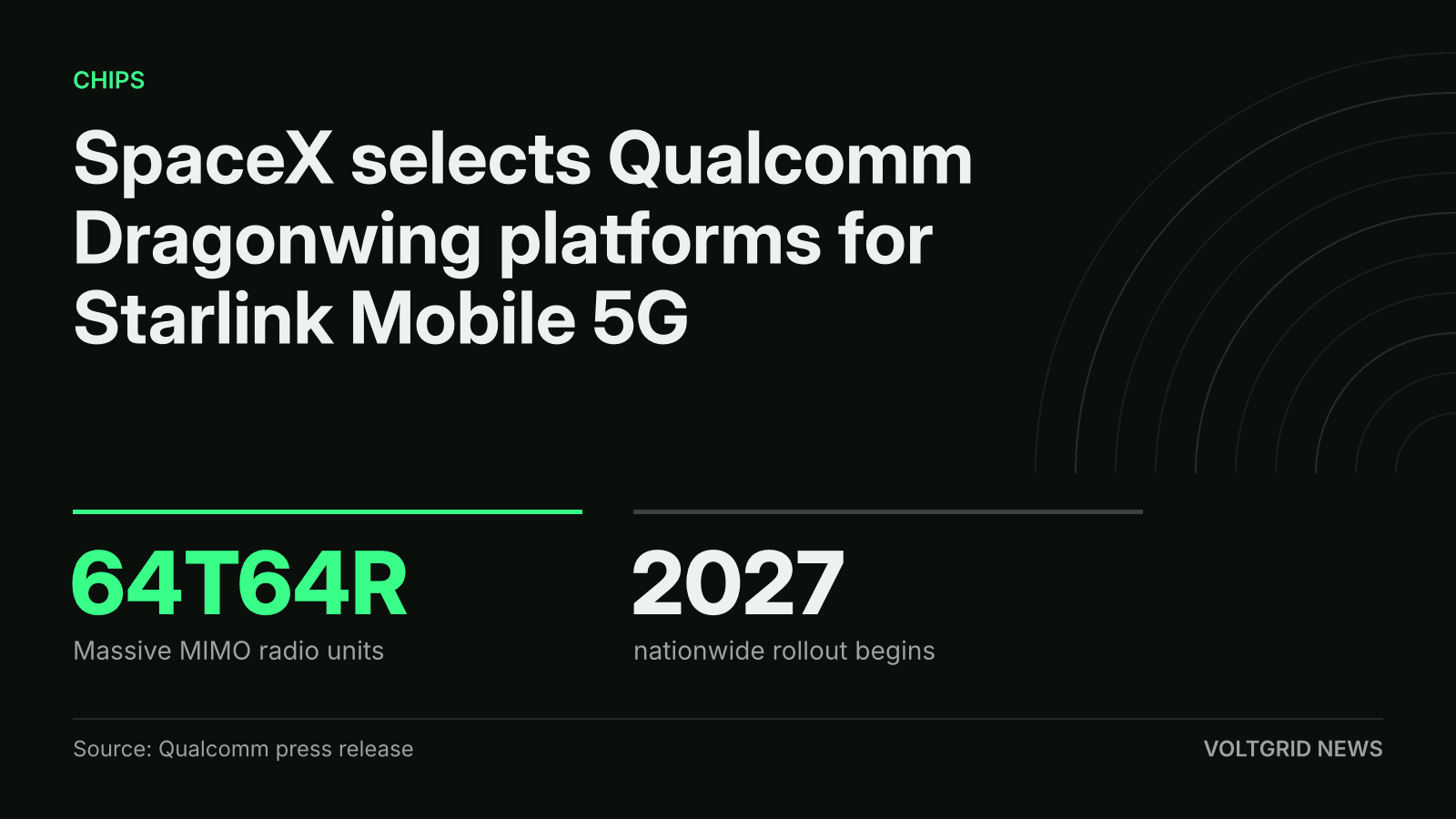
SpaceX chose Qualcomm's Dragonwing platforms for Starlink Mobile's US 5G network, with nationwide rollout planned from 2027.
Illustration (AI-generated)
SpaceX has selected Qualcomm's Dragonwing cellular infrastructure platforms for Starlink Mobile's US nationwide terrestrial 5G network, with rollout starting in 2027 across tens of thousands of sites, Qualcomm said on Nov. 4.
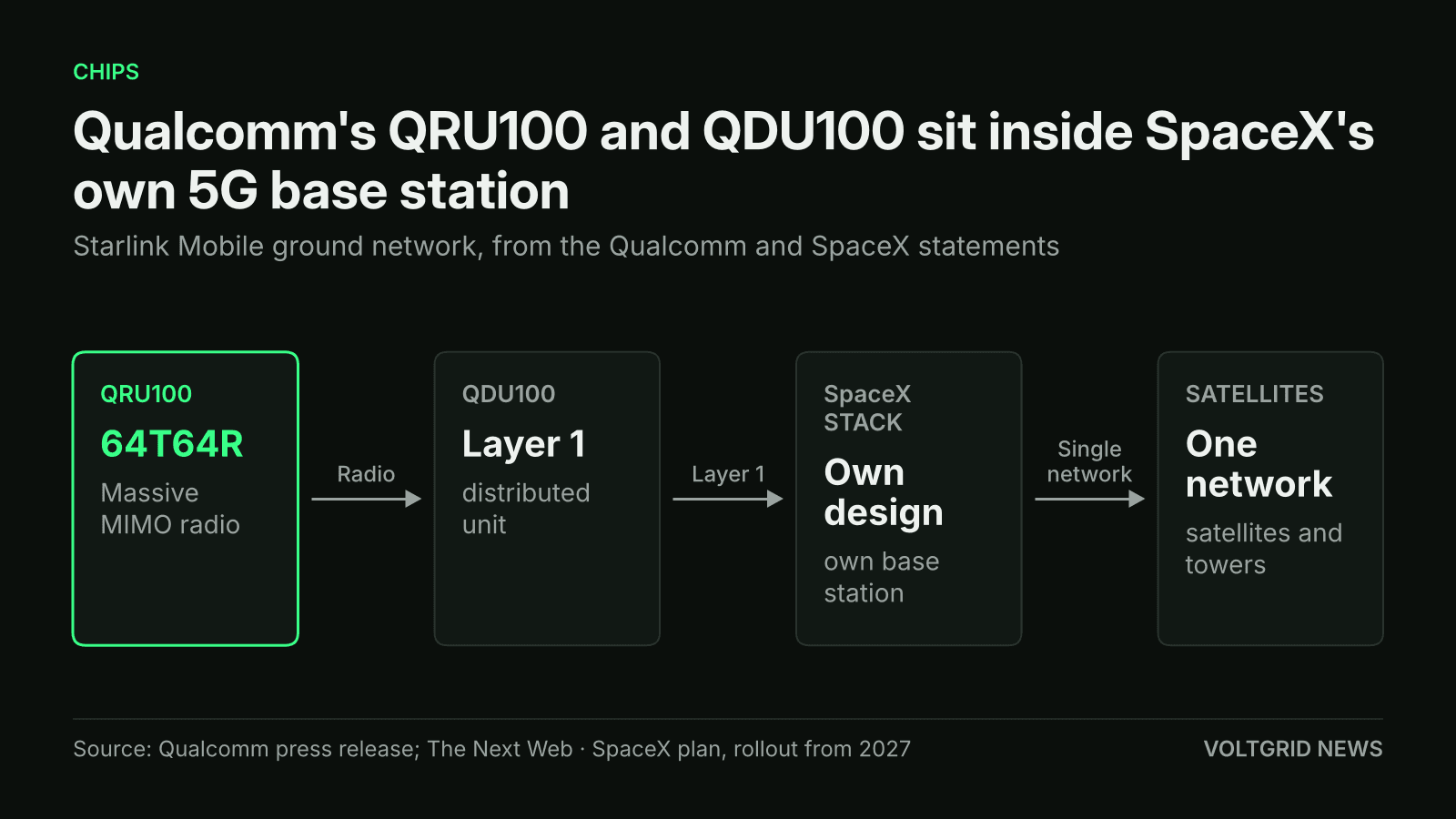
Qualcomm supplies the radio and Layer 1 silicon; SpaceX plans its own base station architecture across satellites and towers.
Illustration (AI-generated)
The multi-year agreement covers two chips and a software layer. The Dragonwing QRU100 handles processing inside the Massive MIMO radio units, and the QDU100 handles latency-sensitive Layer 1 processing in the distributed unit. Qualcomm also supplies commercial-grade Layer 1 software. The radios will use 64 transmit and 64 receive paths (64T64R), which Qualcomm says improves coverage, capacity and spectral efficiency. Neither company disclosed financial terms or a site count more precise than "tens of thousands."
Why Qualcomm's Infrastructure Role Matters
Qualcomm is best known for Snapdragon phone chips, but this deal sits in its infrastructure business. Voltgrid reported on Oct. 22 that Qualcomm is cutting jobs as it pivots to AI chips, leaning on data center products to offset weak handset demand. A nationwide base station build is a second, separate bet on non-handset silicon, and it is a named, multi-year customer rather than a roadmap slide.
For the power side, the pitch is energy per site. Qualcomm says the two platforms are designed to improve performance per watt across radio and distributed-unit processing, which it ties to deployment economics at scale. That is a vendor claim: the release gives no wattage, no comparison against rival radio silicon and no measured result. Across tens of thousands of sites, though, any per-site saving compounds.
How Starlink Mobile's 5G Network Will Be Built
According to The Next Web, SpaceX plans to deploy the network across several frequency bands in successive rollout phases, and spent much of 2025 expanding its spectrum holdings, including airwaves acquired from EchoStar. Qualcomm's release describes a multi-band network deployed across multiple rollout waves.
Michael Nicolls, SpaceX's senior vice president of Starlink, said the company is working toward a single network that combines its satellites with terrestrial towers, and that Qualcomm's platform will help accelerate SpaceX's own base station end-to-end architecture. In other words, SpaceX is designing the base station itself and buying the Layer 1 silicon and software from Qualcomm. Until now, The Next Web notes, SpaceX's mobile efforts centered on satellite connectivity to ordinary smartphones, including text messaging through partners such as T-Mobile.
Both companies also cast the build as groundwork for AI-native 6G: the release calls the collaboration a commercial step toward that vision. The Next Web notes it remains a longer-term ambition, and the initial deployment is 5G.
What is not confirmed yet
The release names no unit volumes, prices or per-site hardware counts, and does not say which frequency bands go live first or where the first sites will be. It does not say how much of the base station, beyond Layer 1 silicon and software, comes from Qualcomm. Rollout is a 2027 plan, not a shipping network.
Qualcomm reports fiscal fourth-quarter and full-year 2026 results after the market closes on Nov. 4, with its call at 1:45 p.m. Pacific. Whether and how the company quantifies this deal there is the first thing to watch, followed by the first 2027 site deployments.