KAIST Battery Additives LiBOB and SN Clash; One-Molecule TPAB Tested
KAIST says two common lithium-ion additives weaken each other's protective layers when mixed, and a single-molecule additive, TPAB, kept more capacity in lab cells.
2 min read
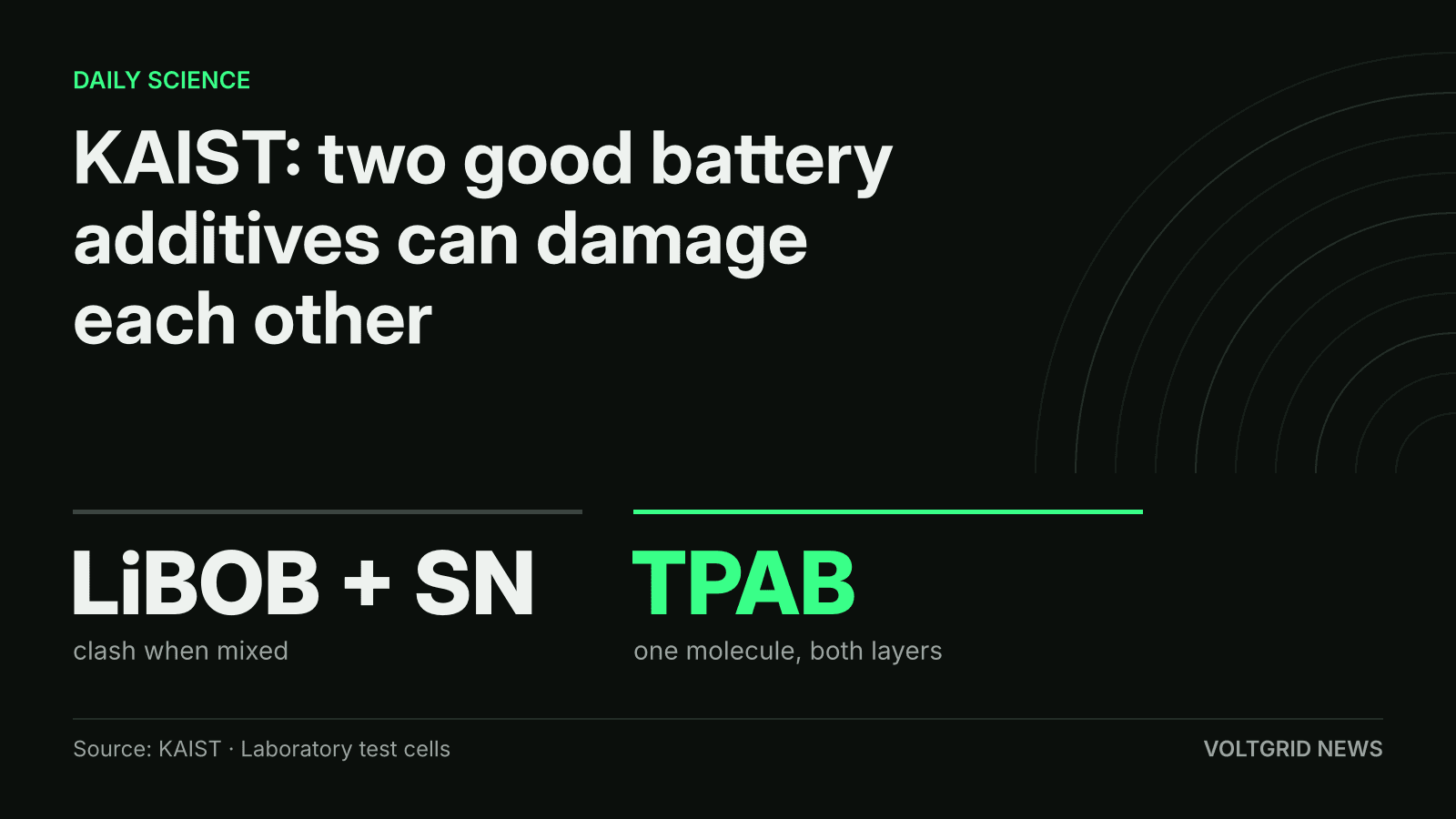
KAIST reports that mixing two common additives, LiBOB and SN, can damage the protective layer, while the single-molecule additive TPAB avoids this in laboratory test cells.
Graphic: Voltgrid News
KAIST researchers said on Nov. 17, 2026 that two common battery additives, each useful alone, damage each other's protection when mixed in lithium-ion cells, and that a single-molecule additive, TPAB, avoids the clash in laboratory test cells.
The team is led by Professor Nam-Soon Choi of KAIST's Department of Chemical and Biomolecular Engineering, with Professor Dong-Hwa Seo of the Department of Materials Science and Engineering. The work was published online in ACS Energy Letters on Oct. 19, 2026, and was selected as a cover article, according to KAIST. Its release gives no capacity-retention figures, only that TPAB cells kept more capacity than cells with the conventional pair.
Why two good additives can cancel out
An electrolyte is the liquid that carries lithium ions between a battery's two electrodes. Small amounts of additives form thin protective layers on the electrode surfaces, which reduces side reactions and slows ageing. The layers matter most on silicon-containing anodes. Silicon stores a lot of lithium but swells and shrinks sharply with each charge, and a damaged layer means more electrolyte breaks down and more lithium is used up rebuilding it. Less lithium is then left for charging, so capacity falls.
The researchers studied two widely used additives, lithium bis(oxalato)borate (LiBOB) and succinonitrile (SN). They found that products from LiBOB breaking down push SN to decompose in unwanted ways. That interfered with building a stable layer on the anode, which ended up with less lithium fluoride (LiF), a key protective component, and higher resistance. At high temperature, electrolyte decomposition and lithium consumption sped up, KAIST said.
The point for cell designers is that testing each additive alone does not predict how a blend behaves inside a real cell. The researchers propose that additives be judged by what they do to each other as well as by their own performance.
The one-molecule alternative
Instead of mixing separate additives, the team used triisopropanolamine borate (TPAB), which joins an amine group and a borate group in one molecule. In cells with TPAB, stable protective layers formed on both the cathode and the anode, and they limited the continuing electrolyte breakdown that drives degradation.
In KAIST's laboratory cells, LiBOB and SN interfere with each other, while TPAB combines both functions in one molecule.
Graphic: Voltgrid News
The team tested TPAB in high-energy cells that pair a high-nickel cathode, the type used in electric vehicles, with a graphite-silicon composite anode. Those cells kept more capacity through repeated charging and discharging than cells with the conventional additive combination, and degraded less after long storage at high temperature.
What it could mean, and what is not confirmed yet
For EV owners the possible gain is a slower fall in driving range over years of use, KAIST said. Aju Press, which reported the study on Nov. 17, noted that the results come from laboratory test cells and that the additive has not yet been applied to commercially produced batteries. The paper's own test figures are not public outside the journal, so none beyond KAIST's description are given here.
The research was funded by Samsung SDI, the National Research Foundation of Korea and the Technology Innovation Program of Korea's trade ministry. It is separate from KAIST's lithium-metal separator work, which Voltgrid covered on Nov. 10.
Still open: how much capacity TPAB cells retain and over how many cycles, whether the gain holds in larger cells, and whether any manufacturer will test the additive. Neither KAIST nor Aju Press gives a commercial timeline.
Sources
- Desk
- Science Desk
- Published
- Sources
- 2 cited