NRC ACRS Rule, NuScale and Elementl AI Target Paperwork, Not Build Risk
The NRC's ACRS rule, NuScale's Gordian rollout and Elementl's Lattice suite with Google Cloud all target pre-construction paperwork. Neither AI vendor has quantified any saving; the NRC puts its rule's at $16.1 million.
5 min read
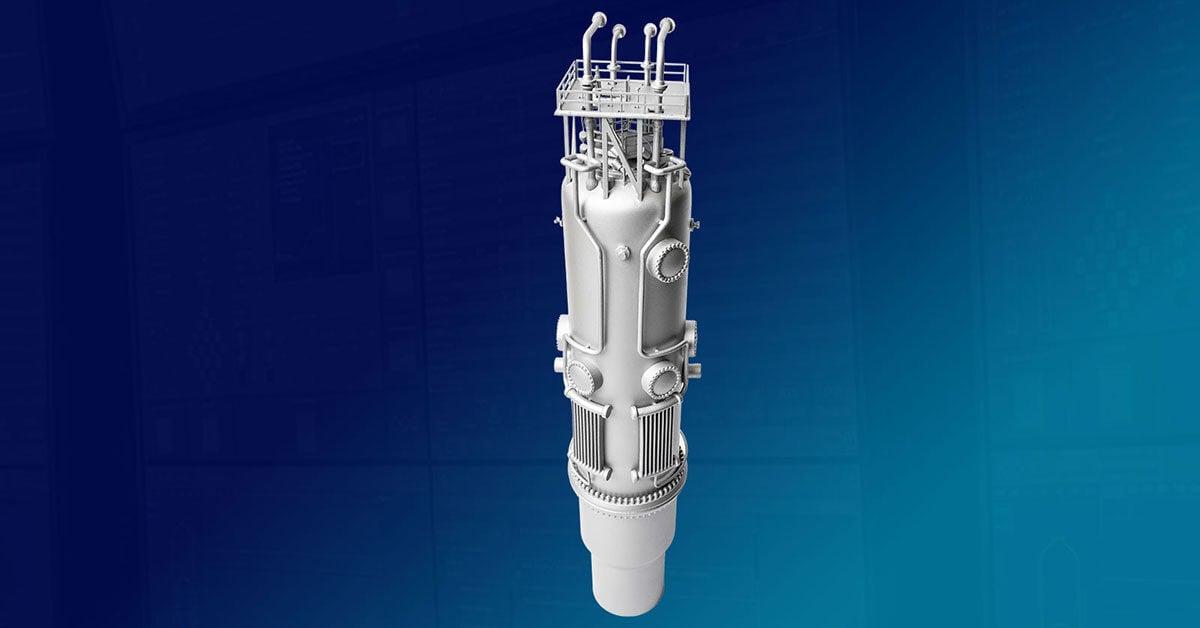
A rendering of the NuScale Power Module, rated at 77 MWe or 250 MWt gross per module. It is not a photo of a built plant.
Image: NuScale Power
Source · Press image from the NuScale Power website, used for news reporting.
Within two days, two reactor developers and the US Nuclear Regulatory Commission (NRC), through its ACRS rule, each moved against the same part of a nuclear project: the paperwork before anything is built. Elementl Power and Google Cloud launched an AI suite for siting and licensing, NuScale Power widened its use of Everstar's Gordian AI platform, and the NRC narrowed its advisory committee's reviews. That points to a shorter pre-construction schedule if the companies' claims hold, but the construction, fuel and financing risks that decide when a reactor first makes power are untouched.
What the NRC, NuScale and Elementl Announced
On Nov. 17, Elementl Power and Google Cloud announced Elementl Lattice, a set of project-delivery tools built on Gemini for business and BigQuery, which DatacenterDynamics reported on Nov. 18. The companies say it targets preconstruction work: siting requirements, technology selection, regulatory approvals and technical planning. Its first named tool, Atlas, screens hundreds of site characteristics across thousands of square miles for several reactor designs at once. The partners claim it cuts months of preliminary desktop research to days or weeks. Further tools, still in development, aim to keep one controlled record of a plant's design, licensing requirements and approved changes.
On Nov. 18, NuScale said it is expanding Gordian, Everstar's nuclear-specific AI platform, to its licensing, plant services, project management, supply chain, quality assurance and product development teams. NuScale said a pilot period yielded efficiency gains. Everstar says Gordian compresses months of licensing, engineering and operations work into days, and that its own aim is to cut the cost of US reactor deployments by an order of magnitude.
Neither company has put a number on what its tool saved, in hours, weeks or dollars, and neither disclosed the terms of its arrangement. Every speed claim above is the companies' own.
On Nov. 17, the NRC published a direct final rule in the Federal Register that cuts the personnel and functions of the Advisory Committee on Reactor Safeguards (ACRS) to the minimum needed for its statutory obligations, in response to section 4(b) of Executive Order 14300. ANS Nuclear Newswire reported that the rule focuses ACRS reviews on safety-significant issues that are novel or noteworthy, such as first-of-a-kind designs, and keeps a committee of 7 to 15 members, each serving four-year terms, ANS reported. The committee still reviews construction-permit and operating-license applications, limited to novel or noteworthy issues. The rule takes effect on Feb. 1, 2027, unless the NRC receives significant adverse comments by Dec. 17, 2026; a companion proposed rule was published the same day.
Why Faster Paperwork Does Not Move First Power
A new reactor's path runs through site selection, application preparation, NRC review and hearings, then construction, fuel loading and start-up. The three moves all sit in the first half of that line. Lattice works on siting and the licensing record. Gordian works on the document load of licensing, quality assurance and engineering changes. The ACRS rule removes advisory re-reviews of technology the committee has already examined, which NRC staff argued did not help the agency decide, according to ANS.
All three moves sit in the paperwork stretch of a new reactor's path; the ACRS rule's comments are due Dec 17, 2026 and it takes effect Feb 1, 2027 unless significant adverse comments arrive.
Graphic: Voltgrid News
That fits a wider push. The NRC's contested-hearing rule, which caps initial decisions at 135 days on its standard track, and the six nuclear bills the House passed, including fewer uncontested licensing hearings, aim at the same stretch. ANS reports that the Nuclear Advisory Committee Reform Act, which would write the ACRS change into law, has passed the House and awaits the Senate.
If the AI claims hold, the gain is real for developers who must prepare many applications. Elementl's Google agreement of May 2025 covers early-stage development capital for three US projects, each expected to be at least 600 MW, with an option for commercial off-take and no disclosed price, term or purchase commitment, DatacenterDynamics reported; the sites have not been named. Faster screening helps a developer with more sites than staff. It does not tell a buyer when power arrives.
The Case That Paperwork Is the Bigger Delay
The strongest objection is that paperwork may be a larger share of the delay than this argument allows. Every engineering change ripples through a plant's licensing documents; a tool that tracks those effects, as Gordian is designed to do, could shorten the review and cut rework during construction too. Seen that way, the three moves together could take real time out of the schedule before a shovel moves.
The numbers disclosed so far do not show it. The NRC's own regulatory analysis in the Federal Register puts the ACRS rule's total savings at $16.1 million, undiscounted, or $354,018 to $390,058 a year depending on the discount rate. The estimate rests on NRC staff time and meeting travel, over 17- and 50-year horizons, and it is small next to the C$7.7 billion budget Darlington's first SMR unit is set to exceed. The AI vendors give no figure at all.
The risks that decide first power sit elsewhere. Ontario's first BWRX-300 at Darlington, a project well past licensing, is set to miss its October 2030 date and C$7.7 billion budget. NuScale's own release lists binding customer contracts, a constrained supply base, funding and customers' regulatory approvals among its risks.
What It Means for NuScale, Elementl and Data-Center Buyers
For NuScale, the tool lands on a design the NRC approved in a standard design approval in May 2025, though no NuScale plant is licensed yet: each NuScale Power Module is rated at 77 MWe, or 250 MWt gross, and plants scale to 924 MWe with 12 modules. Its commercial path runs through the ENTRA1 and TVA program of up to 6 GW, which has no PPA yet, and the company reported third-quarter revenue of $281,000 and an operating loss of $64.8 million. Faster document work lowers its costs; an order is what changes its revenue.
For Elementl, Lattice is a tool for a portfolio that is still mostly early-stage, from the three Google projects to its letter of intent for a development partnership of up to $750 million, not a final investment decision, for an Ohio project of up to 1.5 GW. For Google and other data-center buyers, the moves suggest more sites will reach an application sooner. They do not add a megawatt under contract, and none shifts a target date for first power.
What to Watch: ACRS Comments and First Orders
A direct final rule takes effect on a set date unless significant adverse comments arrive, which is why the NRC uses it for changes it expects to be non-controversial. For the ACRS rule the comment deadline is Dec. 17, 2026 and the effective date is Feb. 1, 2027. If the NRC withdraws the rule after such comments, it publishes a notice, and the comments carry over to the companion proposed rule published the same day. Elementl naming its first Google-backed site, NuScale or Everstar publishing a measured saving, and a firm order or PPA under the ENTRA1 program would each test whether faster paperwork turns into earlier power.
Sources
- 01Elementl Power Deploys Google Cloud's Gemini to Accelerate Commercial Nuclear DevelopmentGoogle Cloudgooglecloudpresscorner.com
- 02NuScale Power Implements Everstar's Gordian AI Platform to Accelerate Commercial Reactor DeploymentNuScale Powernuscalepower.com
- 03NRC issues final rule on ACRS reformANS · Nuclear Newswireans.org
- 04Advisory Committee on Reactor Safeguards Functions (direct final rule)Federal Register (US NRC)federalregister.gov
- 05Elementl Power partners with Google Cloud on AI suite to speed up nuclear siting and licensingDatacenterDynamicsdatacenterdynamics.com
- Published
- Sources
- 5 cited

