Trina Storage Hybrid Genset Pairs 2.5 MW Gas Engines With Batteries
Trina Storage launched a gas-and-battery plant for AI data centers at RE+ 2026, pairing engines up to 2.5 MW with 5 MW/10 MW blocks; it gives no ramp rate, price or delivery date.
2 min read
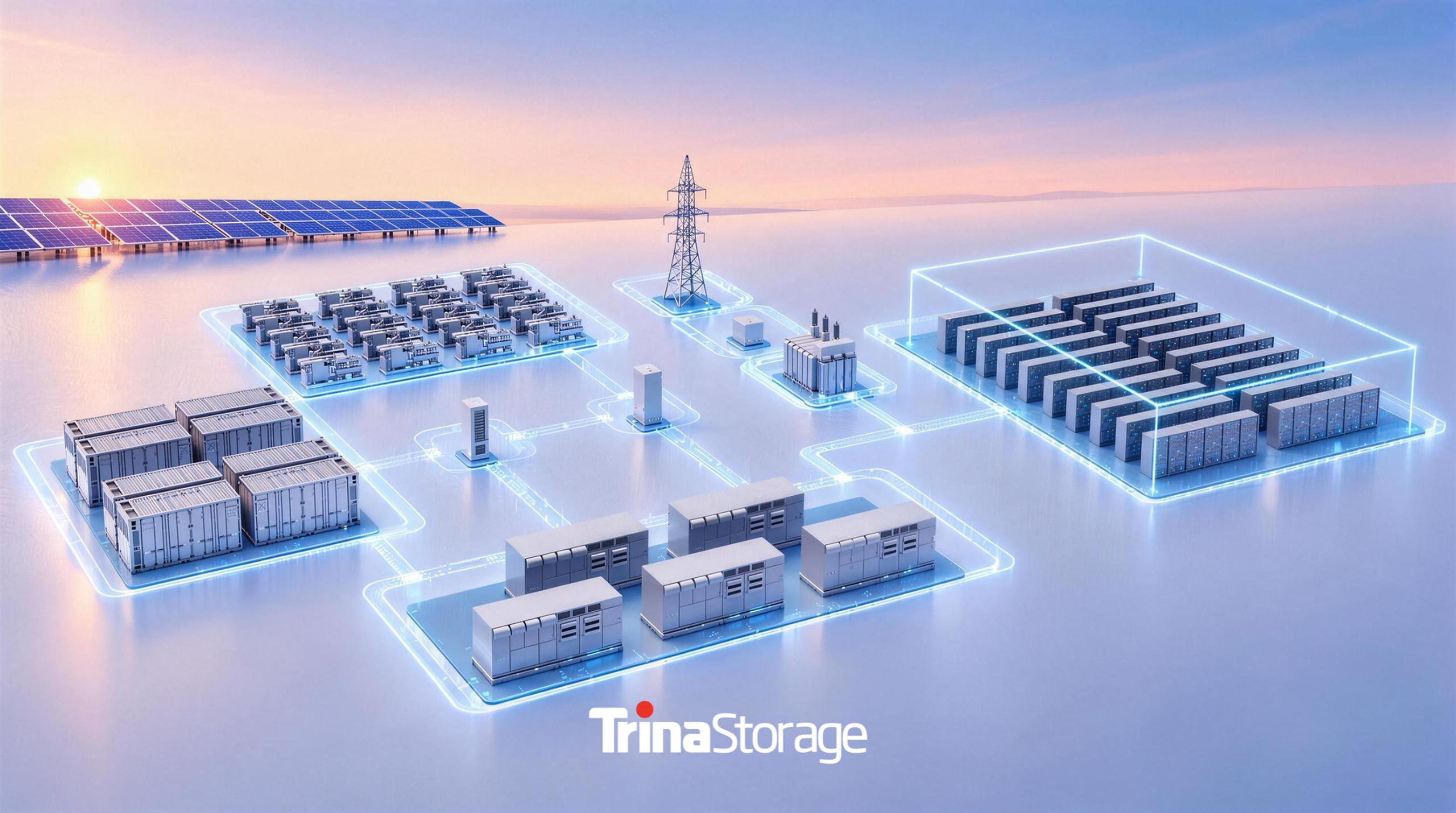
Trina Storage's illustration from the Elementa Hybrid Genset launch release shows engines, batteries and a data center on one site; it is a company rendering, not a photo of an installed plant.
Image: Trina Storage
Source · Press image from the Trina Storage release, used for news reporting.
Trina Storage, a business unit of Trina Solar, launched Elementa Hybrid Genset at RE+ 2026 in Las Vegas on Nov. 18, a gas-engine and battery plant built from engines rated up to 2.5 MW and reference configurations based on 5 MW/10 MW building blocks, in Trina's wording, according to its PR Newswire release.
The release says the control layer is designed to scale from 5 MW to 1 GW. Trina acts as system integrator: qualified partners supply the reciprocating engines, while Trina supplies its Elementa DC battery systems, its Electra AC platform and a hybrid plant controller. The product is aimed at data center developers who need on-site power while grid interconnection is delayed, limited or unavailable.
Why Gas Engines Need a Battery Beside Them
Trina's argument is about load shape. AI workloads can swing power demand fast enough that gas generators alone may struggle to follow, the release says, while a battery responds quickly but cannot carry a site through a long outage by itself. The controller therefore splits the work: the battery takes sudden load increases while the gas engines ramp up gradually. Trina calls the three control functions load-transient sensing, hybrid power coordination, and fault isolation with resilient supply. Caterpillar makes a similar pairing for AIP Corp's Monarch campus, where 2 GW of gas generator sets are to be augmented with batteries; Caterpillar says its G3516 sets reach full load in approximately seven seconds.
Trina says the controller lets the battery take sudden load steps while gas engines ramp gradually; the release gives no ramp rate or response time.
Graphic: Voltgrid News
The release gives no site size. The product sits within a wider shift that Voltgrid has tracked in on-site AI power, where far more capacity has been announced than is running.
Configurations and Timeline
The release lists four reference scenarios: grid-connected with backup generation, grid-constrained, bridge-to-grid and off-grid, with solar PV optional. Two electrical architectures are offered. Load Sensing prioritizes cost and performance, and Double Conversion gives full electrical isolation and better power quality.
Trina previewed the product at Data Center World Power in September. In that Sept. 22 preview release, Trina said the design aligns with developers' 2027 notice-to-proceed and 2029 commercial-operation windows, and that interconnection waits have stretched up to 5 to 7 years in parts of the US, including Virginia. TaiyangNews reported the preview on Oct. 6. Those are Trina's framing of developer schedules, not a delivery date for the product.
Trina Storage is already a battery supplier in Europe, where OX2 signed a 3 GWh framework with it, as Voltgrid reported on Nov. 14, but that deal covers stand-alone storage and not this product.
What Is Not Confirmed Yet
The release states no ramp rate, no response time, no efficiency, no price, no first-delivery date and no customer. It says Trina is engaging with data center developers to explore applications, and that final configurations and performance specifications will be assessed per project. The release describes the battery as providing fast power response and grid-forming capabilities, yet also says further testing of grid-forming functionality and hybrid control strategies is ongoing, alongside certification activities.
The release also writes the battery block as "5 MW/10 MW" without saying whether the second figure is MWh. Trina has not named its engine partners or the engine fuel supply it assumes, and gas supply is the dependency any buyer would have to check first. Validation so far rests on simulation, hardware-in-the-loop testing and Trina's own integrated platform, so all performance claims are the vendor's.
Sources
- 01Trina Storage Teases Elementa Hybrid Genset at Data Center World PowerTrina Solartrinasolar.com
- 02Trina Storage's Hybrid Genset For US AIDCsTaiyangNewstaiyangnews.info
- 03Trina Storage Launches Elementa Hybrid Genset, a Modular Gas-and-Storage Power Plant for AI Data CentersThe Manila Timesmanilatimes.net
- Published
- Sources
- 3 cited