Rolls-Royce SMR Aseismic Bearing Demonstrator Completed, 470 MWe Design
Skanska UK built and trialled a precast aseismic bearing pedestal for Rolls-Royce SMR in a Doncaster factory, a test of the off-site construction meant to cut build risk. GDA Step 3 is still open.
2 min read
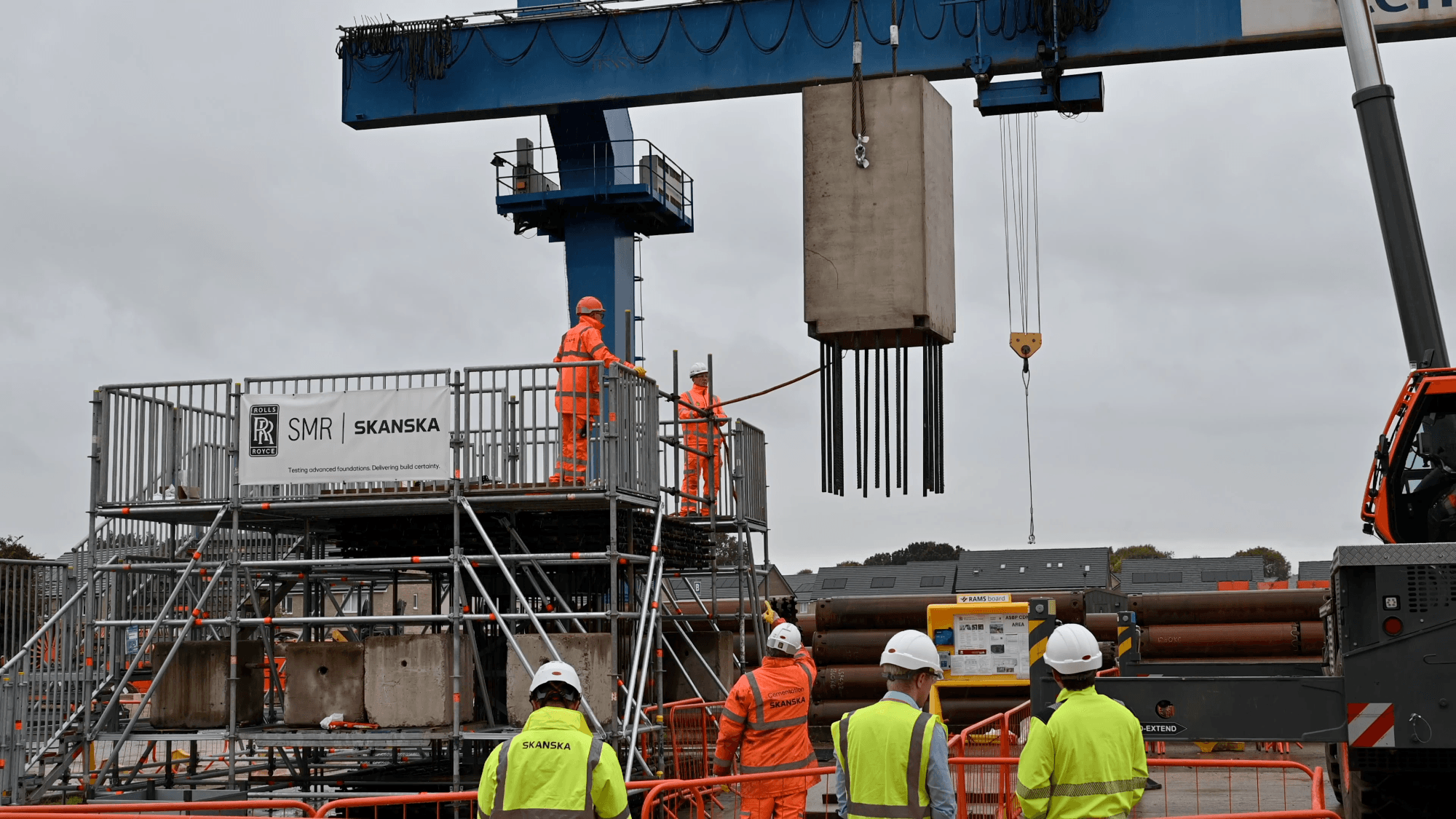
The aseismic bearing pedestal demonstrator being lifted at Skanska UK's Bentley Works in Doncaster, from Skanska's release of Nov. 18.
Image: Skanska UK
Source · Press image from the Skanska UK newsroom, used for news reporting.
Skanska UK has completed a demonstrator of the aseismic bearing pedestal for the 470 MWe Rolls-Royce SMR, built and trialled off site at its Bentley Works in Doncaster, the construction company said on Nov. 18.
Rolls-Royce SMR hired Skanska UK, a unit of Sweden's Skanska, for the job in January, World Nuclear News reported. Skanska said the trial proved its method for making the first-of-its-kind precast pedestal away from the site. Ruth Todd, the reactor maker's operations and supply chain director, called it an important step toward a factory-built delivery approach and said testing critical parts ahead of deployment can reduce risk and improve predictability.
What the demonstrator proves
Aseismic bearings sit under the nuclear island and decouple the reactor building from ground motion in an earthquake, absorbing seismic energy before it reaches the structure above. The pedestals carry those isolation devices. What the trial shows is a manufacturing method: a precast pedestal can be made in a controlled factory setting rather than poured at the plant. It is a supply-chain test, not a regulatory step, and it approves nothing.
That matters for time to power. Rolls-Royce SMR says 90% of the plant will be built in factory conditions; the company says this reduces project risk and could shorten build schedules. For a buyer of firm power, the build schedule decides when the megawatts arrive. First-of-a-kind projects have slipped elsewhere: OPG said on Nov. 10 that its first BWRX-300 at Darlington will miss its October 2030 commercial operation target and its C$7.7 billion budget.
What a GDA Step Does and Does Not Allow
The UK's Generic Design Assessment lets the Office for Nuclear Regulation and the environment regulators examine a reactor design before anyone picks a site. It runs in steps: for Rolls-Royce SMR, Step 1 ran from April 2022 to April 2023, Step 2 to July 2024, and Step 3 began in July 2024, according to ONR.
A completed step is a progress marker, not permission to build. Only the end of Step 3 can bring a Design Acceptance Confirmation from ONR and a Statement of Design Acceptability from the Environment Agency. Even those approve the design, not a plant: an operator still needs environmental permits, a development consent order and a nuclear site licence.
Where the program stands
The design, a small pressurised water reactor, is still in that third step of the UK's Generic Design Assessment; the Office for Nuclear Regulation lists its assessment as ongoing. The first project is three units at Wylfa on Anglesey, where Rolls-Royce SMR signed a contract with Great British Energy-Nuclear in April to begin site-specific design and delivery activities, ahead of a final investment decision. World Nuclear News reports that decision is expected in 2029; it does not say who set that date, and no decision has been taken. Skanska's release says the UK is expected to deliver first power from Anglesey in the mid-2030s, followed by the Czech Republic and then Sweden; that is the supplier's expectation, not a schedule set by the project owner. In the Czech Republic, utility ČEZ, which holds a 20% stake in Rolls-Royce SMR, plans the first unit in the area of its Temelín site.
The demonstrator is done; the 2029 Wylfa investment decision and mid-2030s first power remain targets.
Graphic: Voltgrid News
Neither company disclosed the contract's value, how many pedestals a plant needs, or when production bearings must be delivered for Wylfa or Temelín.
Sources
- 01Sweden’s Skanska Completes Critical Demonstrator Project For Rolls-Royce SMRNucNetnucnet.org
- 02Skanska completes critical demonstrator project for Rolls Royce SMRSkanska UKskanska.com
- 03Generic Design Assessment: Rolls-Royce SMROffice for Nuclear Regulationonr.org.ukas read on Nov 18, 2026
- 04Prototype aseismic bearing completed for Rolls-Royce SMRWorld Nuclear Newsworld-nuclear-news.org
- Published
- Sources
- 4 cited