Kioxia, NVIDIA Test 1.1 PB Raw Flash on GB200 Rack; GP2 Claims 18M IOPS
Kioxia and NVIDIA ran a proof of concept with 144 XD8 SSDs (about 1.1 PB raw) on a GB200 NVL72 rack, and Kioxia's GP2 SSD claims over 18M random read IOPS; neither has a price or ship date.
3 min read
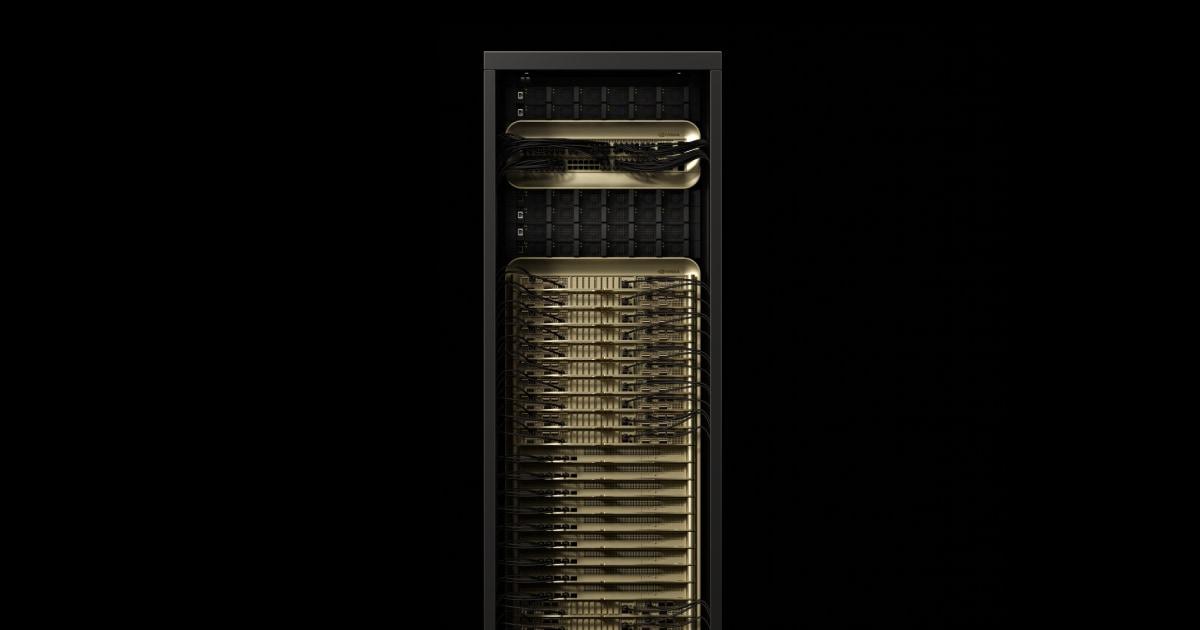
NVIDIA's GB200 NVL72 rack, per NVIDIA's product page; the image is NVIDIA's product picture, not a photo of the Kioxia proof-of-concept rack.
Image: NVIDIA
Source · Product image from the NVIDIA website, used for news reporting.
Kioxia said on Nov. 25 that a proof of concept with NVIDIA used 144 KIOXIA XD8 Series 7.68 TB SSDs, about 1.1 PB of raw flash, to demonstrate the potential to extend effective GPU memory to petabyte scale on a GB200 NVL72 rack, and that its new GP2 Series SSD delivers over 18 million random read IOPS (512-byte block, Kioxia testing).
In the first of two Business Wire releases, Kioxia America said NVIDIA's SCADA software library (Scaled Accelerated Data Access) is designed to extend effective GPU memory capacity using NVMe SSDs, in support of NVIDIA's Storage-Next initiative. The rack has 18 server nodes with eight SSDs each, which Kioxia puts at nearly 60 TB of flash per node. The system supports 512-byte accesses, with the potential to support 2 trillion 512-byte vectors. The release frames both the petabyte scale and the vector count as potential, not production results.
The second release introduced the KIOXIA GP2 Series Super High IOPS SSD, built on XL-FLASH generation 3 flash and designed to PCIe 6.0 and NVMe 2.3. Kioxia quotes over 18 million random read IOPS at a 512-byte block size, nearly double the GP1 Series announced in August, and up to 50 DWPD (drive writes per day) of endurance. Sequential read of up to 28 GB/s is described as an expected figure for a drive still under development, based on PCIe 6.0 x4 bandwidth and early evaluation results.
Why it matters for GPU memory and power
The pitch is to add a flash tier next to high-bandwidth memory (HBM) instead of buying more HBM or DRAM, which Kioxia says costs significantly more at the same capacity. For scale, NVIDIA lists 13.4 TB of HBM3E per GB200 NVL72 rack, so by Voltgrid's arithmetic the 1.1 PB of raw flash is about 83 times that, a capacity comparison only. NVIDIA lists 576 TB/s of HBM3E bandwidth per GB200 NVL72 rack, while neither Kioxia release gives a throughput or latency figure for the rack test.
Neither release gives a power figure for the SSDs or the rack. Kioxia says XL-FLASH uses significantly less power per I/O than typical TLC-based SSDs and that GP2 supports direct liquid cooling, with E1.S 9.5 mm and E3.S form factors under consideration. A data-center planner cannot yet size the extra watts per rack from these releases.
The numbers side by side
The two releases fit together: the XD8 rack test shows the architecture on a current drive, while GP2 is the purpose-built drive for the same 512-byte accesses. At 18 million IOPS and 512 bytes, one GP2 would move at least about 9.2 GB/s of random reads by Voltgrid's arithmetic, below its 28 GB/s sequential projection. Kioxia says future GP generations will target up to 100 million random read IOPS.
The figure has moved before. TechRadar and Fudzilla reported in October that an upgraded GP drive, announced ahead of the Open Compute Project summit, exceeded 20 million IOPS; Fudzilla noted the number was a manufacturer claim pending independent testing. The November release says over 18 million and "approaching 20 million" in a quote. Voltgrid found no explanation from Kioxia, and it is not shown that the October drive is the GP2.
Voltgrid has also covered SK hynix's reported conversion of ¥129B of Kioxia bonds and Phison's NPU SSD, another attempt to move work closer to flash.
How a Flash Tier Extends GPU Memory
High-bandwidth memory (HBM) sits beside the GPU. It is fast but small: NVIDIA lists 13.4 TB of HBM3E across a GB200 NVL72 rack. A flash tier adds capacity behind it. NVIDIA's SCADA library is designed to let GPUs read small blocks, down to 512 bytes, straight from NVMe SSDs, which Kioxia says suits vector databases and graph neural networks. Kioxia's proof of concept spread about 1.1 PB of raw flash over 144 drives in one rack.
Kioxia's proof of concept, a vendor claim, put about 1.1 PB of raw flash behind a rack that holds 13.4 TB of HBM3E.
Graphic: Voltgrid News
For blocks this small, the count of reads per second matters more than megabytes per second. Kioxia says its GP2 drive does over 18 million random reads per second at 512 bytes, from its own testing, and expects up to 28 GB/s sequential. Neither company has published rack throughput, latency or power, so the capacity gain is shown but its cost in speed and watts is not.
What is not confirmed yet
Kioxia gives no price and no ship date for GP2. Evaluation samples reach select customers by the end of 2027, for functional evaluation only, and the release says sample specifications may differ from mass production. The NVIDIA rack test is a proof of concept, and the companies say they are still evaluating the technical feasibility and performance of SCADA and Storage-Next. No throughput, latency or power result from the rack was published. Figures are from Kioxia America's Nov. 25 releases.
Sources
- 01KIOXIA GP2 Series SSD Delivers New Levels of Performance for GPU Memory ExpansionBusiness Wirebusinesswire.com
- 02Kioxia and NVIDIA Collaborate to Expand Effective High-Bandwidth Memory Capacity with SSDsBusiness Wirebusinesswire.com
- 03Kioxia upgraded XL-FLASH drive exceeds 20 million IOPSTechRadartechradar.com
- 04Kioxia pushes SSD performance past 20 million IOPSFudzillafudzilla.com
- Published
- Sources
- 4 cited