Huawei, Phlexing Link Domestic EDA Tools in Live Chip Project
Huawei said at a Beijing forum on Nov. 24 that Chinese chip-design software now runs as one tool chain on a real project, aimed at 3D-packaged chips that lean on packaging while SMIC trails on process.
2 min read
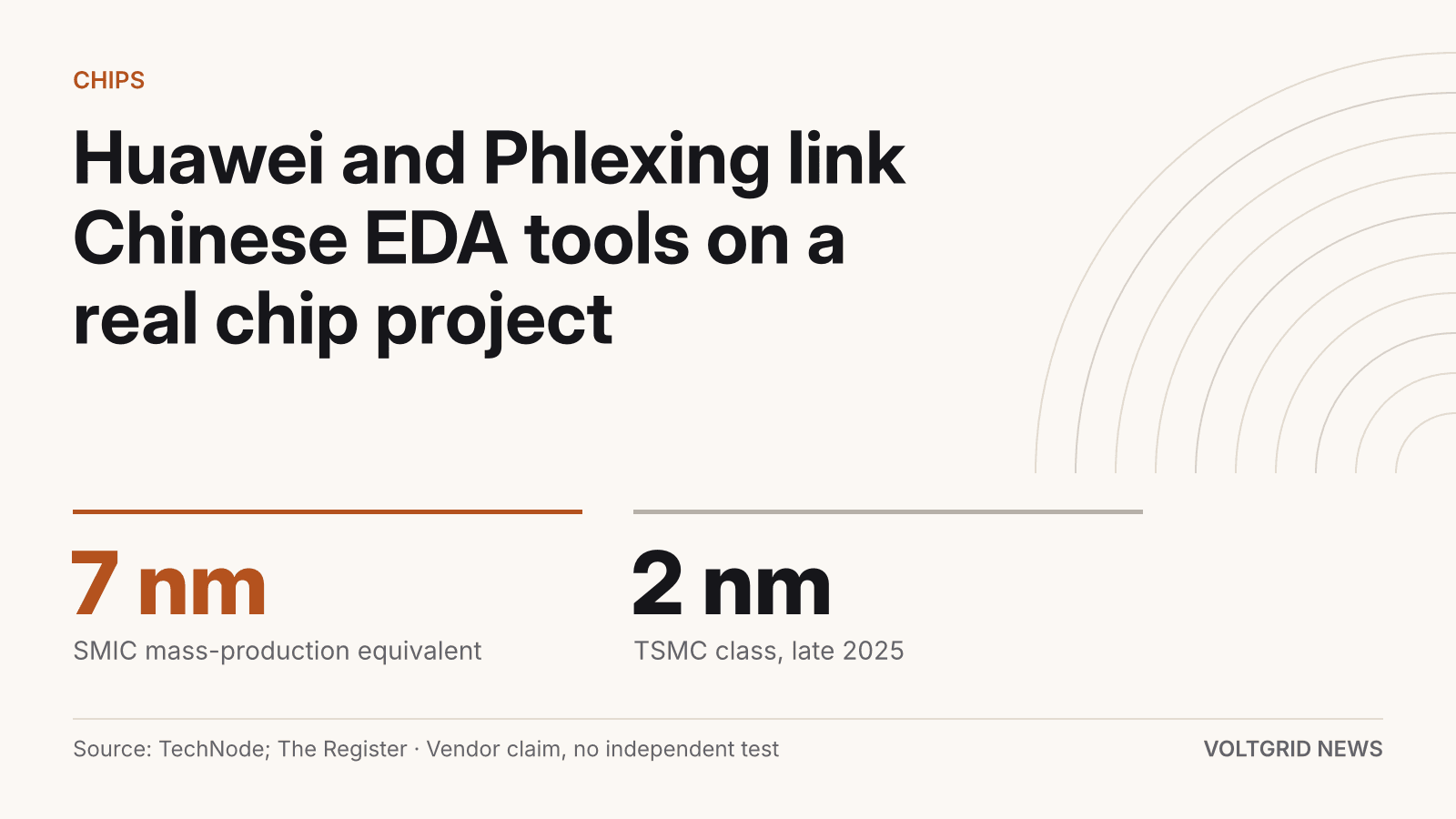
Key facts: SMIC's reported 7 nm-equivalent mass production against TSMC's 2 nm-class output from late 2025 (The Register).
Graphic: Voltgrid News
Huawei and software partner Phlexing Technology said on Nov. 24 that Chinese chip-design (EDA) tools now run as one chain on a real chip project, TechNode reported from Huawei's Beijing forum.
Phlexing chairman and general manager He Qing called it the industry's first successful integration of a domestic EDA tool chain, TechNode reported. That description is the company's own, and neither report cites an independent test or benchmark of the tools. The Register, which also covered the event, described the effort as an attempt to overcome the fab deficit with packaging.
EDA is the software used to plan, verify and prepare chips for manufacturing. The Register noted that Cadence Design Systems, Synopsys and Siemens dominate the field, and that US export controls restrict Huawei and other blacklisted Chinese firms' access to their tools. Huawei's chip unit HiSilicon therefore built its own with Phlexing's help.
The consequence is a design-side workaround for a manufacturing limit. The Register put SMIC, China's largest foundry, at mass production on the equivalent of a 7 nm process, against TSMC's 5 nm-class output from 2020 and 2 nm-class mass production from late 2025. Huawei's answer, called the Tau Scaling Law, uses 3D hybrid bonding to reach higher transistor density for a given area. Without tools that can design such stacks, the approach cannot scale, and that is the gap Phlexing says it is closing.
What Phlexing's tools do
According to TechNode, Phlexing's GloryEX software extracts the resistance and capacitance of chip interconnects, which lets engineers calculate how signals travel through a design. Its GloryBolt checks power integrity, meaning whether a chip's power distribution can operate reliably. Both checks belong to the verification stage that comes before a design goes to manufacturing.
Huawei then connected Phlexing's software with other Chinese EDA tools, TechNode said, coordinating chip designers, foundries and packaging companies around a real design workflow. The collaboration also covers designs that combine different manufacturing processes and three-dimensional structures.
Huawei linked Phlexing's GloryEX and GloryBolt with other Chinese EDA tools around a real design workflow, a vendor claim (TechNode).
Graphic: Voltgrid News
He told the forum that traditional EDA has long handled only single processes, while Tau EDA has to integrate and decompose several, as the Register quoted him. Coupling multi-scale, multi-structure and multi-physics problems required new analysis tools, he said. The Register reported that a process design kit (PDK), the library of rules and models a foundry supplies to designers, was co-developed with Huawei starting in 2024, and that these technologies have now gone live.
Where it fits in Huawei's roadmap
Packaging is already central to Huawei's accelerator plans. Voltgrid News examined the Ascend 950's throughput under the US export formula, where HBM yields and SMIC wafers were the limits. The Register expects many of Huawei's coming advances in accelerators, near-packaged optics, networking and rack systems to depend on multi-die packages that tools like Phlexing's would enable.
Supply of the memory those packages need is a separate constraint, as Voltgrid News reported on HBM smuggling to China.
What is not confirmed yet
No chip, node, yield or schedule was named for the real project, and neither report says which Huawei product it was. The claim of a first fully integrated domestic tool chain rests on Phlexing and Huawei's own statements. What to watch next is whether a Huawei product built with Tau EDA ships, and on which SMIC process.
Sources
- Published
- Sources
- 2 cited