Lenovo Pro 9n RTX Spark Laptop Gets Only 16GB of 32GB for Graphics
Tom's Hardware's Nov 22 review reported the 32GB Lenovo Pro 9n could allocate at most 16GB to graphics, while StorageReview ran a 12GB split it chose. Tom's lists a $2,999.99 base price.
3 min read
Follows NVIDIA RTX Spark Laptops Start at $2,599, 128GB Models in Stock
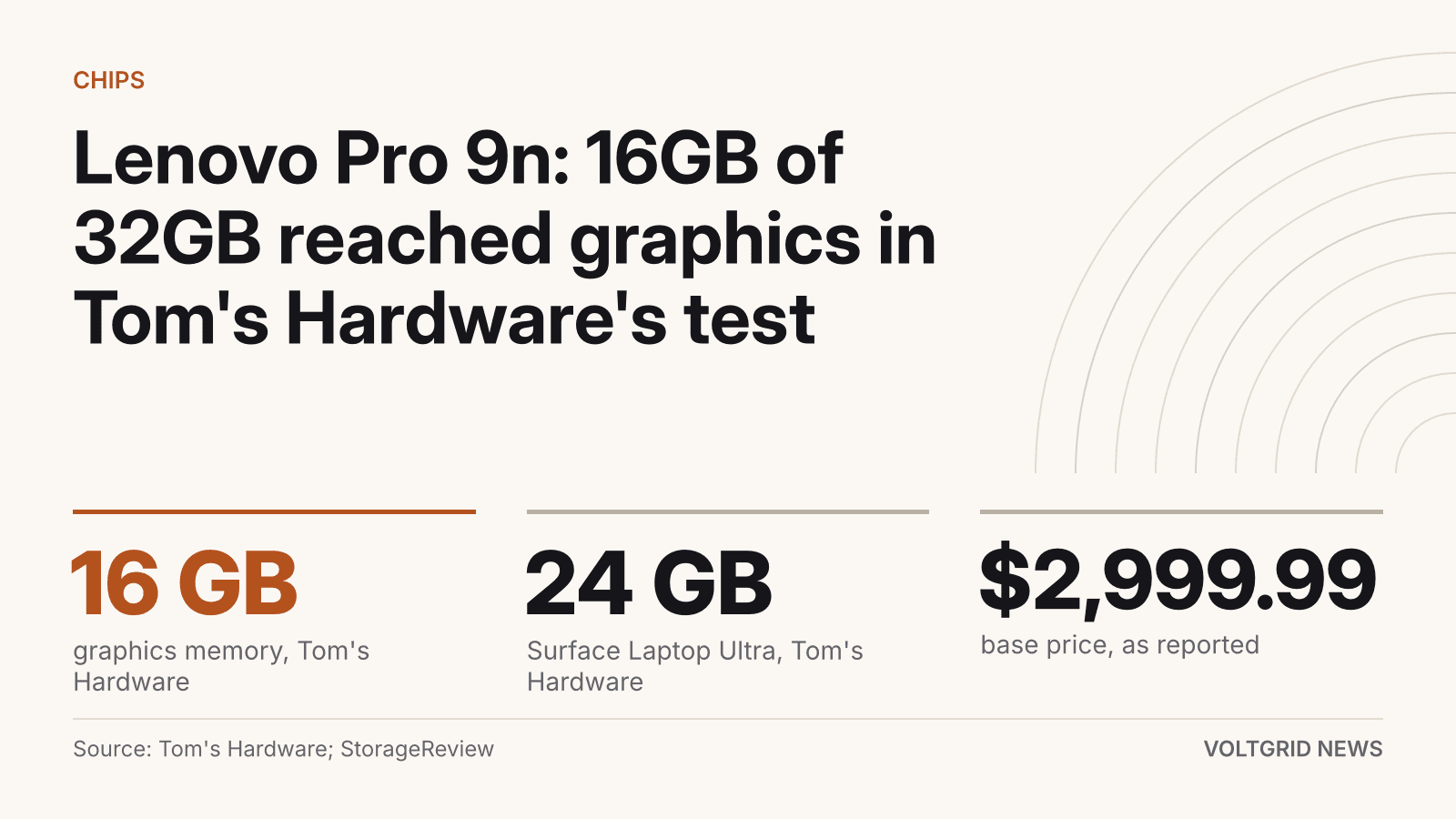
Tom's Hardware measured 16GB of graphics memory on the 32GB Lenovo Pro 9n and 24GB on the Surface Laptop Ultra.
Graphic: Voltgrid News
Tom's Hardware's review of the Lenovo Pro 9n, published Nov 22, reported that its 32GB unit with NVIDIA's 18-core RTX Spark N1X could allocate only 16GB of that memory to graphics.
That ceiling shaped the test. To fit the GPU's share, Tom's ran its AgentPerf-Local benchmark on Qwen 3.8-27B at the IQ3_XXS quant. Microsoft's Surface Laptop Ultra, also a 32GB machine but with the 20-core N1X, allowed 24GB in Tom's test. The Pro 9n finished the run in 1,196.6 seconds against 1,148.3 for the Surface (lower is faster), about 4 percent longer, although the Surface had 24GB for the same job. Tom's review is the latest on the 18-core Pro 9n, after StorageReview's on Oct 16 and Windows Central's on Oct 28, and it follows our RTX Spark laptops product file. It moves the question for 32GB buyers from compute to memory.
Tom's Hardware measured 16GB for the Pro 9n and 24GB for the Surface Laptop Ultra; StorageReview's 12GB was a split it chose.
Graphic: Voltgrid News
Two labs, two memory splits
StorageReview, reviewing the same chip and memory configuration on Oct 16, ran its unit at a 12GB GPU and 20GB system split. The lab chose that split itself in the NVIDIA app, to match the 32GB HP OmniBook it compared against, and said the setting is a Windows-side change, not a BIOS option. At 12GB the laptop could not load the 12.8GB gpt-oss:20b model, so, according to StorageReview, it skipped the model-load and coding-agent tests that need 16GB of GPU-usable memory. On a model that did fit, it measured Llama 3.1 8B at 55.1 tokens per second in Performance mode on mains power, about 2 percent behind the 20-core OmniBook.
The two figures are not a contradiction. One is the most Tom's unit would accept and the other is the split StorageReview picked. Voltgrid found no statement in either review on whether 16GB is a Lenovo default or a hard limit, and Lenovo's own spec page could not be checked. As StorageReview describes it, the fixed split is a Windows limitation that NVIDIA and Microsoft are working to remove. That fits our Oct 31 roundup, in which the 128GB machines ran 35B models while the 32GB units ran no large-model test.
Why GPU memory allocation limits local LLM size
On RTX Spark laptops the CPU and GPU draw on one pool of LPDDR5X, but Windows still splits it. A model's weights must sit in the GPU's share, so the share, not the 32GB total, sets the largest model that loads. Every gigabyte given to the GPU is one the rest of Windows loses.
That is the pattern in both reviews: Tom's needed a heavily compressed quant to fit a 27B model into 16GB, and StorageReview's 12GB split could not hold a 12.8GB model.
Price, battery and the cost of two cores
Tom's reports the base Pro 9n at $2,999.99 with the same 18-core chip and 32GB on Windows 11 Home. Its review unit, with a 1TB SSD and Windows 11 Pro, is listed at $3,249.99. Moving to the 20-core, 6,144-CUDA-core chip adds $450 and brings 64GB and 1TB, Tom's reports. These figures are as the reviewers reported them.
In Tom's battery test, which browses the web, streams video and runs OpenGL at 150 nits, the laptop lasted 10 hours 30 minutes. That is 13 minutes short of the Surface Laptop Ultra and well below the MacBook Pro's 15 hours 57 minutes in the same test. Windows Central reported 8 to 10 hours in mixed use that included gaming, a different workload. In Tom's tests the graphics gap was wider than the AI-run gap: the Pro 9n scored 2,796 in 3DMark Steel Nomad against the Surface's 4,355. StorageReview put the CPU 8 to 11 percent behind the 20-core HP OmniBook in rendering, compression and compile work, with Cinebench 2026 multi-core at 6,394 against 6,934.
For local AI, the $450 step looks better on paper: it doubles memory and buys back the cores, though no review has yet reported how much graphics memory a 64GB Pro 9n allows. The open questions are whether Lenovo or a driver update raises the 16GB ceiling, and when Windows on RTX Spark shares memory without a fixed split.
Sources
- 01Lenovo Pro 9n review: Here's where it wins (and falls short)Windows Centralwindowscentral.com
- 02Lenovo Pro 9n review: 18-core RTX Spark in a fancy chassisTom's Hardwaretomshardware.com
- 03Lenovo Pro 9n 15 Review: 18-Core RTX Spark Keeps Pace With 20 Cores and Runs CoolerStorageReviewstoragereview.com
- Published
- Sources
- 3 cited