Madrone Dew-Point Cooler Skips Chillers, Claims 30% Less Power
Nvidia-linked startup Madrone says its outdoor cooler supplies 20°C water without chillers and cuts power and water 30% in Texas, while Nvidia's 45°C inlet spec puts chillers in question.
2 min read
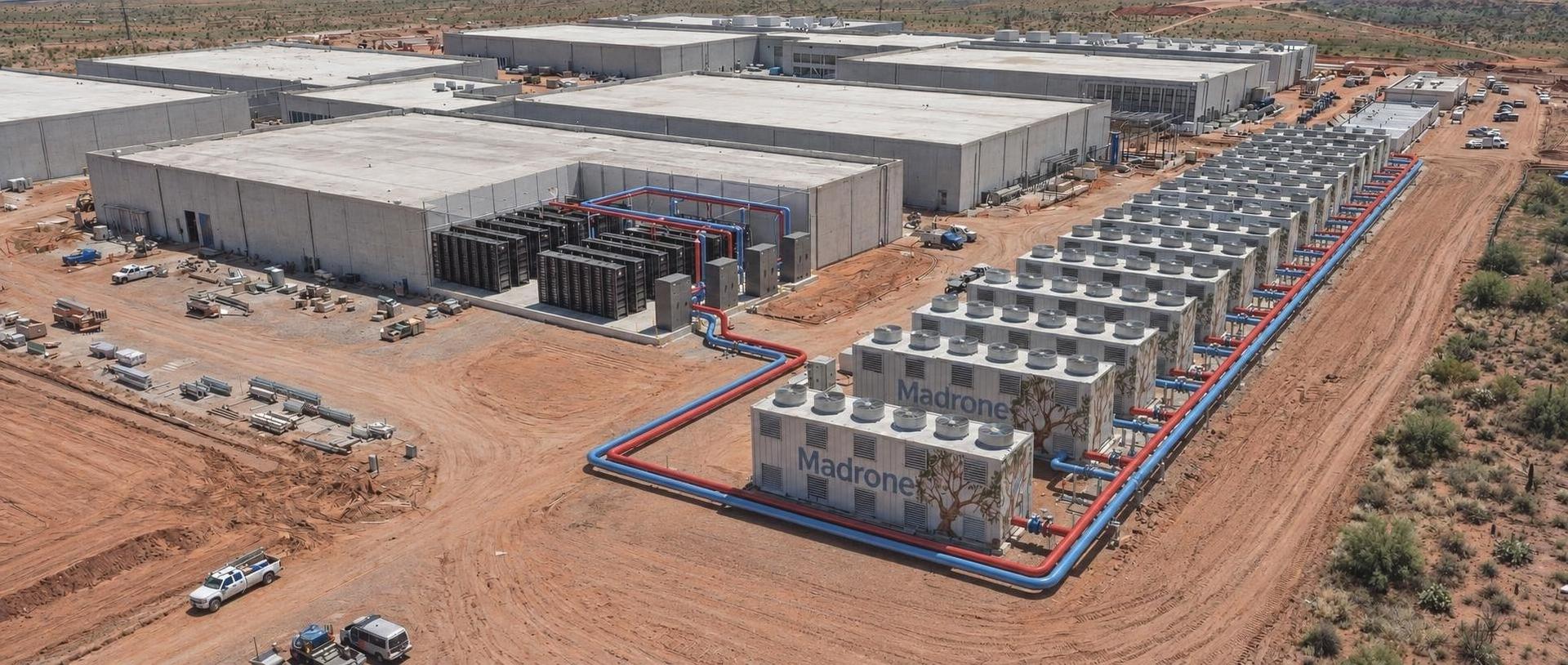
Image from Madrone's website showing its outdoor modules at a data center. Madrone's pages describe only a 1 kW prototype and a 100 kW prototype under construction, so this is not confirmed as a working installation.
Image: Madrone
Source · Image from the Madrone website, used for news reporting.
Madrone, a two-person San Francisco startup in Y Combinator's Spring 2026 batch, says its outdoor dew-point cooler supplies 20°C water with no mechanical chillers and uses 30% less power and water than a chiller-and-tower plant in Texas.
The 30% figure is the company's own claim for Texas, according to Madrone's website, and the site gives no test conditions or customer. Madrone sells a modular unit that sits outside the building, for new hyperscale builds and for retrofits of Blackwell and Rubin halls. Its site also says the cooling enables Vera Rubin operation at 45°C+ ambient without thermal throttling. DatacenterDynamics headlined on Nov. 26 that Nvidia backs the startup; the site lists the NVIDIA Inception Program and Y Combinator as backers.
For a data-center operator the claim matters because cooling takes power that could run GPUs. The Register put the share of total facility energy at 20% to 40% in legacy chiller-and-tower designs. Madrone's site says up to 40% of data center power goes to cooling, and its Y Combinator launch post says up to 30%. Cut that load and the same grid permit supports more racks, which is Madrone's pitch.
The 45°C context
The timing sits next to a wider argument about chillers. In an SC26 column published Nov. 26, The Register said Nvidia announced a 45°C liquid inlet temperature for its parts earlier this year, without giving a date. Most liquid-cooled systems have run at 30°C to 35°C. At 45°C, the column argues, many sites that now need chillers could use rooftop dry coolers, with adiabatic assist during peak heat.
Published estimates and vendor modeling, as The Register cites them, put the cooling-energy cut at 50% to 70% against chiller-and-tower plants and the cut in total data-center power at 10% to 20%, depending on starting PUE (power usage effectiveness) and climate. Those are estimates, not measured deployments. The column also warns that retrofits need flow-rate and pressure-drop checks, and says SC26 attendees were closed-lipped on whether other chipmakers will match 45°C.
Voltgrid's reading: the two numbers are different quantities. 45°C is the inlet temperature Nvidia says its parts tolerate; 20°C is the water Madrone says it supplies. Neither source says how Madrone's unit behaves at a 45°C setpoint. Dry-cooler designs are already moving into reference plans, as Voltgrid reported for Daikin Applied's 60 MW D60-W design, and ZutaCore's modelled 1.03 pPUE also assumes no cooling tower.
Madrone says its unit supplies 20 °C water with no chillers, a vendor claim; Nvidia's reported inlet is 45 °C, a different quantity.
Graphic: Voltgrid News
What is not confirmed yet
Madrone's own pages say it has a 1 kW prototype and a 100 kW prototype under construction. Against the 100 MW campus its launch post uses as a yardstick, 100 kW is 0.1% of that load, so the Texas saving has not been shown at hall scale.
Voltgrid could not read DatacenterDynamics' report, so the size, date and investors of any funding round are unconfirmed here. The Register's water-saving range is inconsistent within the column and is not used. Watch for the 100 kW prototype's measured results, a named pilot site, and any second chipmaker that sets a 45°C inlet.
Sources
- Published
- Sources
- 3 cited