Proper Voltage Salt Vault: 73.1 kWh Sodium-Ion UPS for AI Data Centers
Proper Voltage and Unigrid's Salt Vault sodium-ion UPS cabinet is rated 73.1 kWh and 333 kW for AI load transients, with April 2027 deliveries. Customers and pricing are undisclosed.
3 min read
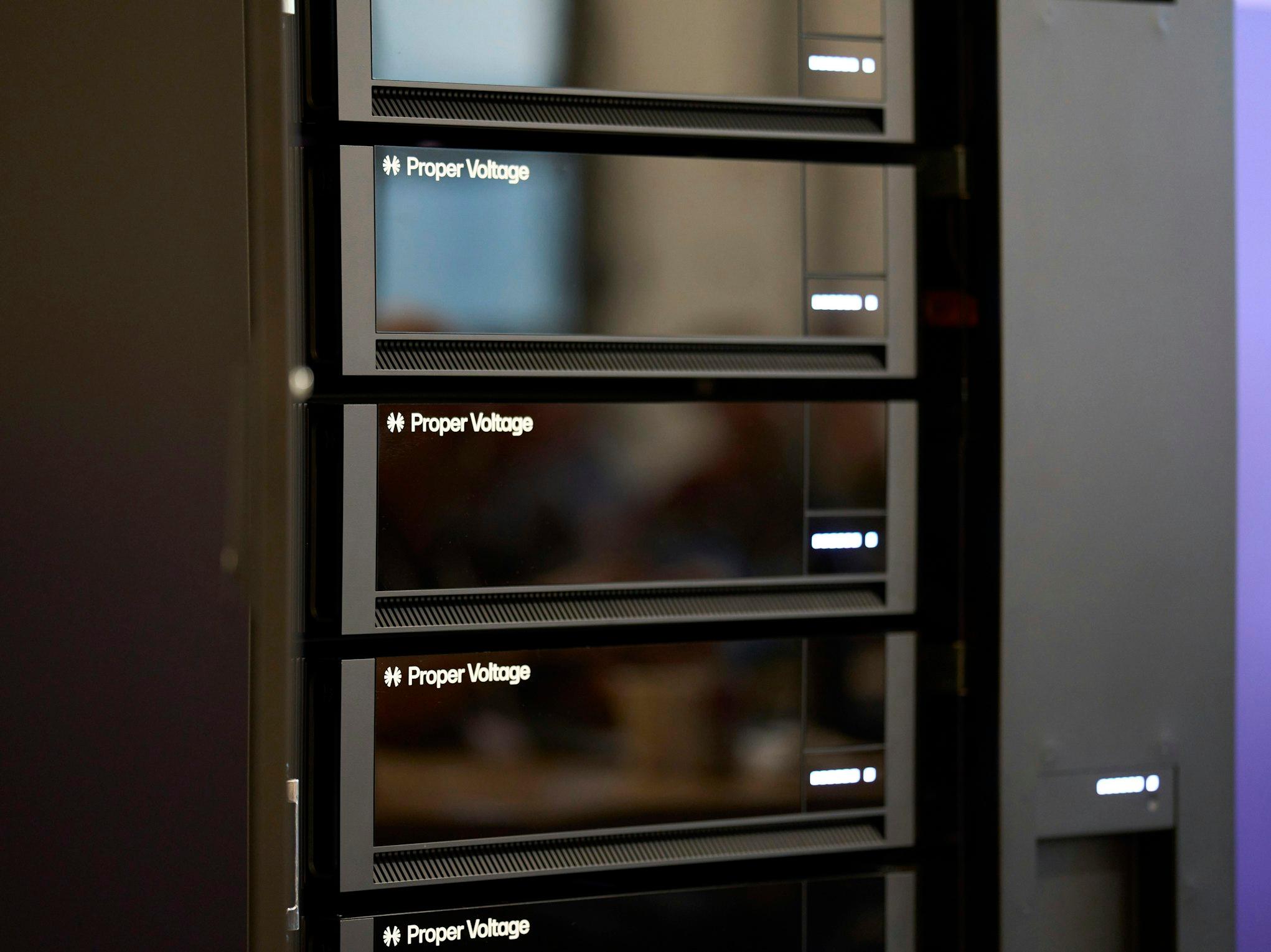
Proper Voltage battery modules in a cabinet, from the company's Salt Vault launch material. The photo may not show the exact Salt Vault High Power configuration.
Image: Proper Voltage
Source · Press image from the Proper Voltage newsroom, used for news reporting.
Proper Voltage and Unigrid launched Salt Vault, a sodium-ion uninterruptible power supply (UPS) cabinet rated at 73.1 kWh and 333 kW, on Nov. 19, with deliveries to data center operators from April 2027.
Proper Voltage, a battery integration company based in Carlsbad, California, said in its release that Salt Vault pairs its battery operating system (bOS), a software layer that regulates output voltage across the full state of charge, with sodium-chromium oxide (NCO) cells from San Diego-based Unigrid. Orders are open, the company said. ESS News, which first covered the launch on Nov. 20, reports that the first customers are unnamed early-adopter data center and critical infrastructure operators.
The target is the load pattern of AI clusters. Both companies say training and inference clusters swing from idle to peak load in milliseconds, and that these sharp, repeated transients strain conventional battery energy storage. ESS News frames the claim carefully: rapid and repeated transients may degrade lead-acid and lithium iron phosphate (LFP) batteries faster than sodium-ion cells. Proper Voltage's release says the cabinet has higher power density than legacy LFP systems, but the release gives no figure for that comparison.
Salt Vault specifications
According to Proper Voltage's product page, the Salt Vault High Power cabinet is rated at 73.1 kWh of energy and 333 kW of power at a nominal 522 VDC, with an allowed range of 360 V to 612 V. Cycle life is listed at 10,000 cycles. The cabinet discharges from -20°C to 40°C and charges from 0°C to 40°C. The page calls the chemistry inherently stable with no thermal runaway risk, and the release adds that the system has "zero fire propagation risk". Both are company claims, with no test report.
A separate Salt Vault Adaptive module on the same page is rated at 6.1 kWh and 12.2 kW, also at 10,000 cycles. The page does not say how the High Power cabinet is built from modules, so the 333 kW rating cannot be traced back to a module count.
Put in proportion, 333 kW against 73.1 kWh means the cabinet would empty in about 13 minutes at full power, by Voltgrid's arithmetic on the listed ratings. That is a high-rate, short-duration profile built for transients, not for hours of storage. The Adaptive module's 12.2 kW on 6.1 kWh works out to about 30 minutes at full power, so the High Power cabinet is a much higher-rate product.
At its vendor-claimed ratings, the 333 kW High Power cabinet would run about 13 minutes at full power, against about 30 minutes for the 12.2 kW Adaptive module (Voltgrid arithmetic).
Graphic: Voltgrid News
How it fits a data center UPS
Proper Voltage says its software-defined voltage control lets the cabinet drop into the UPS systems that legacy data centers already run, without inverter redesign, and adapt to 800 V rack architectures. If that holds, it removes the usual obstacle for a new chemistry: a battery whose voltage curve differs from lead-acid or LFP normally forces changes to the power electronics around it.
The launch follows other sodium-ion moves toward AI sites this month. As Voltgrid News reported, LG Energy Solution showed a sodium-ion plus solid-state transformer system and a UPS rack at RE+ without ratings. CATL's grid-scale block is a different product: its Tener Sodium block is rated at 30+ MWh and 7.5 MW over four hours, while Salt Vault sells power over minutes. Peak Energy named data centers as a new target market when it raised $108 million on Oct. 21.
What is not confirmed yet
No independent performance data or pricing has been disclosed, according to ESS News. The customers are unnamed, and the April 2027 delivery date is a company expectation, not a shipped product. The 10,000-cycle rating comes with no stated depth of discharge, rate or temperature, and the comparison with LFP and lead-acid in transient service is the vendors' own. ESS News also notes that Nvidia's battery qualification program has so far named only Tesla, LG and Hitachi, which shows how hard tier-one data center supply deals are to win.
Sources
- 01New sodium-ion energy storage solution for data centers from California’s Proper Voltage and UnigridESS Newsess-news.com
- 02Critical Power: Salt Vault High Power and Adaptive specificationsProper Voltagepropervoltage.comas read on Nov 20, 2026
- 03Proper Voltage, in Collaboration with UNIGRID Sodium-Ion Technology, Launches Salt Vault UPS Battery SystemProper Voltage (GlobeNewswire release)manilatimes.net
- Published
- Sources
- 3 cited