Rice Graphite Made in 0.2 Seconds Enables 4-Minute Charge Rate
Rice University's Tour lab flash-heated petroleum coke with nickel into graphite in 0.2 s; lab cells took a four-minute charge rate and kept 80% after 1,000 cycles.
2 min read
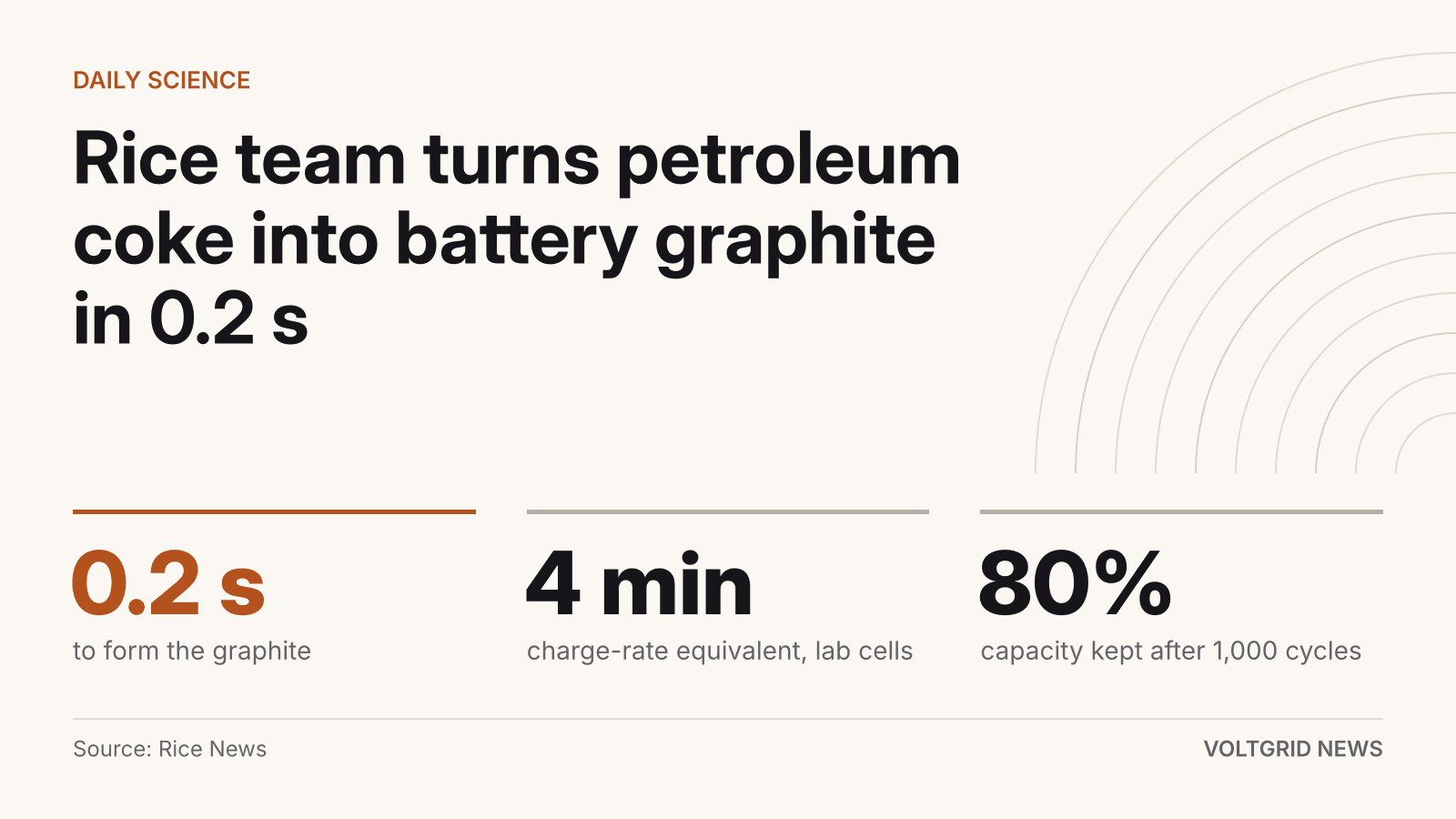
Rice University lab results as reported by Rice News: 0.2 s synthesis, a four-minute charge-rate equivalent and 80% retention after 1,000 cycles.
Graphic: Voltgrid News
Rice University researchers reported on Nov. 23, 2026 that they turned petroleum coke into battery-grade graphite in 0.2 seconds, and lab cells built with it took a charge rate equivalent to a four-minute full charge.
The work comes from the lab of chemist James Tour and appears in the journal Advanced Materials under the title "Trace-Metal-Assisted Flash Synthesis for Fast-Charging Graphite Anodes". According to Rice News, the material kept 80% of its capacity after 1,000 full charge and discharge cycles. Tour's team also said its analysis suggests the route could cut energy use and greenhouse gas emissions by more than 80% compared with conventional graphite production. That figure is the team's estimate, not a measured plant result.
Why the anode sets the charging speed
Most lithium-ion cells, including those in electric vehicles, use graphite for the anode, the electrode that takes up lithium during charging. Graphite is a stack of sheets one atom thick, and the lithium ions must slide in between them. Rice News says how quickly ions move through the graphite is one of the key limits on charging speed.
Making synthetic graphite is the costly part. Conventional production needs long heating at very high temperatures. For a battery maker, a process that takes a fraction of a second could lower energy use and cost at one of the cell's key materials, if it scales.
How a nickel pulse builds graphite
The team mixed a small amount of a nickel compound into petroleum coke, a low-cost carbon residue from oil refining. One short electrical pulse then heated the mixture to about 2,500 C. First author Haojie Zhu, a postdoctoral associate, compared the nickel to "a temporary construction worker" that helps carbon atoms line up into orderly hexagonal layers.
One electrical pulse heating nickel-doped petroleum coke to about 2,500 C is the step that builds the graphite, Rice News reports.
Graphic: Voltgrid News
The nickel also widened the gap between layers slightly, which gives lithium easier access. The team found the gain stayed after more than 99% of the leftover nickel was removed, which points to the structure, not the metal, as the source of the benefit. Temperature mattered: at excessively high temperatures much of the nickel was lost, while lower temperatures gave less ordered graphite.
What this means for cell makers
Faster charging and cheaper anode material are the two goals the Rice team says it addresses at once. For EV makers, a four-minute rate at the cell level is a materials result, not a vehicle spec: charging time in a car also depends on the pack, the cooling and the charger. The Cool Down, which reported on the study on Nov. 28, and Scientific Frontline, which covered it on Nov. 23, both repeat the same headline figures from the Rice release.
What is not confirmed yet
The sources describe lab tests on a lithium-ion battery with the new graphite, not a pilot plant or a commercial cell. None of them gives a production volume, a cost per tonne, a cell size or a date for commercial use. The 80% energy and emissions saving is Tour's own analysis, and the release does not say what the comparison baseline is. A four-minute charge rate and 80% retention after 1,000 cycles are also not shown together in the release as a single test, so readers should not assume one cell did both. Independent replication would be the next test of the result.
Sources
- Desk
- Science Desk
- Published
- Sources
- 3 cited