Zinc Battery on Salt-Lake Water Keeps 80% After 900 Cycles at −50°C
A zinc pouch cell built on salt-lake water kept 80% of its capacity through 900 cycles at −50°C, per Interesting Engineering on a JACS study. It is lab work, and costs are unassessed.
2 min read
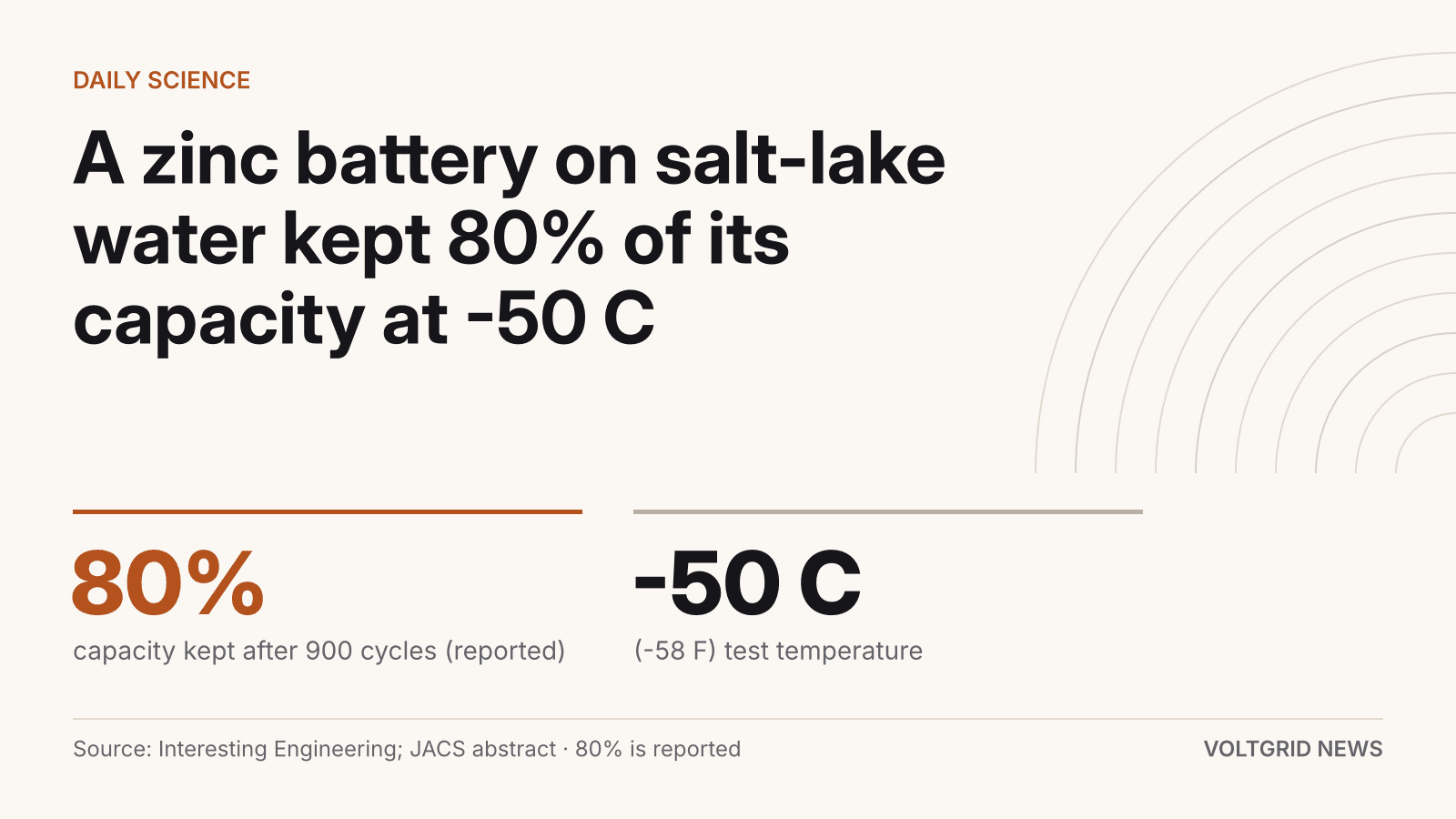
The 80% figure is reported by Interesting Engineering; the journal abstract gives no percentage.
Graphic: Voltgrid News
Researchers led by a team at North China Electric Power University built a rechargeable zinc battery on salt-lake water that kept 80% of its capacity after 900 charge-discharge cycles at −50°C (−58°F), according to Interesting Engineering's report on the study.
The work appeared in the Journal of the American Chemical Society (volume 148, issue 44, dated Nov. 11, 2026). Interesting Engineering names Huajun Tian and colleagues from North China Electric Power University, Qinghai Minzu University and Beijing University of Chemical Technology. The paper's abstract, as indexed by PubMed, describes salt-lake water as an abundant, low-cost, naturally salty medium that can replace deionized water as the solvent of an aqueous zinc-ion battery, with no energy-intensive purification.
How the cell resists freezing
Water-based batteries stall in deep cold because the electrolyte freezes and ions move more slowly. The authors say the lake water's high salinity suppresses ice formation and limits voltage loss. Interesting Engineering adds that the team mixed equal volumes of lake water and propylene glycol, an antifreeze, before adding a zinc salt.
The zinc electrode carries a coating of an indium, tin and zinc alloy. In the microscope images Interesting Engineering describes, uncoated zinc grew branching deposits and gave off hydrogen gas, while the coated electrode stayed smoother and gassed less. The full cell pairs it with a polyaniline cathode, a conducting polymer.
The numbers, and what each one measures
The abstract reports three results. A symmetric cell, which tests the zinc electrode alone, cycled for more than 3,200 hours at −50°C. A full cell with the polyaniline cathode ran more than 2,500 cycles at 5 A per gram. The pouch cell, the closer match to a real battery format, operated stably after 900 cycles at −50°C.
Only the pouch cell is close to a real battery format; the three results come from different cells.
Graphic: Voltgrid News
The 80% retention figure comes from Interesting Engineering's account; the abstract says the pouch cell stayed stable but gives no percentage. The 3,200-hour test measures electrode stability, not battery life, and the 2,500-cycle and 900-cycle results come from different cells, so they should not be added together.
Why cold-climate storage is the target
The authors call the approach low-cost, geographically adaptable and industrially scalable for aqueous batteries in extreme cold, and the abstract says a lake's own brine can stand in for purified water. For storage planners that frames the open question: whether a cell with this electrolyte can be built at a price that suits sites without heating. Voltgrid has covered another zinc cell from University College London that kept 96% capacity after 1,000 cycles; the two use different chemistries and tests, so their figures are not a ranking.
What is not confirmed yet
Salts naturally present in the lake water compete with zinc ions for storage sites in the polyaniline electrode, which lowers the charge it can hold, Interesting Engineering reports. Chloride in the water can also speed corrosion at the zinc electrode. Scaling up will require assessing the cost of the antifreeze and the alloy coating, and the results so far are laboratory results. Neither source gives a commercial timeline, a cell energy density or a voltage.
Sources
- Desk
- Science Desk
- Published
- Sources
- 2 cited