HKUST Perovskite Cell Reaches 27.04%; 92% of Devices Last 1,400 h
HKUST says its nanolink perovskite solar cell hit 27.04% efficiency (26.67% certified) in Nature Photonics, but the 1,400-hour tests are lab results with no module data.
2 min read
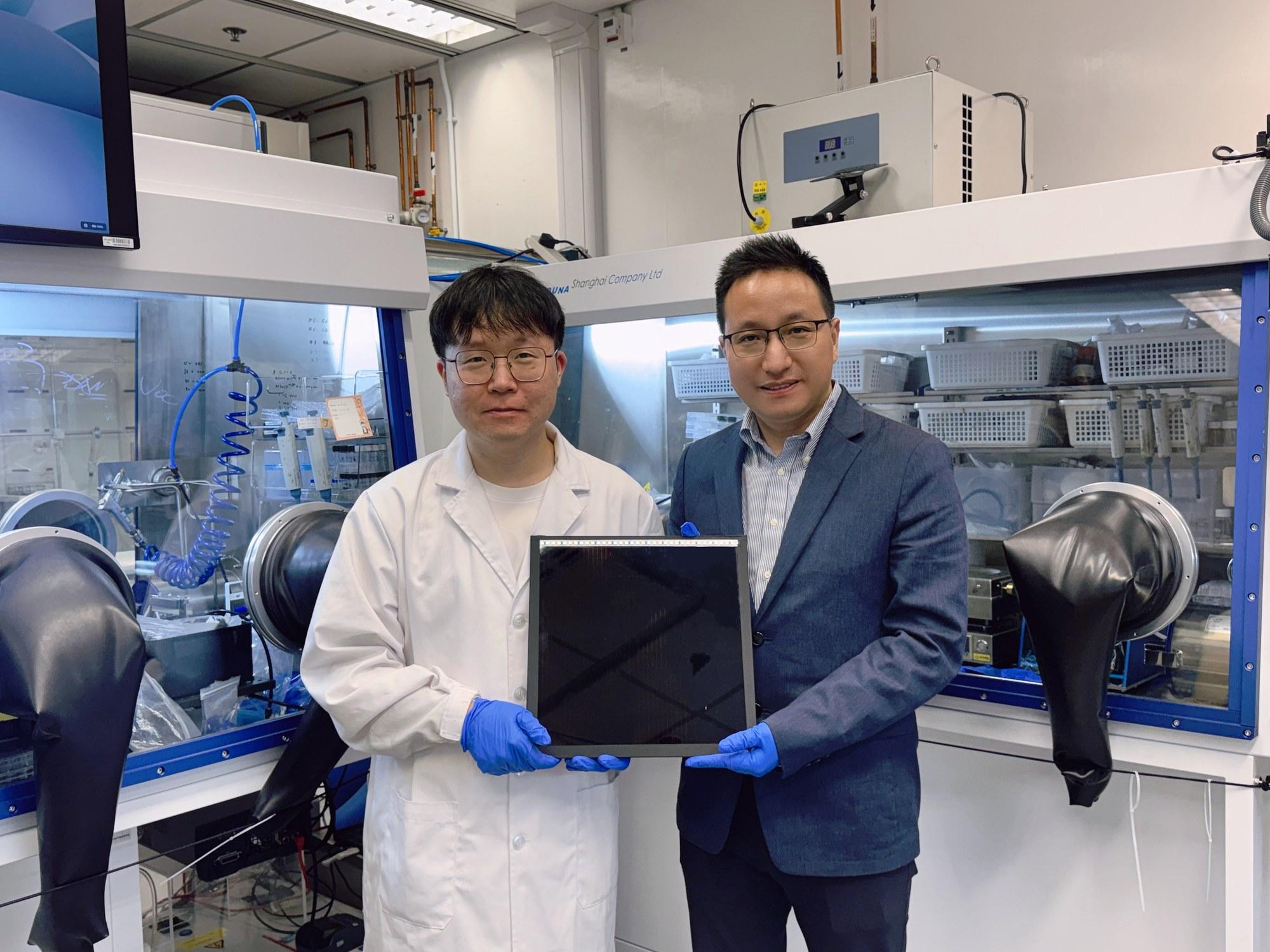
Yuanyuan Zhou (right), acting head of the HKUST Department of Materials, and Wenjian Yu with a perovskite solar cell device made with trans-interface engineering.
Image: HKUST
Source · Press image from the HKUST newsroom, used for news reporting.
Researchers at the Hong Kong University of Science and Technology (HKUST) built a perovskite solar cell with 27.04% power conversion efficiency (26.67% certified), and 92% of more than 50 tested devices lasted at least 1,400 hours.
The result was published in Nature Photonics, where the paper made the November 2026 cover, HKUST said in a release dated Nov. 25. pv magazine reported the work on Nov. 27. Yuanyuan Zhou, acting head of the university's Department of Materials, is the sole corresponding author.
What the team changed in the cell
A perovskite cell stacks a light-absorbing perovskite layer on a charge-transport layer. The boundary between them can crack or peel during operation, which speeds up degradation. Usual fixes add a flat interlayer that smooths over defects, but HKUST says these often trade charge transport against stability.
The team instead grew vertical nanolinks that run through both layers. It put one set of organic linkers into the perovskite and another into the electron-transport layer, then used radicals from azobisisobutyronitrile (AIBN) to polymerize them and bond them across the boundary. Zhou compared it with stitching the layers together rather than applying a Band-Aid.
The numbers behind the claim
The best cell reached 27.04% efficiency, or 26.67% certified, with an open-circuit voltage of 1.220 V, according to HKUST. The release says interfacial toughness rose nearly threefold. pv magazine noted that the certification body was not disclosed.
Stability was tested under maximum-power-point tracking at one-sun illumination. Of more than 50 devices, 92% reached a T80 lifetime of at least 1,400 hours, meaning efficiency stayed above 80% of its starting value. Control devices varied widely, from a few dozen hours to more than 1,800 hours. HKUST also reports better stability under 85°C and 85% relative humidity.
In HKUST's lab tests, 92% of more than 50 devices reached a T80 lifetime of 1,400 hours or more under maximum-power-point tracking.
Graphic: Voltgrid News
Why it matters for solar supply
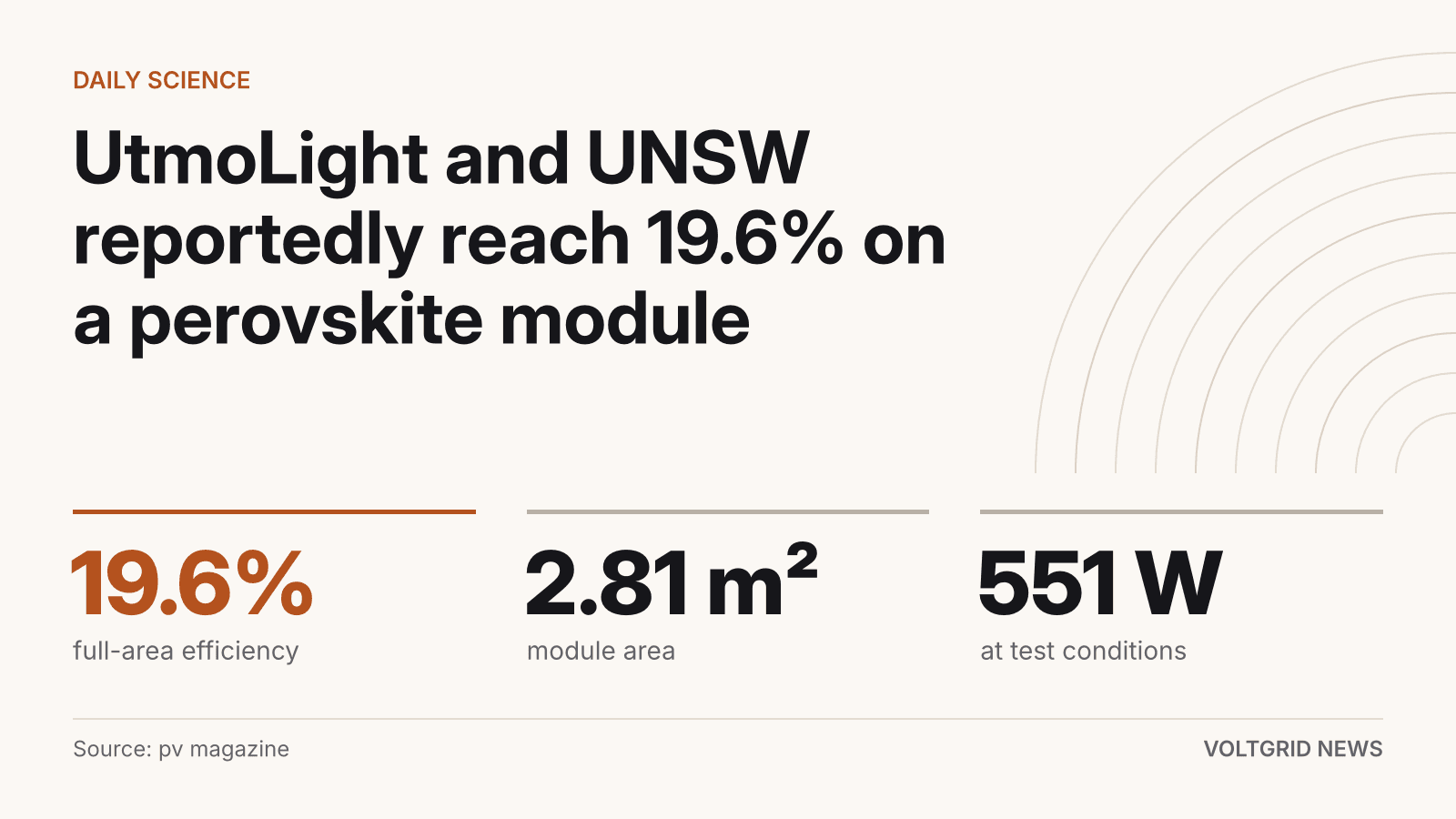
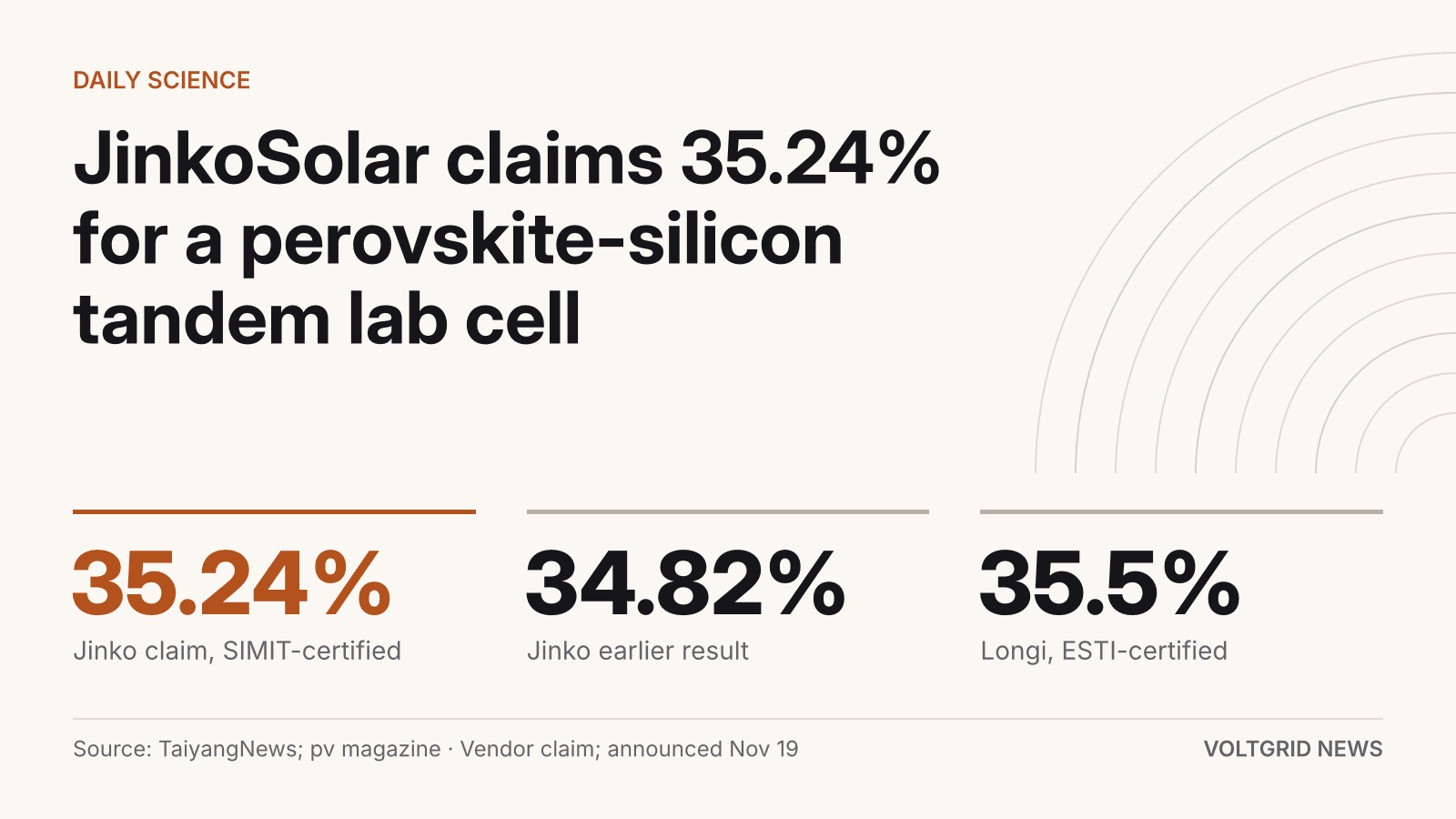
Perovskite efficiency is already past 27% in the lab, as HKUST notes, so the open problem is lifetime. The researchers say the high share of devices reaching 1,400 hours shows better reproducibility, which pv magazine calls a key requirement for industrial-scale manufacturing. Voltgrid News has tracked the other end of the race, such as a 2.81 m² perovskite module at 19.6% and JinkoSolar's certified 35.24% tandem cell, where durability remains the open question for the technology.
What is not confirmed yet
This is a peer-reviewed laboratory result, and 1,400 hours is a short test next to the service life of an installed solar module. The sources give no module-scale data and no commercial date. The team has filed a patent and has support from China Merchants Group to pursue commercialization, HKUST said. The researchers also say the method could apply to other multilayer optoelectronic devices, but that is their expectation, not a result.
Sources
- 01Trans-interface engineering for reliable perovskite solar cells with reproducible stabilityNature Photonicsnature.com
- 02HKUST Pioneers Trans-Interface Engineering to Boost Perovskite Solar Cell Efficiency and StabilityHKUSThkust.edu.hk
- 03Hong Kong researchers build 27.04%-efficient perovskite solar cell via trans-interface engineeringpv magazinepv-magazine.com
- Desk
- Science Desk
- Published
- Sources
- 3 cited