UtmoLight, UNSW Reportedly Hit 19.6% on 2.81 m² Perovskite Module
UtmoLight and UNSW reportedly reached 19.6% stabilized full-area efficiency, about 551 W, on a 2.81 m² perovskite module tested at Fraunhofer ISE, up from 16.1% on UtmoLight's first 2.8 m² panel.
2 min read
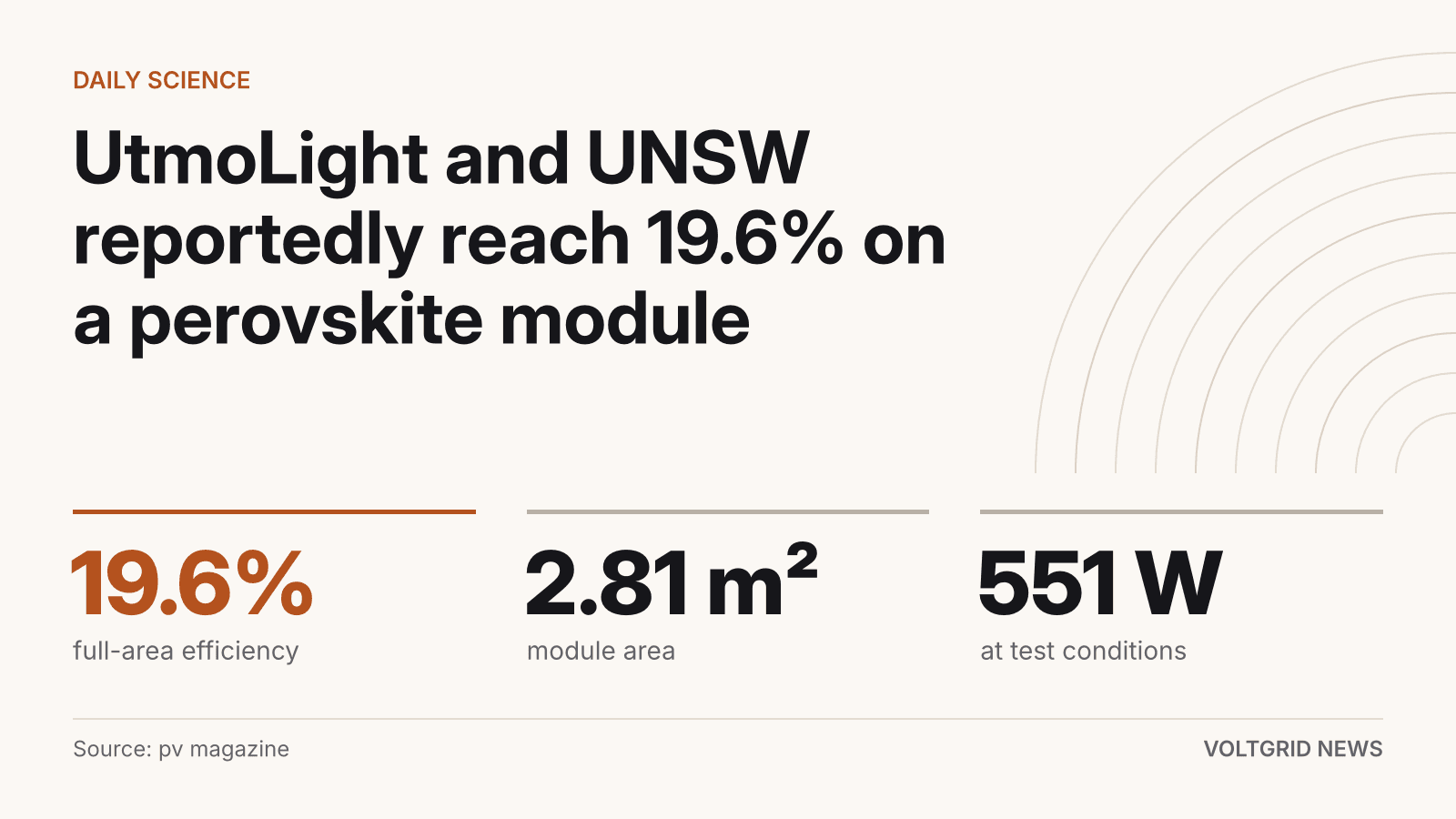
Reported figures for the 2.81 m² perovskite module: 19.6% full-area efficiency and 551 W at standard test conditions (pv magazine).
Graphic: Voltgrid News
UtmoLight and researchers from the University of New South Wales (UNSW) have reportedly reached a stabilized full-area efficiency of 19.6% on a single-junction perovskite module of 2.81 m², pv magazine reported on Nov. 25, 2026.
The figure comes from maximum power point tracking (MPPT) tests at the Fraunhofer Institute for Solar Energy Systems (Fraunhofer ISE) in Germany, according to technical documentation pv magazine said it had seen. At 19.6% over the full area, that works out to about 551 W under standard test conditions. pv magazine calls it a gain of 2.56 percentage points, or about 15% in relative terms, over UtmoLight's previous benchmark for modules of similar size.
What the number means
A perovskite is a crystalline material that turns light into electricity and can be coated onto glass as a thin film. Making it work in a 1 cm² lab cell is one thing. Keeping the film uniform, the defects low and the electrical connections clean across a module the size of a door is much harder, which is why module efficiencies trail lab-cell records.
The comparison that matters is with UtmoLight's own earlier large modules. The company's first 2.8 m² panel, unveiled in November 2024, was rated 450 W at 16.1% full-area efficiency, according to pv magazine and TaiyangNews. In May 2025, pv magazine reported, TÜV Rheinland confirmed 480.5 W and 17.04% for a 2.82 m² module. By Voltgrid's arithmetic, 19.6% is 3.5 percentage points above the first panel and about 101 W more output from nearly the same glass area.
UtmoLight's reported large-module efficiency rose from 16.1% (450 W) to 19.6% (551 W); the latest figure is not independently certified.
Graphic: Voltgrid News
How it got here
In October 2026, UNSW said it had reached a certified stabilised 23.5% on a 30 x 30 cm submodule with a 676 cm² aperture area, using a process that drops the usual nickel oxide layer and lets the hole-selective contact (the layer that collects positive charge) form directly during fabrication. The team said it hoped to reach around 18-19% on a full 2.8 m² module. The reported 19.6% is above that range.
The UNSW team, led by Scientia Professor Xiaojing Hao, acknowledged at the time that further work was needed on efficiency, reproducibility and long-term stability. Perovskites can degrade under moisture, heat and prolonged sunlight, UNSW noted.
What is not confirmed yet
The 19.6% rests on one report of documents that pv magazine says it saw. Neither UtmoLight, UNSW nor Fraunhofer ISE had published a test report for it in the sources Voltgrid could read, and pv magazine itself says "reportedly". It is a full-area figure, not an aperture-area one, and it is a stabilized MPPT result, not a certificate quoted by the source.
It is also one module, not a product. UtmoLight's Chuangshi S2, a 2.81 m² module shown at SNEC in June 2026, is rated 500 W, below the 551 W test result, and the company is targeting 20% efficiency in mass production. No price, shipping date or stability data for the 19.6% module was given. For buyers of utility-scale solar, the next thing to watch is whether the figure survives independent certification and whether it carries over to factory output.
For earlier perovskite results, see our report on JinkoSolar's perovskite-silicon tandem cell, a much smaller laboratory cell.
Sources
- 01UtmoLight, UNSW achieve 19.6% efficiency for 2.81 m² perovskite solar modulepv magazinepv-magazine.com
- 02UNSW leverages industry partnership to set large-scale perovskite PV efficiency world recordUNSW Newsroomunsw.edu.au
- 03UNSW & UtmoLight Report 23.5% Perovskite Submodule Efficiency RecordTaiyangNewstaiyangnews.info
- Desk
- Science Desk
- Published
- Sources
- 3 cited