Inkling 2 Mini Needs About 20 GB: 32 GB Mac Fits, 24 GB GPU Is Tight
Thinking Machines Lab released the open-weights Inkling 2 Mini on Nov. 20, 2026 as a 20 GB checkpoint for 26.4B parameters. Its looped layers add compute per token, not memory.
4 min read
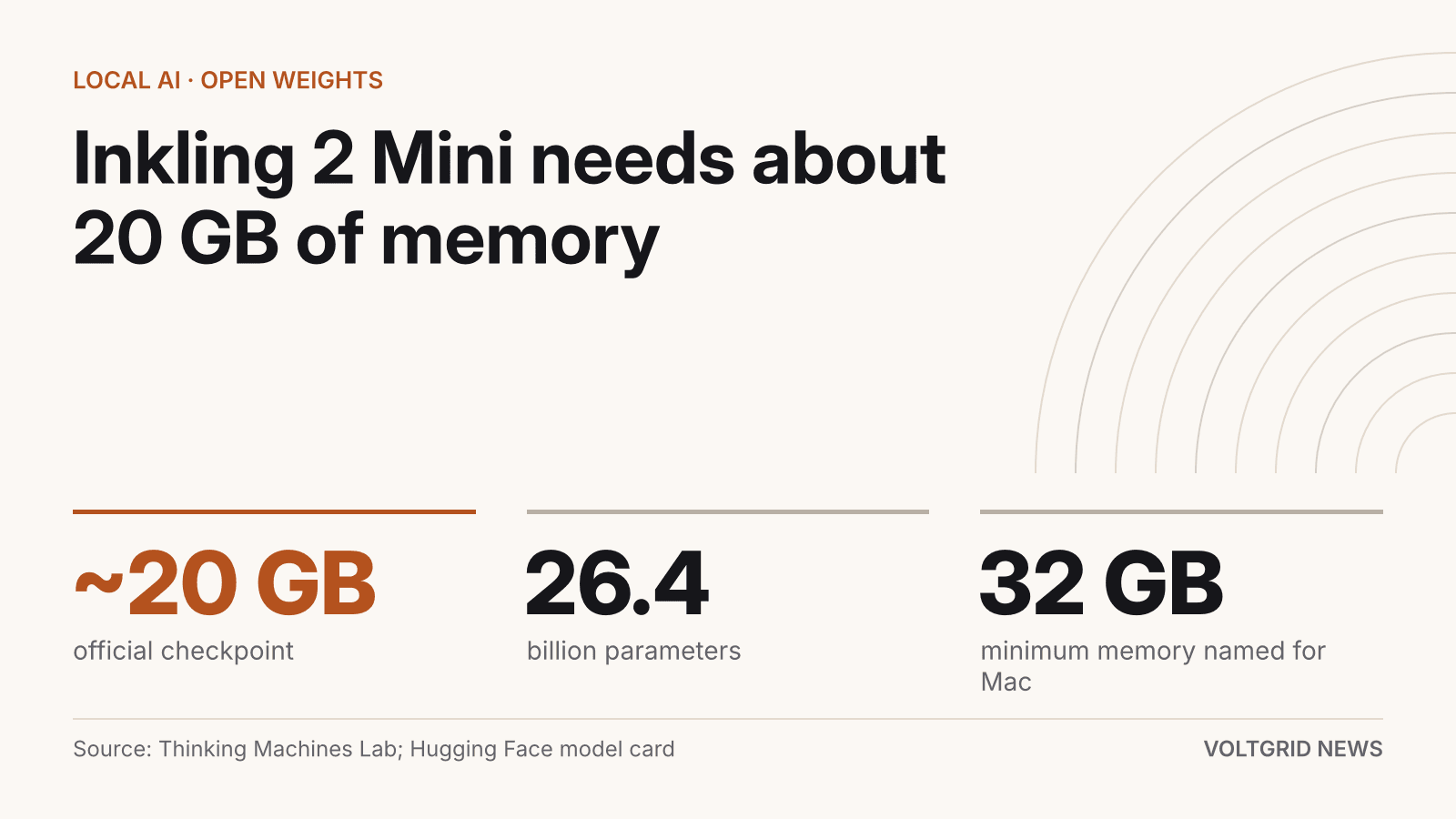
Official checkpoint size and the Mac memory floor, per the Thinking Machines Lab release and Hugging Face model card.
Graphic: Voltgrid News
Thinking Machines Lab released Inkling 2 Mini on Nov. 20, 2026, an open-weights model under the Apache 2.0 license whose official checkpoint needs about 20 GB of memory, small enough, the company says, to run on a laptop. The model has 26.4 billion parameters in total and 3.4 billion active per token, according to its Hugging Face model card, and it is a looped transformer: its middle layers run three times for every token, which adds compute per token but no weights.
Memory decides whether the model loads; looping changes how much work each token costs once it does. The model card lists three supported targets: one NVIDIA DGX Spark, Apple silicon machines with 32 GB or more, and other GPUs, for which it recommends 32 GB or more of memory. Thinking Machines says Ollama runs it on any Mac with at least 32 GB, and that quantized GGUF versions are available through Unsloth and llama.cpp.
Memory on a 32 GB Mac or 24 GB GPU
Thinking Machines trained most of the weights in NVIDIA's 4-bit NVFP4 format and ships them that way: 20 of the 24 layers are NVFP4 and the last four are 8-bit MXFP8, with no conversion after training, the company says. Dividing the roughly 20 GB checkpoint by 26.4 billion parameters gives about 6 bits per parameter on average, a Voltgrid calculation that folds in the 8-bit layers and the parts kept at higher precision.
By the usual rule (weights take parameters times bits, divided by 8), 26.4 billion parameters would need about 13.2 GB at a uniform 4 bits, 26.4 GB at 8 bits and 52.8 GB at 16 bits. These Voltgrid figures cover weights only and leave out the key-value cache, which grows with the prompt and with each extra user, and the card's 1-million-token context window gives no figure for how large that cache gets.
Voltgrid calculation: the official checkpoint of about 20 GB sits between uniform 4-bit and 8-bit weights; KV cache is not included.
Graphic: Voltgrid News
By Voltgrid's subtraction, the 20 GB checkpoint leaves about 12 GB of a 32 GB Mac for macOS, apps and the cache, in line with the 32 GB floor Thinking Machines names. A 24 GB card is tighter: our report on Dell's Pro Max Micro found StorageReview counting 23.9 GB usable on its 24 GB RTX PRO 4000, which by Voltgrid's subtraction is roughly 4 GB of headroom over the weights, and below the model card's 32 GB recommendation. AMD's Radeon AI PRO R9700 meets that recommendation with 32 GB, and a 64 GB box such as Dell's smaller GB10 desktop, where StorageReview counts 58.8 GB as GPU-usable, would also hold an all-8-bit copy of about 26.4 GB with room for long prompts.
That puts Inkling 2 Mini in the same memory class as Qwen 3.6 35B A3B, whose 4-bit file Unsloth lists at 20.6 GB, as our Nov. 19 report noted, while it stores fewer parameters than that model.
Why Looped Layers Add Compute, Not Memory
The model's 24 layers sit in four blocks of six. The first and last blocks run once; the two middle blocks run three times with shared weights, which gives 48 layer passes per token from 24 stored layers, according to the model card. Each extra pass adds about 1.0 billion effective active parameters, so with three passes the card counts 5.4 billion per token.
So the memory bill follows the 26.4 billion stored parameters, and the compute bill follows the 5.4 billion. By Voltgrid's arithmetic, that is about 1.6 times the work the 3.4 billion active parameters alone would suggest. The card itself warns that support for looped models in local runtimes is new and that speed varies by runtime and hardware.
Bandwidth feels it as well. Thinking Machines' own speed chart is a theoretical ceiling at 614 GB/s with 16-bit weights and one user, counting repeated reads across loops. For illustration, here is a Voltgrid calculation on a different basis: if every weight were stored at 4 bits, reading 5.4 billion of them per token would be about 2.7 GB, which caps the 273 GB/s of a DGX Spark near 100 tokens per second, against about 160 if only 3.4 billion were read. The shipped checkpoint averages about 6 bits per parameter, and at that average the same arithmetic gives about 67 and 106 tokens per second. These are theoretical ceilings that leave out the key-value cache and runtime overhead; real runs land below them, and no independent lab has published local speeds for the model yet.
Benchmark Scores From Thinking Machines and Artificial Analysis
On Thinking Machines' own figures, Inkling 2 Mini scores 48.2% on DeepSWE v1.1 and 46.5% on Vals Index v2.2, and the company says it leads every open-weights model under 100 billion total parameters on those tests; its table puts Qwen3.8-27B at 42.2% on DeepSWE. The company also reports that it trails Qwen3.8-27B on multi-turn chat and many-constraint instructions, at 50.0% on MultiChallenge and 33.4% on ComplexConstraints v1.1.
Artificial Analysis, as its model page read on Nov. 27, 2026 shows, scores it 20 on its Intelligence Index against a median of 11 for comparable open-weights models. It also rates it very verbose: 161 million output tokens to run the index, against a median of 93.4 million. That matters locally, because every extra token is paid for at the looped rate. Artificial Analysis lists an output speed of 171 tokens per second, a rolling average for cloud endpoints rather than a laptop's speed.
What to Watch After the Nov. 20 Release
The first independent local measurements on a Mac, a 24 GB card and a GB10 box, with the model, quantization and runtime named, will show how much of the looping cost runtimes absorb. Hugging Face listed 155,741 downloads of the official weights over the last month when read on Nov. 27, and the repository was last updated on Nov. 24.
How it compares
Full table| Product | Memory | Bandwidth | AI compute | Measured speed | Price |
|---|---|---|---|---|---|
| ASUS ExpertCenter Pro ET900N G3ASUS (NVIDIA DGX Station GB300 platform) | 748 GB coherent: 252 GB HBM3e (GPU) + 496 GB LPDDR5X (CPU)[1] | 7.1 TB/s (GPU HBM3e); 396 GB/s (CPU LPDDR5X)[1] | up to 20 PFLOPS AI performance (ASUS gives no precision or sparsity label) (sparse)[2] | GPT-OSS-120B MXFP4, vLLM, 512/512, 1-128 streams: 9,280 aggregate output tok/s at 128 streams; 5,023 on 8,192/1,024 (StorageReview, ASUS-supplied unit, no add-in GPU)[3] | $111,999.99 at Central Computers, US (ET900N G3-2SSD-V2, read Nov 8, 2026); no ASUS list price[4] |
| HP ZGX Fury AI StationHP | 252 GB HBM3e GPU + 496 GB LPDDR5x CPU (4x 128 GB SOCAMM); 748 GB unified[5] | 7.1 TB/s (GPU HBM3e); 396 GB/s (CPU LPDDR5x)[5] | up to 20 petaFLOPS FP4 (HP gives no sparsity label) (sparse)[5] | Two-unit cluster with an ASUS ET900N G3 over two 400G DACs: GLM-5.3 NVFP4 5,018 output tok/s at 256 streams, 512/512, vLLM 0.27.1 TP2 with MTP (StorageReview); no single-unit HP result[6] | $132,000.00 on HP Store US (ZGX Fury G1n, 3-yr warranty, no graphics card, 4x 2 TB SED SSDs; Add to cart; read Nov 11, 2026)[7] |
| MSI XpertStation WS300MSI (NVIDIA DGX Station platform) | 252 GB HBM3e GPU + 496 GB LPDDR5X CPU (748 GB coherent)[8] | 7.1 TB/s (GPU HBM3e); 396 GB/s CPU LPDDR5X[8] | — | StorageReview vLLM: gpt-oss-120b MXFP4 9,294 output tok/s at 128 streams (512/512), 5,038 on 8,192/1,024; MiniMax M3 NVFP4 1,041 at 32 streams with EAGLE3-GQA at a forced acceptance length of 3 (best-case)[8] | $99,999.00 'Start From' at Newegg US (model WS300T60L, 2x 2 TB NVMe RAID1), request-a-quote listing sold by Newegg (read Nov 15, 2026)[9] |
| NVIDIA DGX StationNVIDIA (systems built by ASUS, Dell, GIGABYTE, HP, MSI, Supermicro and Exxact) | 748 GB coherent: 252 GB HBM3e (GPU) + 496 GB LPDDR5X (CPU)[10] | GPU HBM3e 7.1 TB/s; CPU LPDDR5X 396 GB/s; NVLink-C2C 900 GB/s between them[10] | 15 PFLOPS FP4 (without sparsity)[10] | gpt-oss-120b MXFP4, vLLM, 512/512 chat workload: 9,280 output tok/s at 128 streams (MSI WS300 9,294), single GB300 (StorageReview, ASUS ExpertCenter Pro ET900N G3)[3] | No NVIDIA list price; lowest US partner listing read Nov 4, 2026: Exxact Valence VWS-158270643 from $98,450 (Tom's Hardware found $94,930 in Aug); Dell Pro Precision with GB300 lists $160,195[11] |
| Supermicro Super AI Station (ARS-511GD-NB-LCC)Supermicro (NVIDIA DGX Station platform) | 748 GB total coherent: 252 GB HBM3e GPU + 496 GB LPDDR5X system[12] | 7.1 TB/s (GPU HBM3E); 396 GB/s (CPU LPDDR5X)[13] | up to 20 PFLOPS FP4 (Supermicro gives no sparsity label; ServeTheHome describes it as sparse FP4)[12] | Qwen3.8 Flash Next NVFP4, vLLM, tool-loop 4,096-in/512-out: several scenarios exceeded 3,000 output tok/s at 32 concurrent users, still rising (ServeTheHome; RTX PRO 2000 installed)[14] | $92,887.47 before tax and shipping on Supermicro's online store (ARS-511GD-NB-LCC-01-G2); about $90,101.05 with a 3% new-customer discount (TechRadar, Sep 1, 2026)[15] |
| NVIDIA RTX PRO 6000 Blackwell Workstation EditionNVIDIA (sold through PNY, TD SYNNEX and workstation makers) | 96 GB[16] | 1,792 GB/s[16] | 4,000 AI TOPS (FP4, with sparsity) (sparse)[16] | gpt-oss-120b MXFP4, stock vLLM, 512/512 chat workload: 3,064 output tok/s at 128 streams (1,169 on 8,192/1,024 prompts); Server Edition at 600W (StorageReview)[17] | $16,000 on NVIDIA's US marketplace (Workstation Edition), listed out of stock[18] |
| Apple Mac Studio (M5 Ultra)Apple | up to 512 GB unified (96 GB on 30-core M5 Ultra; 256 GB or 512 GB on 36-core/80-core M5 Ultra)[19] | 1.2 TB/s[19] | — | GLM-5.3-Flash MLX 4-bit with MTP on TensorFold, ISL 2048/OSL 512: 94.0 tok/s at 0 context, 96.5 at 128K, 79.4 at 512K; TTFT 1.1 s at 0, 66.3 s at 128K (Tom's Hardware, 256 GB M5 Ultra)[20] | $22,299 minimum with 512 GB ($6,799 36-core CPU/80-core GPU M5 Ultra config plus $15,500 memory upgrade; Oct 28, 2026)[21] |
| AMD Radeon AI PRO R9700AMD | 32 GB GDDR6 (per card, ECC on Linux only)[22] | 640 GB/s (per card, 256-bit GDDR6)[22] | — | ASUS Turbo, 1 card: Qwen3.8-27B 4-bit, STH agent workloads start near 22 tok/s, analysis TTFT 18 s at ~20 tok/s (engine not named, no draft model); Qwen3.6-35B-A3B 4-bit starts at 75+ tok/s, code generation 125 (ServeTheHome)[23] | $1,299 MSRP (AMD, as of Oct 1, 2025)[24] |
Show the other 36 machinesHide the other 36 machines
| Product | Memory | Bandwidth | AI compute | Measured speed | Price |
|---|---|---|---|---|---|
| Corsair FlexPrime V20C Workstation (CSW-9040004-NA)Corsair | 32 GB GDDR6 on the Arc Pro B70 GPU + 32 GB (2x 16 GB) DDR5 system memory[25] | 608 GB/s (GPU GDDR6)[25] | — | Qwen3.8 27B Q4_K_M, llama.cpp server: 19.8 tok/s at 1 request, 33.5 at 4, 35.4 at 8; TTFT 9,005 ms on 8,192-token prompt (StorageReview)[26] | $3,999.99 on Corsair US store (32 GB DDR5, 1 TB SSD; read Nov 15, 2026)[25] |
| ASUS ProArt GR1XASUS | 64 GB or up to 128 GB LPDDR5X unified memory (ASUS spec page, read Nov 18, 2026)[27] | 300 GB/s (ASUS spec page, read Nov 18, 2026)[27] | WITHDRAWN, not a sparse figure: ASUS and NVIDIA say 'up to 1 petaFLOP FP4' with no sparse or dense label; no field asserts either[28] | Qwen3.8 27B Q4_K_M, llama.cpp CUDA, Windows 11: 13.1 tok/s output at 1 request, 31.4 at 4, 40.0 at 8 requests; TTFT 8.6 s (StorageReview, 64 GB unit, sr-client 1.13)[29] | UK pre-order at Scan: GBP 4,199.99 (64 GB/1 TB), GBP 6,624.98 (128 GB/2 TB), GBP 8,409.98 (128 GB/4 TB); due 11 Dec 2026 (read Nov 25, 2026)[30] |
| Mechrevo Master Road X10Mechrevo | 64 GB (with 1 TB SSD) or 128 GB (with 2 TB SSD) unified memory[31] | 300 GB/s (unified memory)[31] | up to 1 PFLOP FP4 (sparse)[31] | — | CNY 32,999 (64 GB/1 TB) to CNY 49,999 (128 GB/2 TB), China only[31] |
| NVIDIA RTX Spark (N1X) PCsNVIDIA (MediaTek collaborated on the custom CPU design) | Up to 128 GB LPDDR5X (20-core CPU / 6,144-core GPU version); up to 64 GB (18-core / 5,120-core laptop version)[28] | Up to 300 GB/s: LPDDR5X-9400 on a 256-bit bus (NVIDIA's product page lists no bandwidth)[32] | — | gpt-oss:20b via Ollama in a Codex CLI coding agent, 64K context: 58.5 tok/s generation, 3 of 4 tasks passed (Dell XPS 16, 20-core N1X, 64 GB; StorageReview)[33] | Laptops from $2,599; pricing and configurations vary by region[34] |
| AMD Ryzen AI Halo (Ryzen AI Max+ PRO 495, 192 GB)AMD | 192 GB LPDDR5X (256-bit)[35] | 273 GB/s[35] | — | — | $7,299.99 for the Linux version (released the week of Oct 12, 2026); Windows version coming soon[35] |
| ASUS Ascent GX10ASUS | 64 GB or 128 GB LPDDR5X-8533 unified[36] | 273 GB/s (8533 MT/s), as listed by StorageReview; ASUS's spec page states no bandwidth[37] | Up to 1 PFLOP FP4 (GB10; NVIDIA's footnote: theoretical, using the sparsity feature). ASUS's pages say 1 petaFLOP / FP4 with no sparsity label (sparse)[38] | gpt-oss-120b, vLLM online serving, equal ISL/OSL: 70 tok/s at batch 1 rising to 680 tok/s aggregate at batch 64 (StorageReview)[37] | $5,999 (128 GB, 1 TB, GX10-GG0010BN, ASUS eShop US, Oct 30, 2026)[39] |
| Dell Pro Precision with GB10 (model FCM1253; launched as Dell Pro Max with GB10)Dell | 128 GB LPDDR5x up to 8533 MT/s onboard (64 GB option also listed)[40] | 273 GB/s (128 GB LPDDR5x, 256-bit)[41] | — | gpt-oss-120b, vLLM online serving, equal ISL/OSL: 68.57 tok/s at batch 1 rising to 670.83 tok/s aggregate at batch 64 (StorageReview)[42] | $7,901.00 (default FCM1253, 128 GB, 2 TB Gen4 QLC) on Dell.com US, unchanged; 64 GB option -$2,150.00 (so $5,751 with 2 TB), 4 TB TLC SED +$2,450.00 (read Nov 26, 2026)[40] |
| Framework Desktop (Ryzen AI Max+ PRO 495, 192 GB)Framework | 192 GB LPDDR5X-8533 soldered[43] | 273 GB/s (256-bit)[43] | — | — | $6,799 (Max+ PRO 495 192 GB DIY Edition pre-order, Nov 3, 2026; storage not included)[44] |
| GIGABYTE AI TOP ATOMGIGABYTE | 128 GB unified system memory[45] | 273 GB/s (LPDDR5x-8533, 256-bit)[46] | — | gpt-oss-120b, vLLM online serving, equal ISL/OSL: 60.71 tok/s at batch 1 rising to 649.62 tok/s aggregate at batch 64 (StorageReview)[46] | $7,499.99 (128 GB, 4 TB PCIe 4.0) and $9,405.63 (128 GB, 4 TB PCIe 5.0; more options from $7,999.99); 128 GB from $5,999.99 (1 TB) and $6,999.99 (2 TB) at Newegg US, read Nov 9, 2026[47] |
| GMKtec EVO-X5 Pro AI Mini PCGMKtec | 192 GB LPDDR5X-8533 onboard (8 x 24 GB, non-upgradeable); up to 160 GB allocatable as VRAM[48] | Up to 273 GB/s[49] | — | GMKtec Laboratory table: GLM-5.3-Flash UD-IQ4_XS (146.05 GB) decode 17.79 tok/s, prefill 70.18, TTFT 14.71 s; Qwen3.8-Flash-Next ROCmFP4-FAST (93.48 GB) decode 45.08 tok/s[48] | $6,799 (192 GB/2 TB) and $7,099 (192 GB/4 TB), no compare-at discount on Black Friday, GMKtec US store (read Nov 27, 2026)[48] |
| HP ZGX Nano AI Station (G1n)HP | 128 GB coherent unified system memory[50] | 273 GB/s (128 GB LPDDR5x)[51] | GB10: up to 1 PFLOP FP4, theoretical, using the sparsity feature; HP and reviewers list 1,000 TOPS FP4 (sparse)[38] | gpt-oss-120b, vLLM online serving, equal ISL/OSL: 69.6 tok/s at batch 1 rising to 722.9 tok/s aggregate at batch 64 (StorageReview)[52] | $7,399.00 at the HP Store for the 4 TB model; $4,759 on Amazon (Notebookcheck, review updated Oct 5, 2026)[53] |
| Lenovo ThinkStation PGXLenovo | 128 GB LPDDR5X unified (256-bit)[54] | 273 GB/s[54] | Up to 1 PFLOP FP4 (Lenovo PSREF gives no sparsity label; XDA says NVIDIA's figure assumes structured sparsity) (sparse)[54] | Qwen3-Coder-Next FP8 (FP8 KV cache), vLLM NGC container, one request at a time, 170K context: 25-40 tok/s (XDA Developers, Lenovo-loaned unit)[55] | US from $5,079 (1 TB base model) on Lenovo's site, per TechRadar's review (Jun 9, 2026); UK from GBP 5,200[56] |
| MSI EdgeMesa N AI+ (128 GB, X-005US)MSI | 128 GB LPDDR5X unified system memory[57] | 273 GB/s[57] | — | Qwen3.8 27B Q4_K_M, llama.cpp CUDA, Windows 11: 13.0 tok/s output at 1 request, 31.1 at 4, 39.8 at 8 requests (StorageReview, 128 GB unit, default 62.5 GB GPU allocation)[58] | $7,499.00 (128 GB, 4 TB, X-005US, MSI US store, out of stock, read Nov 25, 2026)[57] |
| MSI EdgeXpert (MS-C931)MSI | 64 GB or 128 GB LPDDR5x unified (256-bit)[59] | 273 GB/s[59] | 1 PFLOPS FP4 (sparse)[59] | — | No list price; MSI sells via quote (Get a quote)[59] |
| NVIDIA DGX SparkNVIDIA (partner GB10 systems from Acer, ASUS, Dell, GIGABYTE, HP, Lenovo and MSI) | 128 GB; a 64 GB configuration is sold only through OEM partners[38] | 273 GB/s[38] | Up to 1 PFLOP FP4 (theoretical, using the sparsity feature) (sparse)[38] | Qwen 3.8 27B (dense) with multi-token prediction: decode of about 20 tokens/s, with time-to-first-token staying interactive out to the full 262K context.[60] | $6,950.00 (128 GB, 4 TB) on NVIDIA's enterprise marketplace with an Add To Cart button in a copy cached 07:59 UTC on 2026-10-31; stock unverified (listed out of stock on 2026-10-21); 64 GB partner systems from $4,999[61] |
| NVIDIA DGX Spark 64 GBNVIDIA (sold by Acer, ASUS, Dell, Gigabyte, HP and MSI) | 64 GB LPDDR5X unified (two units pool 128 GB over ConnectX-7)[62] | 273 GB/s (256-bit; NVIDIA spec table covers both 64 GB and 128 GB)[38] | 1 PFLOPS FP4 (sparse; NVIDIA spec table covers both memory configurations)[38] | Qwen3.8 27B Q4_K_M, llama-server (llama.cpp CUDA), 8,192-in/1,024-out: 11.0 tok/s at 1 user, 35.3 at 8 users (StorageReview, Dell Pro Precision GB10 64 GB, DGX OS 7, driver 580.178.04)[63] | from $4,999 (partner systems, Oct 2026; no Founders Edition)[62] |
| Sipeed MaixStationSipeed | 128 GB LPDDR5X (256-bit)[35] | 273 GB/s (Sipeed claim)[35] | 256 TOPS FP4 (native FP4, no sparsity; Axera/Sipeed claim)[35] | — | about $3,999 expected for 128 GB, with Kickstarter launch discounts (Sipeed to Tom's Hardware, Oct 2026)[35] |
| AMD Ryzen AI Halo Developer PlatformAMD | 128 GB LPDDR5x-8000 unified[64] | 256 GB/s[64] | — | gpt-oss-120b, vLLM online serving, equal ISL/OSL 256/256: 222 tok/s aggregate at batch 64 vs 701 on DGX Spark (StorageReview)[65] | $3,999 with 2 TB SSD (Jul 2026)[65] |
| Framework Desktop (Ryzen AI Max+ 395)Framework | 128 GB LPDDR5x-8000 soldered (32 GB and 64 GB options)[66] | 256 GB/s[67] | — | gpt-oss-120b MXFP4 in LM Studio (out-of-the-box setup): roughly 45 tok/s (ServeTheHome; Ryzen AI Max+ 395, 128 GB, Windows 11 Pro)[68] | $3,449 (DIY Edition, Max+ 395 with 128 GB, system only; out of stock, Nov 3, 2026)[69] |
| Acer Veriton GN100 AI Mini WorkstationAcer | 128 GB LPDDR5x coherent unified[70] | — | — | gpt-oss-120b, vLLM, total token throughput: prefill heavy 303.61 to 2,777.56 tok/s; decode heavy 38.38 to 292.41 tok/s (batch 1 to 64, StorageReview)[71] | from $3,999 in North America (announced Sep 3, 2025; prices vary by region)[70] |
| ASRock Industrial AI BOX-A395ASRock Industrial | 128 GB LPDDR5X-8000 soldered[72] | — | — | AgentSTH V7, 32 threads: 15% ahead of the next-closest Ryzen AI Max+ 395 box (single-core within 1%); estimated SPEC CPU2026 int rate: top of a 44% spread across four 395 systems; measured by ServeTheHome, Ubuntu 26.04[73] | — |
| Beelink GTR9 Pro (Ryzen AI Max+ 495, 128 GB)Beelink | 128 GB LPDDR5X-8533 unified (soldered)[74] | — | 132 AI TOPS on Beelink's page; AMD lists the PRO 495 at Overall TOPS up to 132 and NPU TOPS up to 55; no precision stated by either[74] | 4.24 tok/s, LM Studio, Qwen3.8-35B-A3B (Beelink's own figure on its store page; quantization, context, backend and RAM size not stated)[74] | $4,799 (128 GB/2 TB) against $5,099 compare-at, Beelink store, unchanged on Black Friday (read Nov 27, 2026)[74] |
| Beelink GTR9 Pro (Ryzen AI Max+ 495, 192 GB)Beelink | 192 GB LPDDR5X-8533 unified (soldered)[74] | — | 132 AI TOPS on Beelink's page; AMD lists the PRO 495 at Overall TOPS up to 132 and NPU TOPS up to 55; no precision stated by either[74] | 4.24 tok/s, LM Studio, Qwen3.8-35B-A3B (Beelink's own figure on its store page; quantization, context, backend and RAM size not stated)[74] | $7,399 (192 GB/2 TB) and $7,799 (192 GB/4 TB) against $7,699/$8,099 compare-at, Beelink store (read Nov 27, 2026)[74] |
| Bosgame M5 MAX AI Mini PCBosgame | 192 GB unified LPDDR5 (soldered); up to 160 GB allocatable to the GPU[75] | — | — | — | $6,199 introductory first-batch pre-order price (192 GB, 2 TB PCIe 4.0 SSD), from Nov 3, 2026, until the first allocation sells out[75] |
| Dell Creator Edition Desktop (DM1273)Dell | 128 GB LPDDR5X unified[76] | — | WITHDRAWN, not a sparse figure: NVIDIA's RTX Spark page says 'up to 1 petaflop FP4' and its Nov 18 desktop post 'up to 1 petaflop of AI performance'; neither says sparse or dense[28] | — | $7,590.00 Dell Price (128 GB, 2 TB Gen4 QLC, Windows 11 Pro default config; Dell.com US, read Nov 22, 2026)[76] |
| Dell Pro Max Micro (FCM2250)Dell | 24 GB GDDR7 on the RTX PRO 4000 SFF (23.9 GB usable measured) + 96 GB DDR5-6400 CSODIMM system RAM in StorageReview's tested build[77] | — | — | Ministral 3 8B, llama.cpp server (CUDA), 4,096-in/1,024-out: 52.0 tok/s at 1 request, 108.9 at 4; TTFT 1,477 ms (StorageReview, RTX PRO 4000 SFF 24 GB, driver 595.99.02, Ubuntu 26.04.1)[77] | From $1,449.00 on Dell.com US; RTX PRO 4000 SFF 24 GB option +$3,870.00 (read Nov 16, 2026)[78] |
| Dell Pro Precision 9 T4Dell | Up to 2x 96 GB GDDR7 (two RTX PRO 6000 Max-Q) + up to 4 TB DDR5 RDIMM in 16 slots, 8 channels[79] | — | — | MiniMax M2.7 Q4_K_M (129.3 GB) split across 2x RTX PRO 6000 Max-Q: 83.7 tok/s one user, 127.3 peak; 30.3 on one card plus system RAM (StorageReview, llama.cpp b11716, Ubuntu 26.04.1)[79] | From $5,925.00 on Dell.com US; dual RTX PRO 6000 Max-Q option +$30,820.00 (read Nov 14, 2026). StorageReview's tested build (Xeon 698X, 256 GB, 2x Max-Q) about $66,600[80] |
| Dell Pro Precision with GB300 (model FCT6263; announced as Dell Pro Max with GB300)Dell | 252 GB HBM3e GPU + 496 GB LPDDR5X CPU[81] | — | — | — | $160,195.00 (Dell.com US default config FCT6263, read Nov 8, 2026)[81] |
| Gigabyte AI TOP Aero | up to 128 GB LPDDR5X unified[82] | — | — | — | — |
| GMKtec EVO-X2 AI Mini PCGMKtec | 64 GB or 128 GB onboard LPDDR5X-8000 (non-upgradeable)[83] | — | — | Llama 3.3 70B Q6_K Instruct: 3.7-3.8 tok/s generation fully on the Radeon 8060S (about 2 tok/s CPU-only); Qwen3-32B 10.4-10.5 tok/s; 128 GB unit, short prompt, tool not named (ServeTheHome)[84] | $3,499.99 (128 GB/1 TB) and $3,649.99 (128 GB/2 TB) against $3,999.99 compare-at; 64 GB/1 TB $2,199.99 against $2,599.99; unchanged on Black Friday (GMKtec US store, read Nov 27, 2026)[83] |
| HP Z2 Mini G1a WorkstationHP | up to 128 GB unified, up to 96 GB assignable to the GPU, up to 8000 MT/s[85] | — | up to 50 NPU TOPS[85] | gpt-oss-120b GGUF (63.39 GB, full GPU offload) in LM Studio: close to 40 tok/s (StorageReview)[86] | $4,781 list for StorageReview's review configuration; about $3,300 street (B&H top spec with 2 TB SSD at $3,342.65, Aug 2025)[86] |
| Microsoft Surface RTX Spark Dev BoxMicrosoft | 128 GB unified memory[87] | — | up to 1 PFLOP FP4, theoretical, using the sparsity feature (Microsoft's June 2 blog footnote citing NVIDIA); the product page names no precision (sparse)[88] | — | $5,999.99 (128 GB, 2 TB Gen 5 SSD, Windows 11 Pro; Microsoft Store US, in stock, read Nov 25, 2026)[89] |
| MSI EdgeMesa N AI+ (64 GB) | — | — | — | — | $4,399 (64 GB / 1 TB, after MSI's cut from $4,699; Nov 2026)[90] |
| Tenstorrent TT-QuietBox 2 (Blackhole)Tenstorrent | 128 GB GDDR6 on the accelerators + 256 GB DDR5-5600 system memory[91] | — | — | — | $9,999 (Oct 30, 2026)[91] |
| WiCi One (RTX 5060 Ti edition)WiCi | 16 GB GDDR7 VRAM; 1 TB NVMe 4 SSD for TurboStream weight paging (WiCi's claim: NVMe used as working VRAM). System RAM not stated[92] | — | — | — | $2,599 list (WiCi shop, Oct 2026); a $600-off code (WICIWELCOME) is applied at checkout. Early-access price was $1,999 (Notebookcheck, Engadget, Sep 2026)[92] |
| WiCi One (RTX 5090 edition)WiCi | 32 GB GDDR7 VRAM; 4 TB NVMe 5 SSD for TurboStream weight paging (WiCi's claim: NVMe used as working VRAM). System RAM not stated[92] | — | — | — | $9,999 list (WiCi shop, Oct 2026); a $600-off code (WICIWELCOME) is applied at checkout[92] |
Italic values are reported by an outlet or measured by an independent lab; the rest come from the maker. Measured speeds use different models, quantizations and tools, so read each with its source rather than against the others. Voltgrid News does not test hardware itself.
Sources (92)
- [1] ASUS
- [2] ASUS
- [3] StorageReview
- [4] Central Computers
- [5] HP
- [6] StorageReview
- [7] HP
- [8] StorageReview
- [9] Newegg
- [10] NVIDIA
- [11] Exxact
- [12] Supermicro
- [13] ServeTheHome
- [14] ServeTheHome
- [15] TechRadar
- [16] NVIDIA
- [17] StorageReview
- [18] NVIDIA
- [19] Apple
- [20] Tom's Hardware
- [21] MacRumors
- [22] AMD
- [23] ServeTheHome
- [24] AMD
- [25] Corsair
- [26] StorageReview
- [27] ASUS
- [28] NVIDIA
- [29] StorageReview
- [30] Scan UK
- [31] Notebookcheck
- [32] ServeTheHome
- [33] StorageReview
- [34] NVIDIA
- [35] Tom's Hardware
- [36] ASUS
- [37] StorageReview
- [38] NVIDIA
- [39] ASUS eShop
- [40] Dell
- [41] HotHardware
- [42] StorageReview
- [43] Framework Blog
- [44] Framework
- [45] GIGABYTE (PR Newswire)
- [46] StorageReview
- [47] Newegg
- [48] GMKtec
- [49] GMKtec
- [50] HP
- [51] HotHardware
- [52] StorageReview
- [53] Notebookcheck
- [54] Lenovo PSREF
- [55] XDA Developers
- [56] TechRadar
- [57] MSI
- [58] StorageReview
- [59] MSI
- [60] Tom's Hardware
- [61] NVIDIA Marketplace
- [62] NVIDIA Blog
- [63] StorageReview
- [64] AMD
- [65] StorageReview
- [66] Framework
- [67] Framework Blog
- [68] ServeTheHome
- [69] Framework
- [70] Acer
- [71] StorageReview
- [72] ServeTheHome
- [73] ServeTheHome
- [74] Beelink
- [75] Notebookcheck
- [76] Dell
- [77] StorageReview
- [78] Dell
- [79] StorageReview
- [80] Dell
- [81] Dell
- [82] Notebookcheck
- [83] GMKtec
- [84] ServeTheHome
- [85] HP
- [86] StorageReview
- [87] Microsoft
- [88] Microsoft Devices Blog
- [89] Microsoft
- [90] Notebookcheck
- [91] Tenstorrent
- [92] WiCi
Sources
- 01Inkling 2 Mini model cardThinking Machines Labthinkingmachines.aias read on Nov 27, 2026
- 02thinkingmachines/Inkling-2-Mini model cardHugging Facehuggingface.coas read on Nov 27, 2026
- 03Thinking Machines has released Inkling 2 Mini, an open weights looped transformerArtificial Analysisartificialanalysis.aias read on Nov 27, 2026
- 04Introducing Inkling 2 MiniThinking Machines Labthinkingmachines.ai
- 05Inkling 2 Mini - Intelligence, Performance & Price AnalysisArtificial Analysisartificialanalysis.aias read on Nov 27, 2026
- Desk
- Local AI Desk
- Published
- Sources
- 5 cited