Samsung Heavy, Tesser Atomics Sign Exclusive Nuclear LNG Carrier MoU
Samsung Heavy and Tesser Atomics signed an exclusive MoU on Nov. 19 for a demonstration nuclear LNG carrier using the Triton salt-cooled reactor, but no output, cost or dates are disclosed.
3 min read
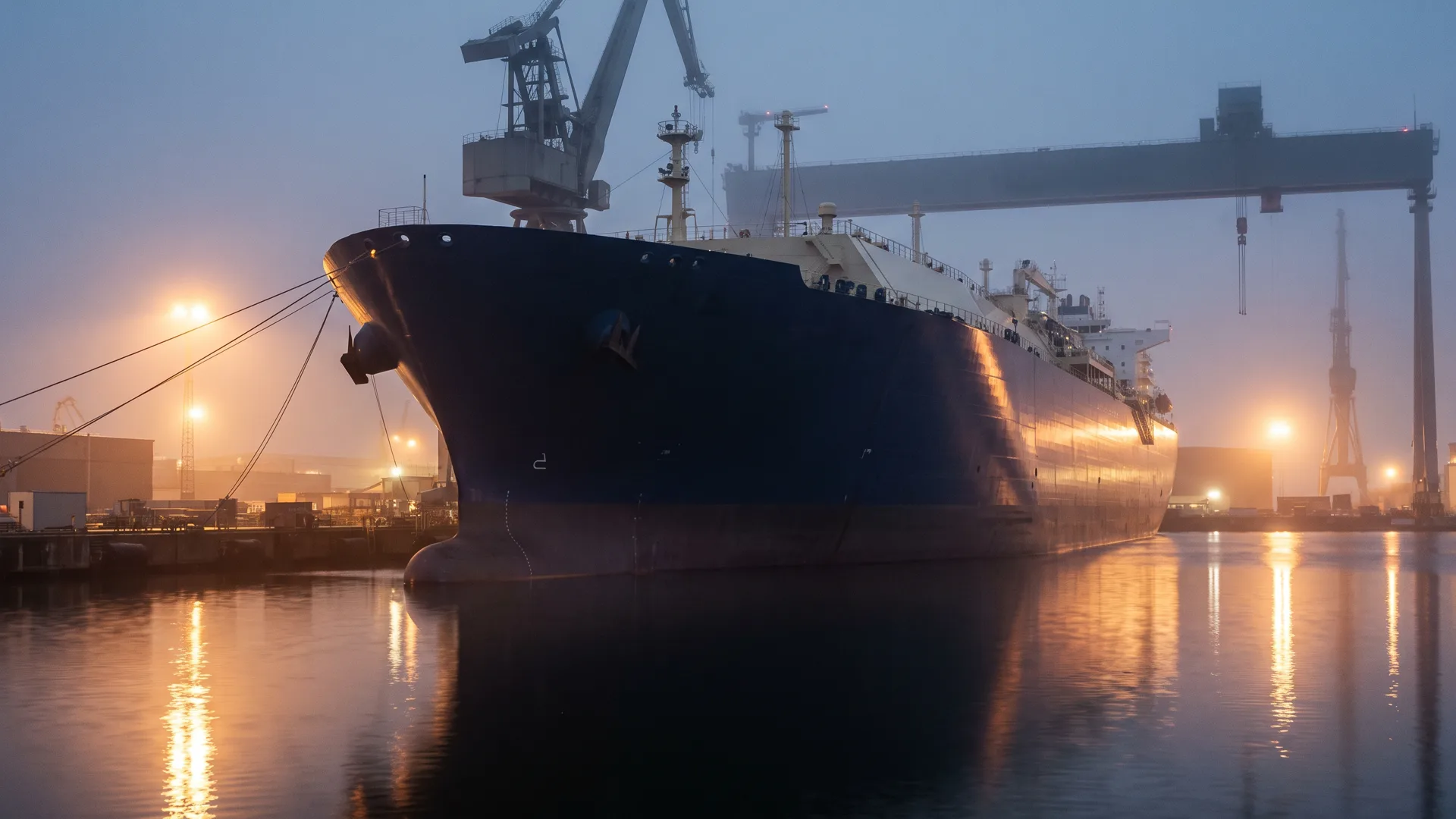
An LNG carrier at a shipyard quay, as shown on Tesser Atomics' site; illustrative, not the demonstration vessel, which has no published design.
Image: Tesser Atomics
Source · Press image from the Tesser Atomics website, used for news reporting.
Samsung Heavy Industries and US reactor developer Tesser Atomics signed an exclusive memorandum of understanding (MoU) in Norway on Nov. 19 to build a demonstration nuclear-powered LNG carrier around Tesser's Triton reactor.
Under the MoU, the Korean shipbuilder becomes Tesser's exclusive shipyard partner and Tesser becomes Samsung Heavy's exclusive reactor partner, World Nuclear News reported. The vessel is meant to trade commercially between the United States and Europe, according to the same report and to gCaptain.
Neither company has said how powerful the reactor is, what the ship would cost, who would pay, or when it would sail. An MoU is a statement of intent, not a shipbuilding order, and gCaptain notes that no construction schedule, vessel specification, project cost or financing has been disclosed.
What the MoU sets up
Tesser describes Triton as a compact fluoride-salt-cooled high-temperature reactor (FHR) designed for ships. It pairs TRISO (tri-structural isotropic) fuel with a low-pressure molten-salt coolant and refuels online, and the company says the module is small enough to fit a ship and powerful enough to propel it. No megawatt figure, thermal or electric, appears in the reports we read.
Samsung Heavy would design and build the ship; Tesser would supply the reactor and lead its regulatory licensing, Marine Insight reported. The work grew out of NuProShip, a Norwegian research programme that assessed reactors for merchant ships, and continues in SFI SAINT, a consortium led by the Norwegian University of Science and Technology and supported by the Research Council of Norway.
Under the exclusive MoU Tesser supplies the Triton reactor and Samsung Heavy builds the ship; no reactor output has been published.
Graphic: Voltgrid News
Texas-based Tesser was co-founded by Per Peterson, who also co-founded Kairos Power. World Nuclear News says Tesser is pursuing markets for the KP-FHR technology while Kairos stays on grid-scale power. Kairos' own agreement with Google, signed in October 2024, targets 500 MW by 2035, per Kairos. The salt-cooled design family is therefore being pushed down two different routes, a Google supply deal on land and a ship at sea. None of the sources ties this project to data-center demand.
How it compares
This is not Samsung Heavy's first nuclear-ship concept. In September 2025 it won Approval in Principle from the American Bureau of Shipping and the Liberian Registry for a 174,000-cubic-metre LNG carrier with a 100 MWt molten-salt reactor designed with the Korea Atomic Energy Research Institute. That figure is thermal output for a separate design, and it should not be set against Triton, which has no published rating. The yard has been busy on shipboard power more broadly: as Voltgrid reported, it signed an MoU with Morimura on solid oxide fuel cells on Nov. 9, targeting 2028.
TRISO is the same fuel type behind X-energy's Xe-100 plans, whose Oak Ridge supply plant we covered in our TRISO-X TX-1 report.
What is not confirmed yet
The MoU's terms, Triton's output, the ship's size and the delivery date are all undisclosed. The Tesser and Samsung Heavy press release could not be read directly; this story relies on its content as carried by World Nuclear News, gCaptain and Marine Insight.
Regulation is the long pole. gCaptain reports that the International Maritime Organization is revising its nuclear code, with adoption of the code and SOLAS Chapter VIII amendments targeted for 2030. It also cites an ABS-supported study putting a nuclear LNG carrier at roughly 2.5 times the build cost of a conventional one. The Norwegian initiative behind the project is aiming for several nuclear-vessel demonstrations in the early 2030s, gCaptain says, but that is the programme's target, not a date for this ship.
Sources
- Published
- Sources
- 2 cited