Scottish Greens Estimate £317 Bill Hit From 9.7 GW Data Center Queue
The Greens' own model puts about 30 hyperscale projects, 9.7 GW by NESO's count, at £317 a year on a typical Scottish bill; NESO has since cited 8.9 GW across 28 projects.
2 min read
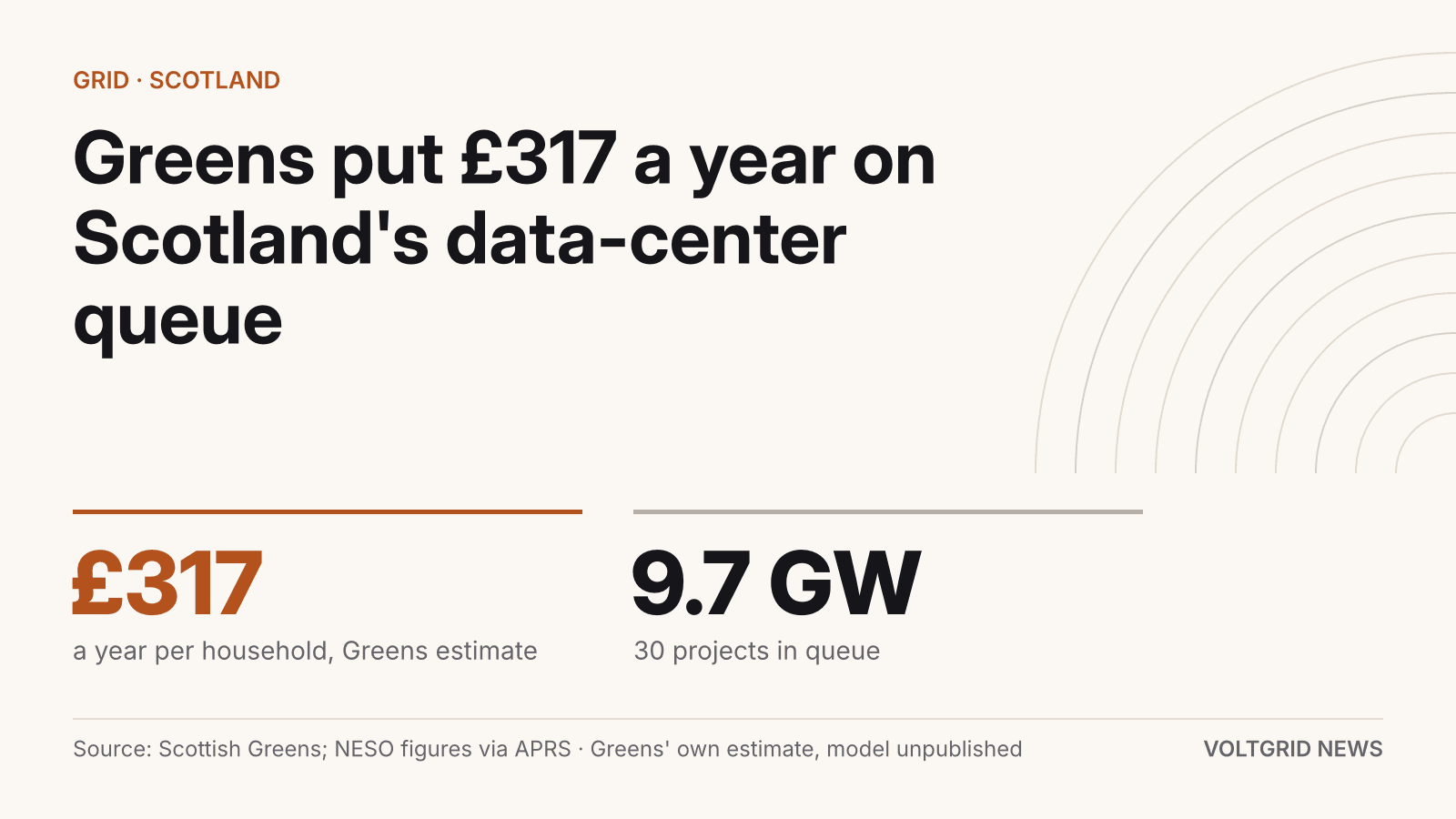
The £317 is the Scottish Greens' own estimate; the 9.7 GW is the queue figure the party attributes to NESO.
Graphic: Voltgrid News
The Scottish Greens said on Nov. 22 that about 30 proposed Scottish hyperscale data centers, almost 9.7 GW by National Energy System Operator (NESO) figures, would have cost a typical Scottish household £317 a year.
The party's release says that if every center had been running since October 2024, wholesale electricity prices across mainland Britain would have been about a third higher. Greens MSP Patrick Harvie put it as "at least £300 more each year" if all 30 proposals go ahead, according to the release and The Herald. The release cites NESO only for the 9.7 GW. It does not set out the model, the price data or the load profile behind the price effect, so the £317 is the party's own estimate, not a figure from NESO, Ofgem or the Scottish Government.
The scenario also cannot have happened as described. A place in the connection queue is not a built site: Data Centre Review reported that some projects have connection dates stretching into the late 2030s, and that NESO's Matt Magill told MSPs that connections reform could remove speculative applications from the queue.
Where the 9.7 GW Figure Comes From
A NESO official gave MSPs the figure at the Economy, Energy and Tourism Committee on Sept. 15, according to the campaign group Action to Protect Rural Scotland (APRS): 9.7 GW of data-center demand across 30 projects. APRS says NESO later told The National that the figure was 8.9 GW for 28 projects. The Greens' release still uses 9.7 GW.
NESO's reported queue figure for Scotland fell from 9.7 GW to 8.9 GW as the project count went from 30 to 28, according to APRS.
Graphic: Voltgrid News
The base is thin. APRS says NESO answered a December 2025 freedom-of-information request by saying it has no register of demand connections, unlike the public register it keeps for generation and storage. Ofgem, the regulator, is exploring a demand capacity register, APRS says NESO told it in August.
How Big 9.7 GW Is
APRS argues that 8.9 GW would be more than twice Scotland's peak winter demand. It also cites Ofgem's consultation figure of 73 GW of contracted data-center demand across Great Britain, against a 2025 GB peak of 45.8 GW on Jan. 9, 2025. On those figures the Scottish queue alone is about a fifth of that GB peak, though a queue total and a measured peak are different kinds of number.
Other large-load queues run at similar scale. ERCOT is checking nearly 10 GW of 25 MW to 75 MW projects, as Voltgrid reported, and the UK government's covenant offering priority to data centers that pass its tests is covered in our review of national power rules. On the supply side, we covered the Eastern Green Link 3 licence separately.
What Is Not Confirmed Yet
The Herald said the Scottish Government had been approached for comment; it had previously said major energy and infrastructure decisions must balance economic benefit, environmental impact and system needs. The Greens have not published the model, and no NESO or Ofgem view on the £317 has been published.
Ofgem's July 29 consultation proposes charging developers to stay in the demand queue, according to APRS. Holyrood's inquiry into hyperscale data centers took evidence until Nov. 15. Which of the 28 or 30 projects survive that queue clean-up will decide how much of the 9.7 GW ever becomes load.
Sources
- 01Scottish Parliament opens inquiry into hyperscale data centresData Centre Reviewdatacentrereview.comas read on Nov 22, 2026
- 02NESO has no register of data centre demand in the grid queueAction to Protect Rural Scotlandaprs.scotas read on Nov 22, 2026
- 03Energy bills could rise by £300 a yearScottish Greensgreens.scot
- 04Hyperscale data centres could add £317 to energy billsThe Heraldheraldscotland.com
- Published
- Sources
- 4 cited