Wyoming Intertie: DOE Offers $2.8B Loan for 1,800 MW East-West Link
DOE's conditional $2.8 billion commitment to Grid United would fund a 106-mile Wyoming link adding up to 1,800 MW between the Eastern and Western grids, but no capacity buyers are named.
3 min read
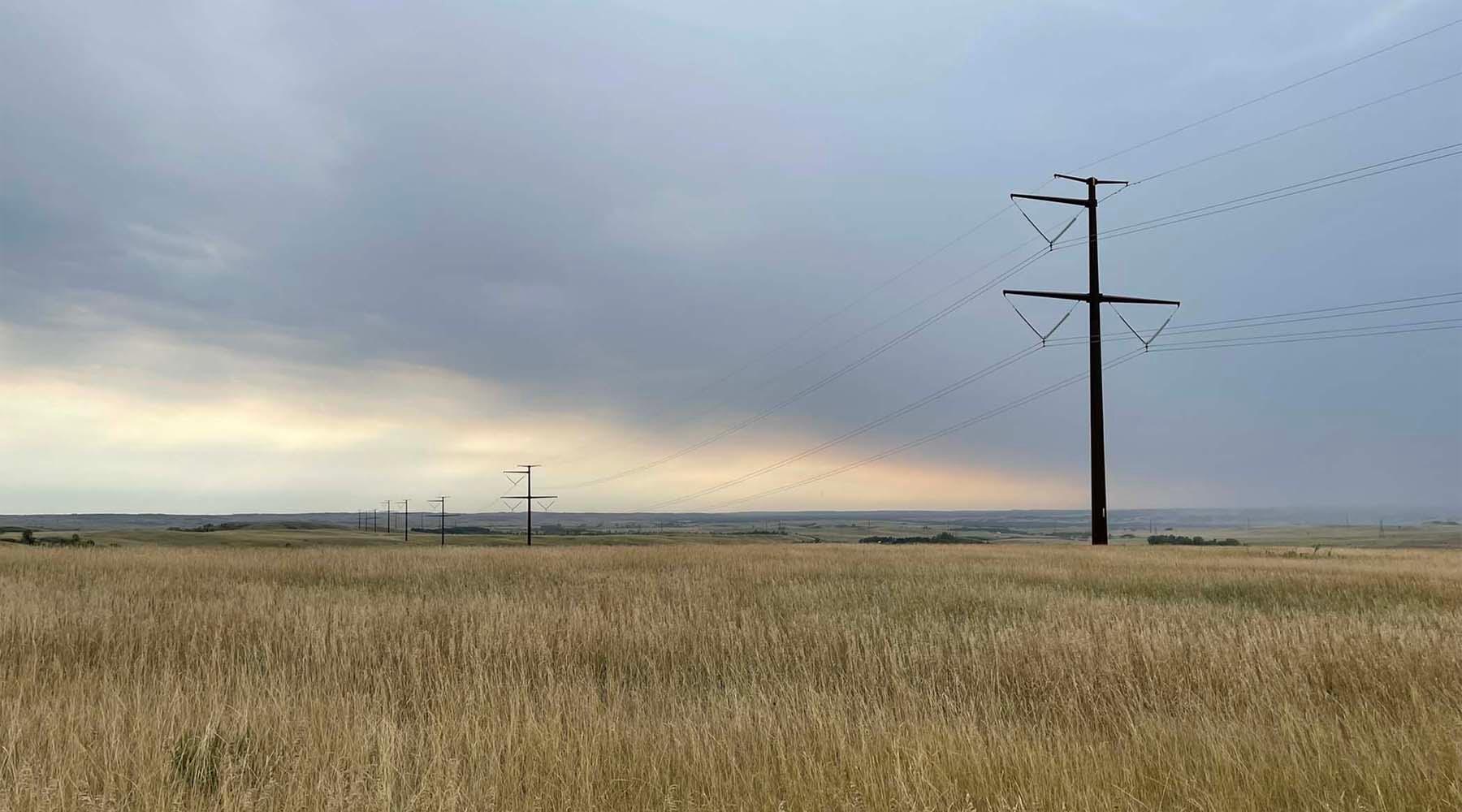
A Grid United transmission line on open prairie, from the developer's projects page. The photo is not identified as the Wyoming Intertie route.
Image: Grid United
Source · Press image from the Grid United website, used for news reporting.
The US Department of Energy has offered Grid United a conditional loan commitment of up to $2.8 billion for Wyoming Intertie, a 106-mile transmission project that would add up to 1,800 MW of transfer capacity between the Eastern and Western Interconnections, DOE said on Nov. 17, 2026.
DOE's Office of Energy Dominance Financing, the former Loan Programs Office, issued the commitment, according to DOE's release. DOE says the line would add about 1.8 GW of transfer capacity between the Southwest Power Pool (SPP) and the Western Electricity Coordinating Council (WECC), and that it could save electricity consumers up to $39 billion across 17 states in the two regions. POWER Magazine noted that DOE did not detail how it reached the $39 billion figure.
The commitment is an intent to lend, not a loan. DOE said Grid United must meet technical, legal, environmental and financial conditions before the department signs definitive documents or disburses any money. According to POWER Magazine, the loan would cover 80% of construction costs over a 30-year term that includes construction, and the $2.8 billion excludes interest during construction. Disbursements would begin only after notice to proceed.
What it changes for East-West transfer capacity
Existing transfer capacity between the two grids totals 1,320 MW, according to Grid United's filing to the Federal Energy Regulatory Commission (FERC), as relayed by POWER Magazine. That capacity is spread across facilities in Montana, South Dakota, Nebraska, Colorado and New Mexico, each rated 130 MW to 210 MW, and five of them date from 1977 to 1988 and use older line-commutated converter technology.
Voltgrid's arithmetic: if all 1,800 MW were added and nothing were retired, total East-West transfer capability would reach 3,120 MW, about 2.4 times today's 1,320 MW. POWER Magazine describes the project as one that "could more than double" existing capacity. Grid United's three planned voltage-source-converter links, including the 3,000 MW North Plains Connector and the 1,800 MW Three Corners Connector, would total 6,600 MW of ratings, five times the existing capability, according to POWER Magazine.
DOE and Grid United put the new link at up to 1,800 MW, against 1,320 MW of existing East-West capacity as reported by POWER Magazine.
Graphic: Voltgrid News
The project is bidirectional. Grid United says the extra capacity would let operators draw on surplus generation across the interconnection during extreme weather, and would give Wyoming generators access to more markets.
Route, equipment and timeline
Wyoming Intertie would link the existing Aeolus substation near Medicine Bow in the Western Interconnection to a proposed high-voltage direct current (HVDC) back-to-back converter station near the Laramie River Station outside Wheatland, according to POWER Magazine. The route crosses Carbon, Albany and Platte counties. Parts of it cross federal land and need National Environmental Policy Act reviews, and the project needs a Wyoming Industrial Siting Certificate.
Grid United's October 2026 schedule, cited by POWER Magazine, puts the completion of federal environmental reviews and a permitting notice to proceed in 2029, construction as early as 2030 and commercial operation in 2032 or 2033, contingent on HVDC equipment procurement. Grid United estimates the federal rate would save ratepayers more than $500 million compared with private financing.
Context
DOE has used the same office for other large commitments this autumn. Voltgrid reported on its conditional commitment of up to $5 billion to Constellation and on Alliant Energy's $5.1 billion DOE loan for gas and storage. Unlike those regulated-utility borrowers, Grid United is an independent developer, and POWER Magazine reports the loan could be assigned to utilities that buy capacity on the line.
What is not confirmed yet
Grid United has not publicly named capacity customers, according to POWER Magazine. Its financing fact sheet lists commercial capacity contracts, full right-of-way, federal, state and local permits and compliance with federal program requirements as conditions of financial close. The $39 billion savings figure and the 1.8 GW capacity are DOE's and Grid United's own estimates. No definitive loan agreement has been signed, and no date for one has been given.
Sources
- Published
- Sources
- 2 cited