NERC Winter Reliability Assessment: 3 Areas Elevated, Demand Up 21 GW
NERC rates Québec, the Maritimes and SERC-East elevated for winter 2026-27 as peak demand rises 21 GW and 26.2 GW of capacity arrives, while gas pipelines and imports limit New England, MISO and SPP.
3 min read
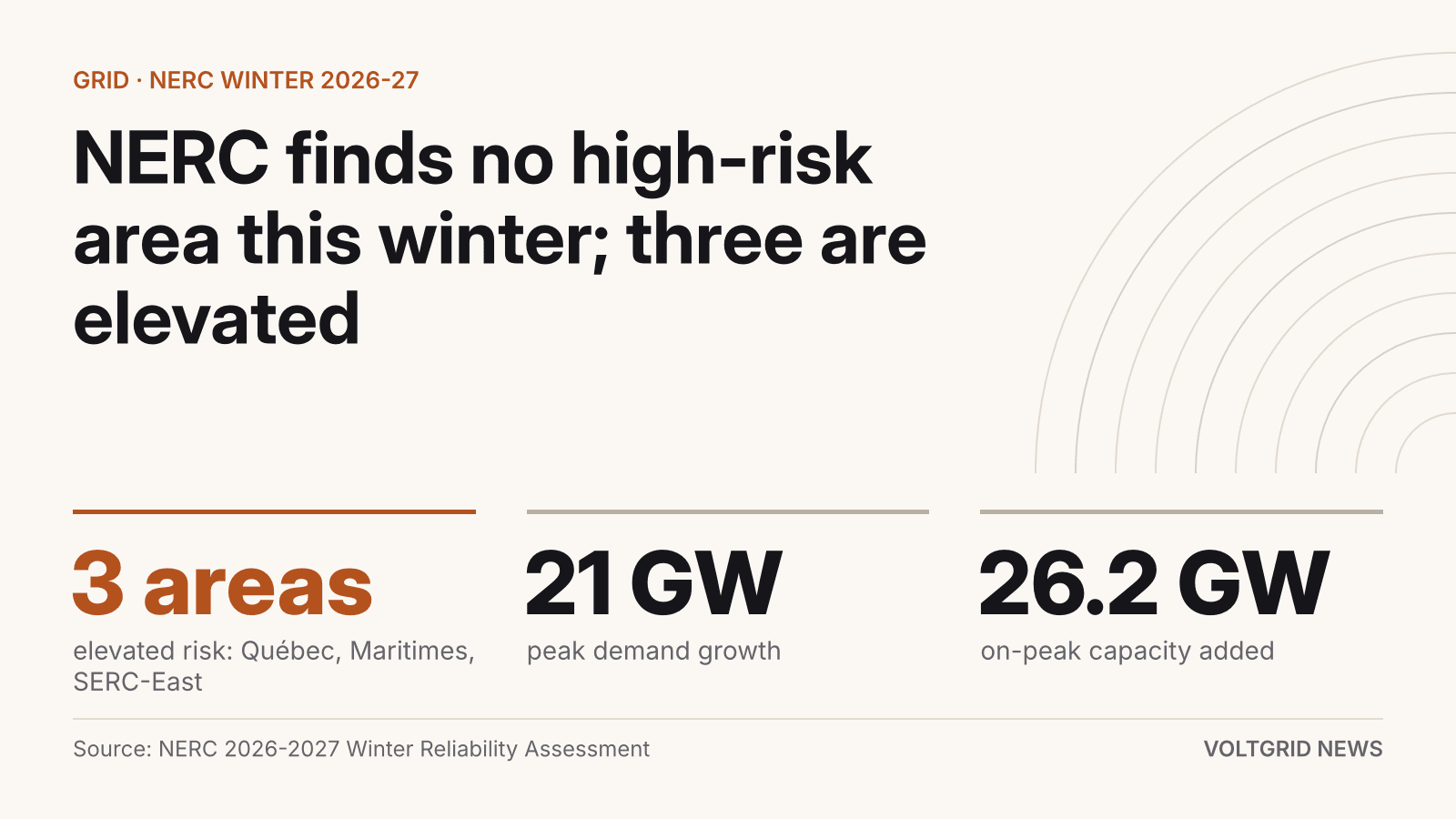
NERC's 2026-2027 Winter Reliability Assessment rates Québec, the Maritimes and SERC-East at elevated risk.
Graphic: Voltgrid News
NERC's 2026-2027 Winter Reliability Assessment, released Nov. 18, rates Québec, the Maritimes and SERC-East at elevated risk and finds no area at high risk.
Aggregated peak demand across NERC's assessment areas is up 21 GW (2.6%) since last winter, NERC said, while winter on-peak capacity grew 26.2 GW (2.4%). Batteries added 9.2 GW of on-peak capacity and natural gas 8.7 GW, and 21 of the 23 areas forecast higher peaks. NERC ties the load growth to data centers, large industrial users and electrification, and noted that U.S. thermal retirements of 50 MW or more stood under 700 MW for 2026 as of September.
Data centers also sit on the emergency side of the ledger. Demand response, the contracted load curtailment operators can call on, rose 1.9 GW (4.5%) to 43.6 GW as more data centers and large loads joined programs, and some of it can be used only after an Energy Emergency Alert. Balancing authorities with data centers may also ask the U.S. Department of Energy for Federal Power Act 202(c) authority to direct large loads onto backup generators as a last resort. Voltgrid covered NERC's data center ride-through project in October, after 3,800 MW of load dropped in Northern Virginia.
Where the Elevated Risk Sits
Québec enters winter with a smaller net reserve margin because known outages cut certain generation by 1,500 MW, only partly offset by a roughly 500 MW drop in net firm exports. Its anticipated reserve margin is 12.6% against a 12.2% reference level, and the system peaks around 8 a.m. The Maritimes sit at 16.7% against a 20.0% reference level, and NERC expects operators there to line up extra transfers with neighbors.
SERC-East, historically a summer-peaking area, now carries 46,369 MW of net internal demand, up 3.5%, and its anticipated reserve margin fell to 15.5% from 17.9%, barely above the 15.0% reference. NERC's probabilistic runs concentrate the limited loss-of-load risk in early-morning hours in January, when cold weather lifts heating load, cuts generation and restricts imports.
The Maritimes' anticipated reserve margin of 16.7% is below its 20.0% reference level; Québec and SERC-East sit above theirs.
Graphic: Voltgrid News
Pipeline and Import Limits in New England, MISO and SPP
NERC did not expect supply shortfalls in New England, MISO or the Southwest Power Pool (SPP), but flagged constraints that could strand load pockets. In New England, 9.3 GW of the area's 17.8 GW of gas-fired capacity holds alternate stored fuel, and NERC warned that stored fuel can drain fast in a long cold event like 2012-2013. In the southern parts of MISO and SPP, import-dependent pockets could fall short if a wide-area event limits local generation. NERC expects SPP's winter peak to grow about 3.5%.
A new analysis of gas-only generators puts numbers on the fuel risk. Their worst hourly loss to lack of fuel over five years was 8,000 MW of SPP's 23,936 MW, or 33%, and 5,453 MW of MISO's 49,797 MW, or 11%. U.S. gas storage stood at 3,724 Bcf on Oct. 23, below last year's 3,871 Bcf at the start of winter and above the five-year average of 3,686 Bcf. Utility Dive reported that NERC's Mark Olson called El Niño a source of uncertainty, since extreme storms can sit inside a mild average.
NERC rates PJM at normal risk this winter. Voltgrid's earlier PJM winter outlook covered the operator's own capacity and peak figures, which are not NERC's.
What is not confirmed yet
On a call reported by Utility Dive, NERC's Bob Tallman described New England as elevated because of its limited gas pipeline capacity. The assessment's risk map shades New England normal risk with a limited-pipeline-capacity overlay, so the report's rating is used here. The New England and New York fuel-loss figures were submitted by the areas themselves and may include dual-fuel units. Actual outcomes depend on the weather between December and February.
Sources
- Published
- Sources
- 2 cited