PJM Board Approves $5.1B Valley Link, Exelon Work Up $783M
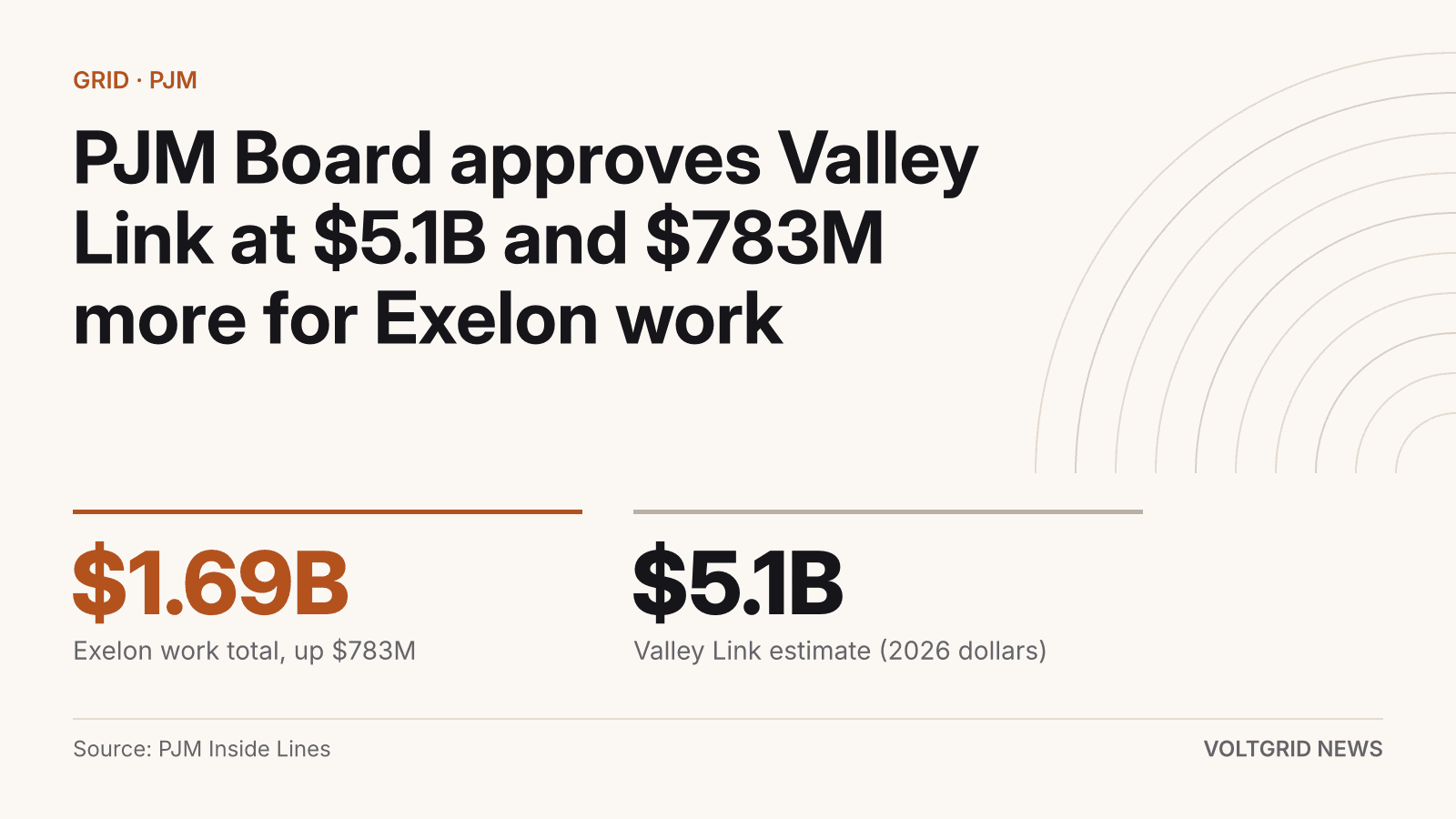
PJM's Board approved $783M more for Exelon work, now $1.69B, much of it needed before Brandon Shores and Wagner in Maryland can retire; Valley Link's $5.1B estimate was also approved.
3 min read
Follows Valley Link 765 kV Cost Rises to $5.1B, In-Service Slips to 2031
PJM's Board of Managers approved scope and cost changes on Nov. 18, according to PJM Inside Lines.
Graphic: Voltgrid News
PJM Interconnection said on Nov. 18, 2026 that its Board of Managers approved scope and cost changes to baseline transmission projects, including a $783 million rise in costs on Exelon work, to an updated total of $1.69 billion, and a Valley Link estimate that moved from about $3.0 billion in 2024 dollars to $5.1 billion in 2026 dollars.
The Exelon increases cover work awarded to Exelon and its subsidiaries in three competitive windows. Across those projects, costs rose by $783 million to an updated total of $1.69 billion, PJM said.
As Voltgrid News reported on Nov. 4, Valley Link VA Inc., a consortium of Transource, Dominion Energy and FirstEnergy, holds two 765 kV transmission lines and their substations, awarded in PJM's 2024 Window 1. PJM said major components' in-service dates have moved from June 1, 2029, to a range of January 2030 through May 2031, depending on the facility. The grid operator described the lines as a new extra-high-voltage backbone for moving power west to east across its footprint.
Why PJM's Board Approved the Cost Increases
PJM named construction labor and outside services, right-of-way and land costs, and material and equipment prices as the main Valley Link cost drivers. It said land costs "continue to increase at unprecedented multiples." For the Exelon work it cited higher utility labor rates for engineering, construction and commissioning, driven by workforce shortages, wage inflation and project complexity.
PJM staff recommended proceeding because the reliability needs have not changed, the timeline is "increasingly acute," and in some cases original in-service dates slipped by nearly two years. Further delay, PJM said, would likely leave the solution unchanged while extending regulatory timelines and costs.
The Exelon projects matter because much of the work must be in place before the Brandon Shores and Wagner generating units in Maryland can retire. PJM said that if those needs are not met in time, it becomes more likely the units keep running under a Reliability Must-Run arrangement, which it described as a higher reliability risk that also carries added cost.
For Valley Link, the practical consequence is timing. The lines were meant to relieve overloads that PJM expects as load grows and power flows shift. Facilities now arrive between about 7 and 23 months after the original June 2029 date, going by PJM's stated range. PJM's release attributes the need to projected load growth and does not name data centers as the cause, so developers waiting on connections in the corridor should read the later dates as a delay in added west-to-east capacity.
The Numbers Behind the Change
The $3.0 billion and $5.1 billion figures use different dollar years, so the increase of roughly $2.1 billion combines inflation with scope and market effects. PJM first showed the Valley Link figures to its Transmission Expansion Advisory Committee (TEAC) on Nov. 3, on slides 13 and 14 of its presentation, as Voltgrid reported at the time. The Exelon changes were presented at the committee's Oct. 6 meeting.
PJM's Board-approved Valley Link estimate is $5.1B in 2026 dollars, against about $3.0B in 2024 dollars, with Exelon work up $783M to $1.69B, according to PJM.
Graphic: Voltgrid News
Independent researcher Tommy Turner, writing in Cardinal News on Nov. 6, read PJM's Nov. 3 materials and found all 14 Valley Link projects previously due June 1, 2029 now show later dates. He put the Joshua Falls to Yeat line and Yeat substation at $1.56 billion in 2026 dollars, up from $753 million in PJM's August figures, with a Jan. 17, 2031 date. Turner's piece is opinion, and the figures are his reading of PJM's tables.
Turner also noted that on the cost shares now in PJM's tariff, Dominion's customers carry about 45% of that line, and that the formula dividing the bill has not changed. PJM's release says nothing about cost allocation.
What is not confirmed yet
PJM's release does not give the board's vote date, a facility-by-facility cost table or the individual in-service dates; it points to a PDF of full details posted on PJM.com, which was not reviewed for this report. Whether the Valley Link figures will move again once routing is final is not stated. Cardinal News raises the question of whether PJM's operating agreement requires it to re-evaluate the need when a selected developer's delay follows a missed milestone. Turner writes that PJM's November materials do not say whether the rule applies.
Sources
- Published
- Sources
- 2 cited