Data Center Tariffs: AEP Ohio, Dominion Set Minimum Bills Up to 85%
AEP Ohio's data center tariff sets minimums up to 85% and 50% collateral; Dominion's GS-5, from 2027, sets 85% for wires, 60% for generation and $1.5 million per MW. Neither reaches PJM's auction price.
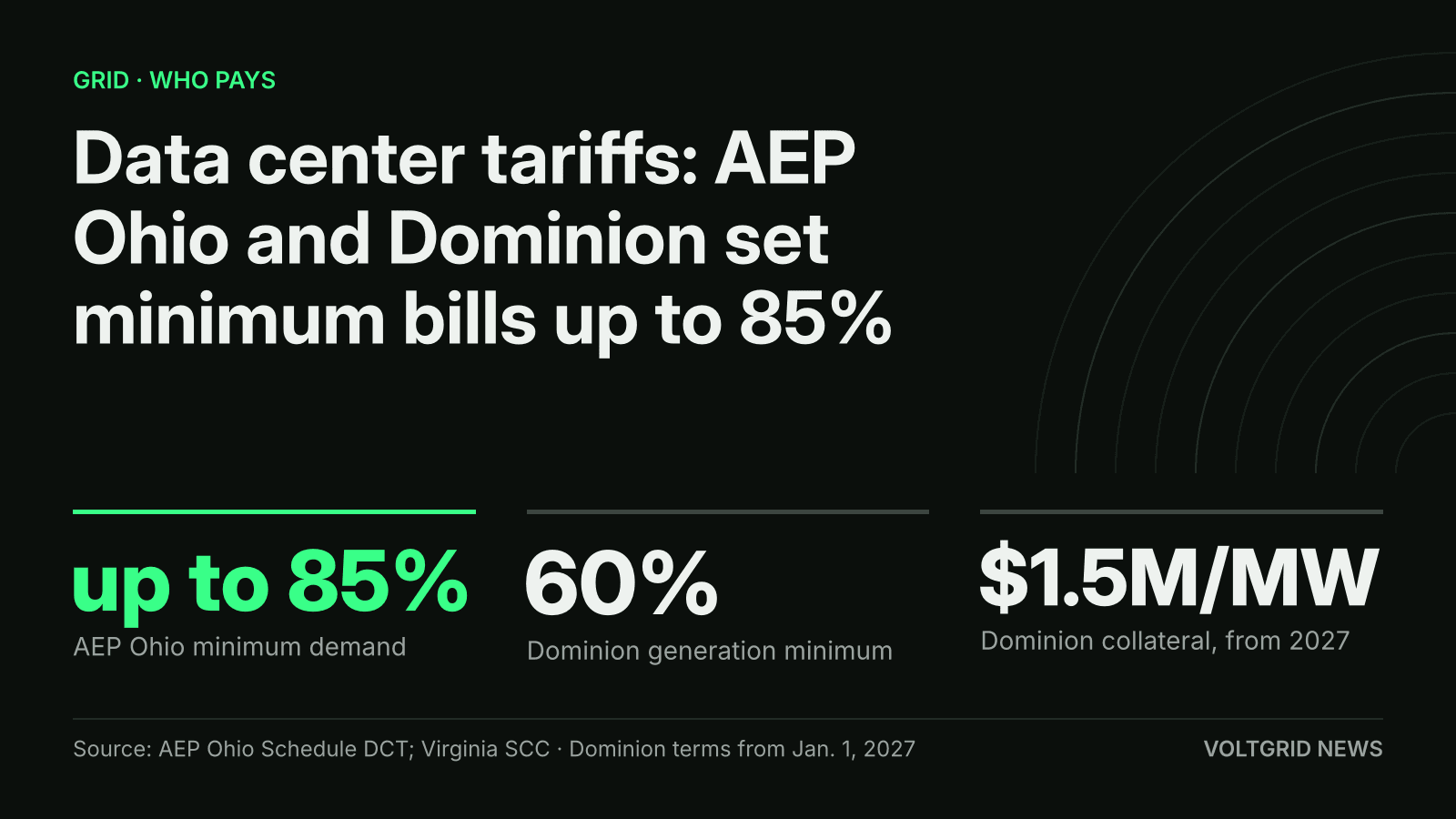
AEP Ohio's tariff sets minimum demand of up to 85% of contract capacity; Dominion's GS-5 terms apply to contracts signed from Jan. 1, 2027.
Voltgrid News
Illustration (AI-generated)
AEP Ohio and Dominion Energy are writing protection for other customers into their data center tariffs: minimum charges of up to 85% of reserved capacity, terms of 12 to 14 years, collateral and exit fees. Those terms recover each utility's own spending. They do not reach PJM's regional capacity price, which is where the region's market monitor counts the largest cost of data center load.
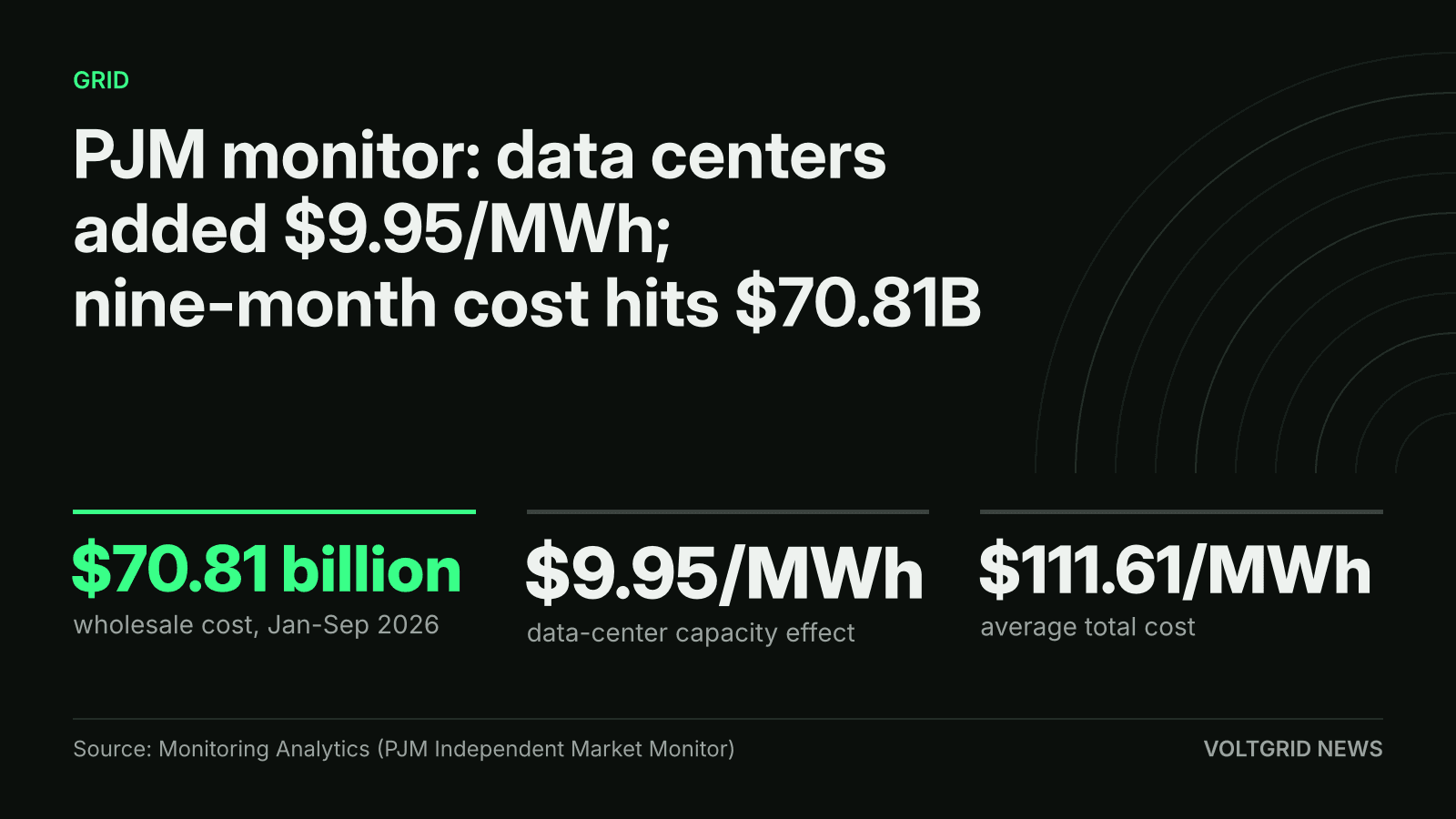
That cost is large. PJM Interconnection's Independent Market Monitor says data center load, both actual and forecast, has raised capacity-market costs for all customers by $29.4 billion across four auctions, and that it accounted for $9.95 of the $111.61 per MWh average wholesale cost in January through September 2026, 9.8% more than the $101.66 the monitor says it would have been without data center load. The figures come from Monitoring Analytics' third-quarter State of the Market report, posted Nov. 12. They are the monitor's counterfactuals, not PJM's, and PJM disputes who should carry the bill.
PJM: what the monitor measured, and what it did not
The monitor puts PJM's nine-month wholesale cost at $70.81 billion, up from $48.60 billion a year earlier, an increase of $22.21 billion ($70.81 billion minus $48.60 billion) or 45.7%. Per MWh, the total rose from $79.19 to $111.61. Capacity, the piece the monitor ties to data centers, rose 81.1% to $19.42/MWh, while transmission rose 4.6% to $19.16/MWh.
The monitor's $9.95 is a level, not a year-on-year change. It says that without data center load in the 2025/2026 and 2026/2027 capacity auctions, the nine-month cost would have been $101.66/MWh. The difference, $111.61 minus $101.66, is $9.95, which is 9.8% of the no-data-center figure (9.95 / 101.66). The monitor states that this excludes any effect on energy or transmission costs.
The larger figure is cumulative. The monitor counts an "irreversible" $29.4 billion (its table gives $29,368,774,465) of added capacity cost across the 2025/2026, 2026/2027, 2027/2028 and 2028/2029 auctions. It is a sum over four delivery years and should not be set against the nine-month $70.81 billion.
PJM's capacity auction, the Base Residual Auction (BRA), does not buy electricity. It pays power plants to promise they will be available three years from now, at a price per megawatt per day. Utilities pass that price on to every customer in the region, whether or not their own area added new load. When forecasts of data center demand go up, PJM has to buy more promised capacity, prices climb toward the cap, and households and factories pay the higher price. That is why the monitor can put a dollar figure on data center load even though no data center was billed directly.
Clearing prices were $269.92 per MW-day for 2025/2026 and $329.17 for 2026/2027, according to the monitor's tables. The 2027/2028 auction cleared at its $333.44 cap, and 2028/2029, held July 14, cleared at the $325 cap, down 2.5%, PJM said. Over the four auctions the price rose 20.4%, from $269.92 to $325 (325 / 269.92 = 1.204), after peaking at $333.44.
PJM's capacity price rose 20.4% over four auctions, from $269.92 to $325 per MW-day, after peaking at the $333.44 cap in 2027/2028.
Voltgrid News
Illustration (AI-generated)
Two other figures matter. The 2028/2029 result left PJM 6,831 MW short of its reliability requirement, after a shortfall of about 6,500 MW in the previous auction. PJM called the last two auctions the first in which the whole region fell short; the monitor counts a smaller 208.7 MW shortfall in the 2026/2027 auction as well. The monitor adds that the price-collar agreement cut 2028/2029 auction revenues by $13,314,277,218: on the demand curve PJM would otherwise have used, revenues would have been $29,722,226,243 instead of the actual $16,407,949,025. That cut is 44.8% of the higher figure. Across the 2026/2027, 2027/2028 and 2028/2029 auctions, the monitor puts the collar's total revenue cut at $26,397,465,049, or 35.0%.
PJM's spokesman Jeffrey Shields told the Pennsylvania Capital-Star, as relayed in our Nov. 12 story, that PJM disagrees with the monitor's view that PJM controls how data center costs are shared and says that is for state regulators. The monitor's forward warning is that the 2029/2030 auction, to be run in December, will use a forecast that still includes data centers it calls canceled or unlikely, and will add another $5 billion to $10 billion. That is a forecast, not a result. The monitor also warns of further costs if PJM runs its May capacity auction with a much higher maximum price.
Other markets: no matching count
MISO's annualized prices of $116.06 to $126.19 per MW-day were far below PJM's, though its summer price for zones 1-7, $424.30, was above PJM's $325 cap. MISO did not break out data center load, so its results put no number on data center cost. In its 2026-2027 Planning Resource Auction, released April 28, annualized prices were $126.19/MW-day for the North/Central subregion, $116.06 for zones 8 and 10 and $123.12 for zone 9, and offered capacity grew by as much as 4% in each season, MISO said. The delivery year differs from PJM's 2028/2029, so the two sets of prices are shown side by side, not as a ratio.
ERCOT has no capacity market, so there is no equivalent figure. Its work is on eligibility and curtailment. It is probing nearly 10 GW of projects sized below 75 MW, and its chief executive plans to ask Texas lawmakers to let it require data center cuts at emergency level 1 rather than level 2. Neither step puts a dollar figure on cost shifting. CAISO's board approved a large-load plan on Oct. 28 that includes a framework to prevent cost shifting, due at FERC by Nov. 16.
Large-load tariffs: what a utility can require
A tariff is the contract a utility files to bill a class of customers. The terms that protect other customers are a minimum bill (the customer pays for most of what it reserved even if it uses less), a long term, collateral and an exit fee.
AEP Ohio's Schedule DCT, which covers data centers of 25,000 kW or more, sets an initial term equal to the load ramp (no more than four years) plus eight years. Minimum demand is at most 85% of contract capacity. A customer without both an A- or A3 credit rating and audited cash above 10 times the requirement must provide a guarantee or collateral equal to 50% of total minimum charges over the term; surety bonds are not accepted. After the fifth contract year past the ramp, a customer can exit by paying 36 months of minimum charges.
Dominion Energy's GS-5 class takes effect Jan. 1, 2027, and its contract and collateral terms apply to customers that take initial service and sign a service agreement on or after that date, under the Virginia State Corporation Commission's Nov. 25, 2025 final order in Case PUR-2025-00058. The order defines the class as sites of 25 MW or more with a load factor of at least 75%, and sets collateral of $1.5 million per MW, reducible by up to 70% for strong credit. Dominion's May 2026 report describes a 14-year term including a four-year ramp, minimum demand charges of 85% for transmission and distribution and 60% for generation, and exit fees equal to the minimum charges over the unexpired term. Dominion says customers can cut contracted demand by 20% with 36 months' notice without exit fees, or by up to 50% if the capacity is reassigned.
AEP Ohio and Dominion set minimum charges of 60% to 85% of reserved capacity; Georgia Power's rule allows 15-year contracts but sets no percentage.
Voltgrid News
Illustration (AI-generated)
Georgia Power's rule, approved by the state commission on Jan. 23, 2025, applies to new customers above 100 MW. It allows, rather than requires, contracts of 15 years instead of 5, plus minimum bills, and requires such contracts to be filed with the commission. The commission's release gives no percentage. A federal proposal would go wider: the Senate voted 73-25 on Nov. 9 to take up a bill that would assign grid costs to loads of 20 MW or more, but that vote was procedural and the bill has not passed.
Pledges against tariffs
Microsoft's January commitment says it will ask utilities and public commissions to set its rates high enough to cover its electricity costs. Its executive Noelle Walsh repeated on Nov. 11, according to Bloomberg, that "we will pay our own way," as Voltgrid reported. OpenAI said on Jan. 21 that each Stargate community plan would include a commitment to pay its own way on energy, according to The Register.
A pledge is binding only to the extent a commission writes it into a tariff. The tariffs above recover a utility's own transmission, distribution and generation spending from the customer that triggered it. A regional auction price is different: in PJM it is set across 13 states and the District of Columbia, which is why the monitor and PJM disagree about whether states can allocate it. That is Voltgrid's reading, not a finding of either party.
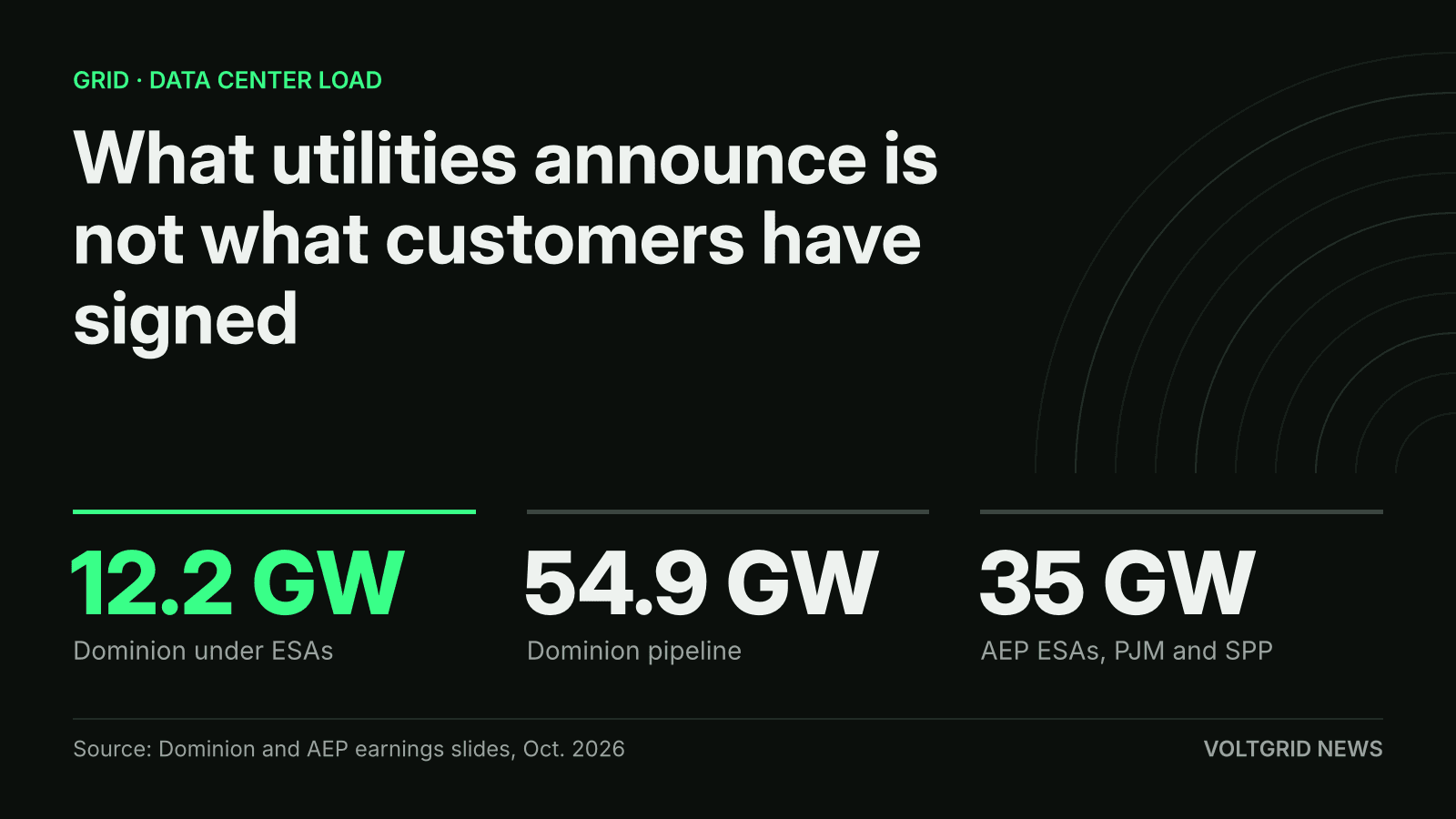
For engineers and investors, the practical signal is that maximum terms of 12, 14 and 15 years (AEP Ohio, Dominion, Georgia Power) and minimum charges of 60% to 85% of reserved capacity are now written into tariffs in Ohio and Virginia and allowed by Georgia's rule, and Dominion says such terms are meant to screen out speculative requests. The load side is being filtered too: FERC approved PJM's 50 MW registry, and Dominion now reports how much of its pipeline is under final contracts.
What to watch
Nov. 16: CAISO's large-load filing is due at FERC. Nov. 17: the Virginia SCC starts its evidentiary hearing on the Dominion-NextEra merger, where SCC staff testified that the companies had not shown the deal meets Virginia's Utility Transfers Act test and proposed 57 conditions, WHRO reported. Dec. 10: ERCOT's audit report is due. December: PJM's 2029/2030 auction, which the monitor wants postponed; no postponement has been announced. Jan. 1, 2027: Dominion's GS-5 class takes effect for new service agreements. Jan. 11, 2027: the SCC's deadline on the merger. March 1, 2027: the start of PJM's proposed backstop auction, which FERC has not yet approved. Exelon's complaint asking for a prompt auction has no ruling.
PJM's 2029/2030 auction comes in December; Dominion's GS-5 terms start Jan. 1, 2027; PJM's backstop auction is proposed for March 1, 2027.
Voltgrid News
Illustration (AI-generated)
Sources
- 012026 Quarterly State of the Market Report for PJM: January through SeptemberMonitoring Analytics (PJM Independent Market Monitor)monitoringanalytics.com
- 02AEP Ohio data center tariff (Schedule DCT)AEP Ohioaepohio.com
- 03PSC Approves Rule to Allow New Power Usage Terms for Data CentersGeorgia Public Service Commissionpsc.ga.gov
- 04PJM Capacity Auction Procures 138,318 MW of Generation ResourcesPJM Interconnectioninsidelines.pjm.com
- 05GS-5 Large-Load Rate Class ReportDominion Energysustainability.dominionenergy.com
- 06Final Order, Case PUR-2025-00058 (Dominion Energy Virginia biennial review; Rate Schedule GS-5)Virginia State Corporation Commissionnpr.brightspotcdn.com
- Editor
- Ege Erten
- Published
- Sources
- 6 cited
- Standards
- AI-assisted