Dominion Data Center Load: 12.2 GW Under Final Contracts of 54.9 GW
Dominion has 12.2 GW of data center load under final service agreements out of 54.9 GW; AEP counts 84 GW as contracted. Size rules differ: 25 and 75 MW in Texas, 50 MW in PJM, none in the Senate bill.
Nuclear & Microgrids DeskEdited by Ege Erten
8 min readAI-assisted
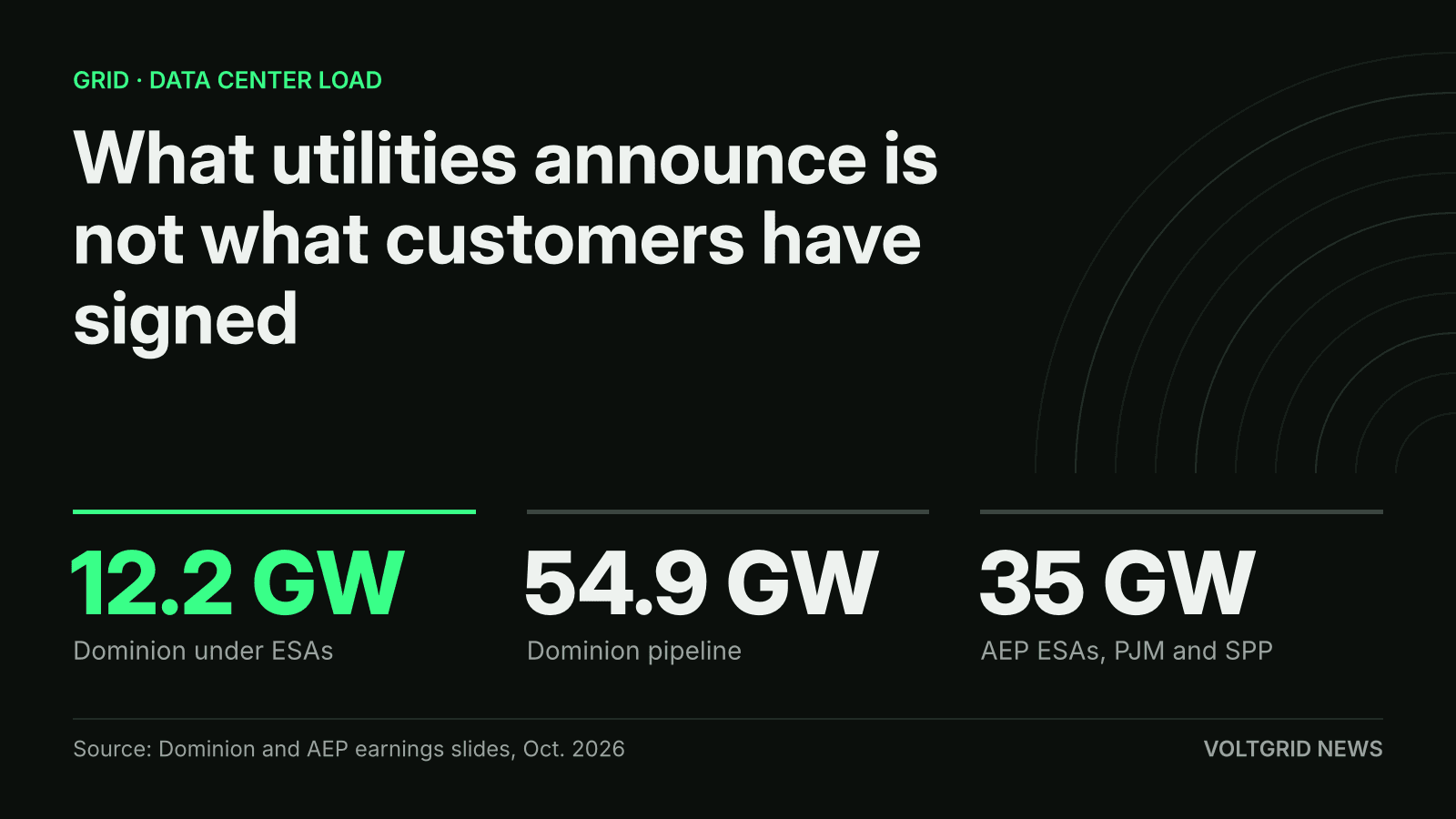
Dominion reports 12.2 GW of data center load under final service agreements out of about 54.9 GW; AEP has 35 GW under ESAs in PJM and SPP.
Voltgrid News
Illustration (AI-generated)
Dominion Energy's Oct. 30 earnings slides put 12.2 GW of Virginia data center capacity under final electric service agreements, out of about 54.9 GW that CFO Steven Ridge described on the call as in "various stages of contracting," as quoted by Utility Dive.
AEP, two days earlier on Oct. 28, said it counts 84 GW of incremental contracted load through 2031, up from 69 GW a quarter before. The two figures do not measure the same step. The gap between what a utility announces and what a customer has bound itself to pay for decides connection dates, how much capacity PJM, the 13-state grid operator, must buy and who carries the cost of the wires.
Pipeline Versus Signed: Dominion, AEP and Others
A utility's data center pipeline is a ladder of paperwork. On the first rung a developer signs a letter and pays for engineering studies, which at Dominion start at $250,000. On the second it authorizes construction and agrees to repay the utility's costs if it walks away. Only on the last rung, an electric service agreement (ESA), does it commit to minimum charges for years whether or not it uses the power (take-or-pay). Utilities add the rungs together in a gigawatt total.
Dominion's slide 5 shows the rungs for September 2026: 32.8 GW under engineering letters (about 60% of 54.9 GW), 9.8 GW under construction letters (about 18%) and 12.2 GW under ESAs (22.2%, from 12.2 divided by 54.9). The parts add to 54.8 GW on rounding. So about 22.0 GW, or 40%, has at least a construction letter. The slide puts the rise since December 2025 at about 6.3 GW, or 13%, from about 48.5 GW, on rounded figures; engineering letters rose 5.4 GW, ESAs 2.0 GW and construction letters fell 1.2 GW. Dominion's May 2026 report adds that the ESA is issued within one year of energization, near the end of construction.
The same May report counted 25 GW of projects with assigned energization dates through 2031 and a further 45 GW without dates, a 70 GW queue on a different yardstick. Dominion does not reconcile the two; our reading is that its report ties the construction letter to an assigned date, and the 22.0 GW at that stage or later sits close to the 25 GW with dates.
AEP's definition is wider. Its release says projects count as contracted only if backed by fully executed ESAs or letters of agreement. Slide 18 of its Oct. 28 presentation splits the 84 GW: 35 GW under firm take-or-pay ESAs in PJM and the Southwest Power Pool (SPP), 3 GW in those regions still under letters, and 46 GW in ERCOT, the Texas grid operator, all under letters. The shares are 42% (35 of 84), 4% (3 of 84) and 55% (46 of 84). AEP's 10-Q of the same day cites about 49 GW of AEP Texas letters, and AEP does not reconcile 49 with 46. AEP's 35 GW is the closest match to Dominion's ESA figure.
Dominion has 12.2 GW under final service agreements of 54.9 GW; AEP has 35 GW under ESAs in PJM and SPP of 84 GW. Totals include letters of agreement.
Voltgrid News
Illustration (AI-generated)
Others give smaller pairs. Exelon, per Utility Dive, put "high-probability" large load at 11 GW, 9 GW at its Illinois utility ComEd and 2 GW in the Mid-Atlantic, alongside a separate 23 GW "future pipeline" that fell from 25 GW. PJM's Nov. 3 slides say Exelon told it on July 30 to expect ComEd forecast cuts of 1.3 GW for 2031 and 3.3 GW for 2034, based on how firm customer commitments were. CMS Energy's Consumers unit has energized about 450 MW of 745 MW in signed large-load contracts, excluding the up-to-1 GW Microsoft site.
ERCOT Sub-75 MW Projects, PJM Forecast and Backstop
ERCOT's Sept. 14-15 board deck on Batch Zero, its one-time study of large-load requests, shows a pipeline not yet through the audit Gov. Greg Abbott ordered on Aug. 3. It classed 204 projects (66.4 GW) provisionally as "base" load and 158 projects as "studied" load: 127.9 GW in its summary bullet, but 125.4 GW in the chart data. That puts the two groups at 191.8 GW on the chart data or 194.3 GW on the bullet, across 362 projects, with a further 302.2 GW across 373 projects excluded. The deck does not explain the 2.5 GW gap. Base load includes energized sites: 22,261 of 66,359 MW on the chart, or 33.5%.
The San Antonio Express-News reported on Nov. 6 that ERCOT's Chad Seely told the Public Utility Commission of Texas that nearly 10 GW of medium-size loads, 25 MW to just under 75 MW, are working directly with utilities, clustered at 60 to 74.9 MW. ERCOT is checking whether developers shrank projects to avoid its large-load review, as Voltgrid reported. A questionnaire to about 465 projects drew 433 answers covering 177 GW of requested capacity, which Express-News called proposed, not confirmed.
PJM applies a firmness test in its forecast. Its Jan. 14 load report sees the summer peak at 191,017 MW in 2031 and about 222,000 MW in 2036, and requires "firm" commitments for near-term years while it derates longer-term projects. The 2028/2029 capacity auction on July 14 cleared at the $325/MW-day cap and ended 6,831 MW short of the reliability requirement, after a shortfall of about 6,500 MW in the previous auction.
FERC's Sept. 29 order, docket ER26-3380-000, accepted PJM's first proposal for a reliability backstop, a one-time procurement of new capacity, suspended it five months to Feb. 28, 2027, subject to refund, and found its price ceiling, a MW-weighted average of $555/MW-day over 15 delivery years, just and reasonable. That is 1.71 times the $325 auction cap (555 divided by 325). PJM's amended filing of Oct. 29 keeps the ceiling and the 15-year term and proposes a Mar. 1, 2027 launch, per PJM; FERC had not ruled on it as of Nov. 11. Jefferies analysts quoted by Utility Dive say the procurement could shrink to as little as roughly 630 MW, from an initial 6,800 MW target, as utilities cut near-term large-load forecasts by 6.5 GW.
FERC accepted PJM's $555/MW-day backstop ceiling and suspended the filing to Feb. 28, 2027; the Mar. 1 launch and May 10 results are PJM's proposal.
Voltgrid News
Illustration (AI-generated)
Load Thresholds: 25, 50 and 75 MW Rules
At 50 MW, FERC's Oct. 9 order in docket ER26-3515-000 accepted PJM's Large Load definition and registry from Oct. 12: a cumulative peak of 50 MW or more at one site, counting affiliated facilities within one mile together. FERC rejected PJM's proposed curtailment service and ordered a compliance filing within 30 days; none had appeared on PJM's filings pages by Nov. 11.
At 75 MW, ERCOT's large-load process applies. Per its September deck, since an Aug. 3 pause it is not approving energization of data centers or crypto sites at that size until its audit ends. CAISO, the California grid operator, approved a large-load plan on Oct. 28 with a FERC filing due Nov. 16; its initiative page states no megawatt threshold.
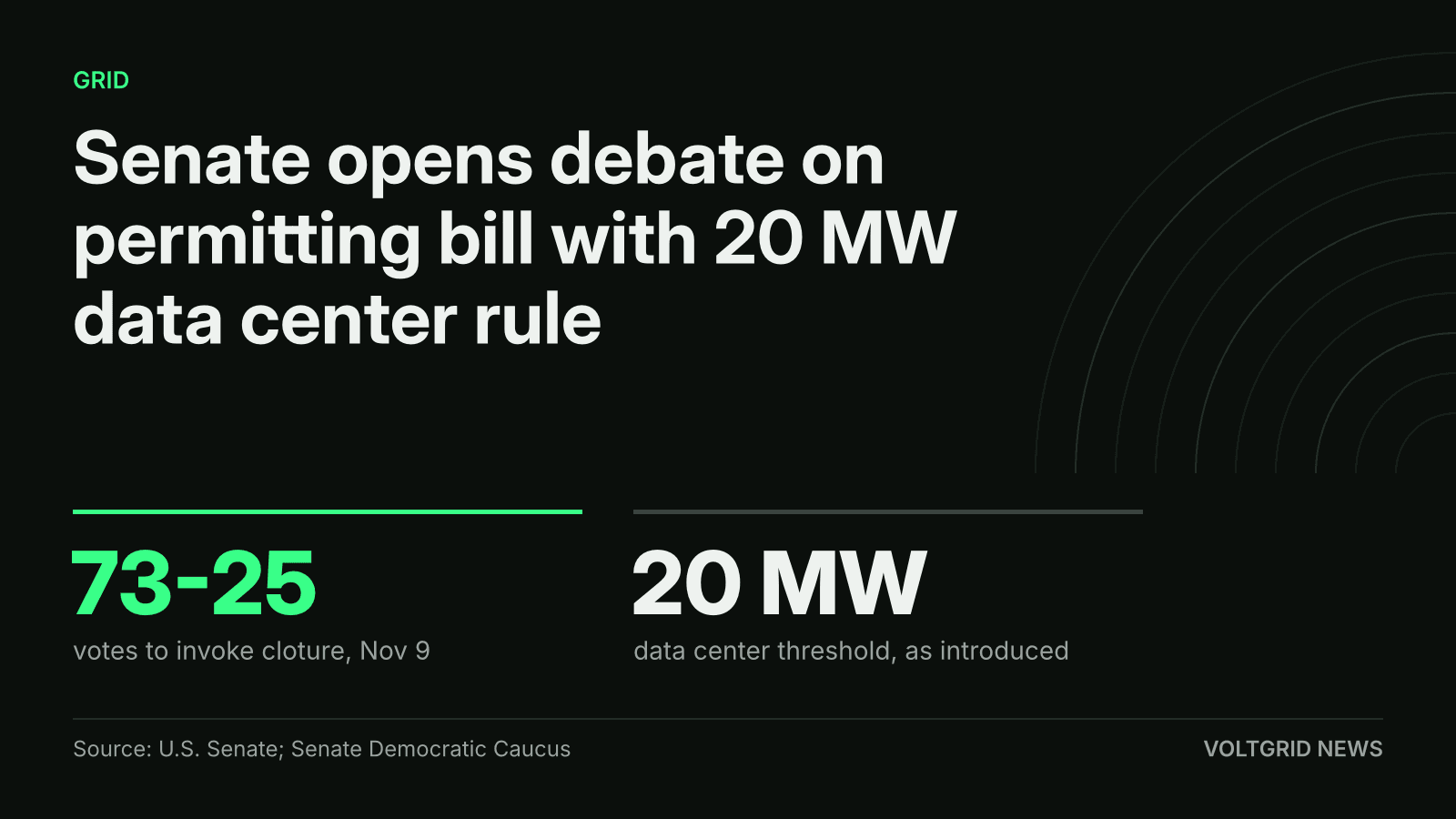
The Senate permitting bill now on the floor, a Nov. 7 substitute to H.R. 2347, sets none either. It would bar utilities from charging other customers the incremental cost of serving any newly connected data center, keep the site liable if it exits early and require financial assurances before the utility builds. It would give FERC 90 days after enactment to rewrite its 1994 transmission pricing policy and propose a rule. The 20 MW cutoff in the bill as introduced on Sept. 30 was dropped. The Senate voted 73-25 on Nov. 9 to end debate on taking up the bill and agreed to take it up 62-21 on Nov. 10. The substitute is pending; nothing has passed.
Our illustration, not a filing: a 60 MW campus is a medium load in Texas and a registry-listed large load in PJM, and under the Senate text, if enacted, it would carry its own incremental grid costs like a data center of any other size.
ERCOT's large-load process starts at 75 MW and PJM's registry at 50 MW; CAISO's plan and the pending Senate substitute state no megawatt threshold.
Voltgrid News
Illustration (AI-generated)
Who Pays for Transmission Wires
AEP's five-year capital plan rose to $100 billion from $78 billion, with about $37 billion for transmission, its Oct. 28 release and slides show; Utility Dive put the prior transmission figure at $33 billion. The $37 billion includes a roughly $5 billion Ohio build of three 765-kV lines, each about 3.2 GW, tied to the proposed 10.4 GW Piketon campus. AEP's 10-Q gives targeted in-service dates of Dec. 31 in 2028, 2029 and 2030, with PJM, Ohio regulators and FERC approvals still needed; Utility Dive says SoftBank affiliates will pay for it. AEP expects take-or-pay ESAs in its vertically integrated states to yield up to $21 billion of fixed-cost offsets for residential customers, up from $16 billion.
PJM's Nov. 3 slides put the Valley Link 765-kV transmission project at $5,115 million in 2026 dollars against $2,995 million in 2024 dollars, up 71% (5,115 divided by 2,995), with the original June 1, 2029 in-service date replaced by May 31, 2031 for most components. Virginia's State Corporation Commission, in an August order, told Dominion to develop a way to assign transmission costs directly to data centers, and the Virginia Mercury, via WTOP, said Valley Link's cost could go to GS-5, Dominion's new large-load rate class. Per Dominion's report, GS-5 starts Jan. 1, 2027 with a 14-year term including a four-year ramp, minimum charges of 85% of contracted demand for transmission and distribution and 60% for generation, and exit fees.
For engineers and investors the contract terms matter more than the headline. A take-or-pay ESA with minimum charges turns forecast load into revenue; an engineering letter is a claim on study time, and Dominion's largest slice sits there. PJM's backstop would charge utilities by large-load growth between the 2026 actual peak and the 2028/2029 forecast, so inflated forecasts can raise bills.
What to Watch
Nov. 16: CAISO's FERC filing on large loads. Dec. 9 to 15: PJM's 2029/2030 capacity auction, with results due Dec. 22, under a forecast peak of 171,916 MW and a reliability requirement of 158,712 MW. Dec. 10: ERCOT files its verification and community-impact reports, with Texas regulators to discuss them on Dec. 17.
Jan. 1, 2027: Dominion's GS-5 class takes effect. January 2027: PJM's next load forecast, per Utility Dive. By Jan. 11, 2027: Virginia's decision on the Dominion NextEra merger. Jan. 31, 2027: the date by which Exelon's Nov. 3 complaint, docket EL27-11-000, asks FERC for an order on a capacity auction held two months before delivery. Mar. 1, Mar. 28, Apr. 28 and May 10, 2027: PJM's proposed backstop launch, bid close, final target and results, which depend on FERC.
Not settled: whether the Senate substitute passes, and in what form; and whether Texas lets ERCOT order data center cuts at level 1 of a three-level emergency or earlier, not level 2, as its chief, Pablo Vegas, told the BloombergNEF Summit he will ask lawmakers to do (Voltgrid's report).
Sources
- 01PJM Capacity Auction Procures 138,318 MW of Generation ResourcesPJM · pjm.com
- 02PJM's Updated 20-Year Forecast Continues to See Significant Long-Term Load GrowthPJM Inside Lines · insidelines.pjm.com
- 03Large loads stakeholder initiative pageCalifornia ISO · stakeholdercenter.caiso.com
- 04AEP third-quarter 2026 earnings release (SEC Exhibit 99.1)American Electric Power · sec.gov
- 05FERC order, Docket ER26-3515-000 (PJM Large Load definition and registry)FERC · pjm.com
- 062029/2030 Planning Period Parameters for the Base Residual AuctionPJM · pjm.com