Tesla Powercore Solid-State Transformer: 7.4 MW, Due in 2027
Tesla's Powercore solid-state transformer folds transformer, inverter and breaker into one unit at 34.5 kV. No price, customer or factory is named, and Heron Power has a head start.
3 min read
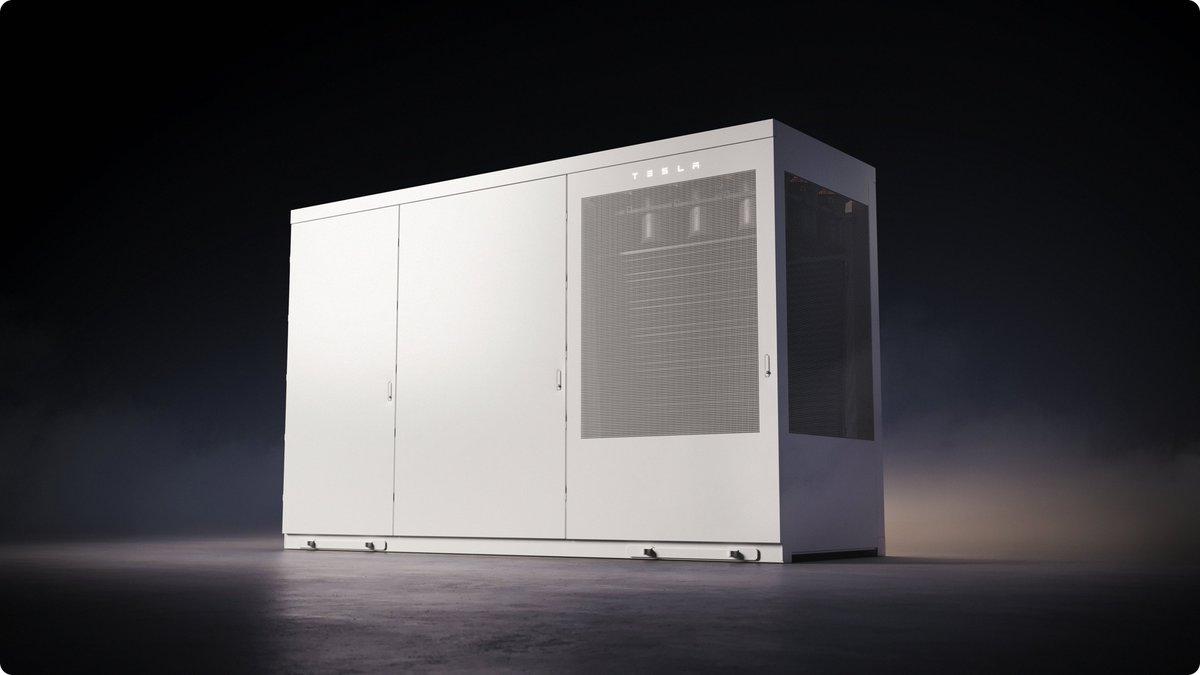
Tesla's Powercore solid-state transformer, in an image Tesla posted with the Nov. 17 launch.
Image: Tesla via X
Source · Press image from Tesla's official Tesla Megapack account on X, used for news reporting.
Tesla unveiled its Powercore solid-state transformer on Nov. 17, a unit that combines a medium-voltage transformer, inverter and breaker and is rated at 7.4 MW (9 MVA) continuous at 34.5 kV, with first units due to operate in 2027.
Tesla announced the product through its Tesla Megapack account on X, according to Electrek and PV Tech, then posted a fuller spec sheet. Powercore delivers a 10 MVA peak for grid-forming duty, takes AC from 10 kV to 34.5 kV and DC from 800 V to 2,000 V, and works from -40°C to 55°C. Tesla claims 98.86% peak efficiency, system availability guarantees of 99.9% or higher and a warranty of up to 25 years. These are vendor figures; no independent test has been published.
The grid angle is equipment supply. A conventional project steps battery or solar output up with a separate oil-filled transformer, and Electrek notes that lead times for those units now stretch into years as data centers and renewables crowd into interconnection queues. A solid-state unit folds the inverter and transformer into one box, so a developer orders one long-lead item instead of two. Tesla has not said how many units it can build, so the relief is unquantified. Voltgrid News reported earlier on GE Vernova's Shreveport transformer plant.
What Tesla says Powercore replaces
For storage, Tesla says its current Megapack layout converts battery DC to 480 V AC before a transformer lifts it to medium voltage, and that this two-step design has twice the losses (Electrek). Powercore converts straight to medium-voltage AC in one stage and will ship pre-assembled with Megapack, according to PV Tech. For solar, it acts as a central inverter for 1,500 V arrays and for 2,000 V systems still to come.
Tesla says Megapack's two-step path has twice the losses of the single stage Powercore uses; the figure is a vendor claim.
Graphic: Voltgrid News
For data centers, Tesla says Powercore converts medium-voltage grid power directly to 800 V DC, the rack architecture Nvidia is pushing, with built-in redundancy that it says gives up to 99.7% availability per unit. PV Tech reports that Tesla is working with Nvidia on 800 V DC engineering, and that Megapack has already qualified under Nvidia's DSX Ready programme. Powercore itself has not.
Against Heron Link
Electrek's comparison puts Powercore at about 50% more power per unit than Heron Power's roughly 5 MW Heron Link, and its 98.86% peak efficiency against Heron's 98.6% DC-to-medium-voltage figure. Electrek cautions that Tesla's number is labeled a peak and Heron's is not, so the two are not strictly comparable. Heron, founded by former Tesla executive Drew Baglino, plans a Morgan Hill, California plant for 10,000 units a year and has named Vantage, Intersect and RWE among its customers. PV Tech also lists Envision, which has deployed an 800 V DC solid-state system at a data center campus in Ulanqab, China. Voltgrid covered another solid-state entrant earlier this week, LG Energy Solution's AC LINK.
What is not confirmed yet
Tesla has not disclosed a price, a customer, a factory site or a production volume. It says only that Powercore will be built in the US from US and imported parts and operate in 2027, with no quarter given. Tesla's own Powercore page could not be read for this report, so the figures here come from its X posts as relayed by Electrek and PV Tech. The two outlets also differ on how much Megapack capacity already runs at data centers, so that figure is left out. Watch for a first named customer and a pilot date, the two things Electrek says Heron already has and Tesla lacks.
Sources
- Published
- Sources
- 2 cited