Large-Load Filings: MISO, NYISO, ISO-NE Propose $100-$250/MWh Curtailment
Large-load filings answering FERC's June 18 show-cause orders diverge on when data centers are curtailed, who brings capacity and study times, POWER Magazine reported; SPP's filing was due Nov. 20.
3 min read

The California ISO headquarters. CAISO is one of five operators whose large-load filings answer FERC's June 18 show-cause orders; the photo does not show the filings' subject.
Image: California ISO
Source · Press image from the California ISO website, used for news reporting.
MISO, NYISO and ISO New England each proposed a wholesale-price trigger of $100, $200 or $250 per MWh for cutting off data centers that take non-firm grid service, in large-load filings made Nov. 13 and 16 in answer to FERC's June 18 show-cause orders, POWER Magazine reported.
PJM and the California ISO (CAISO) proposed no uniform price trigger. All five operators appear willing to use a 50 MW threshold for a "large load", POWER said, but the filings differ on when such customers can connect, what capacity they must secure and what they owe. Southwest Power Pool (SPP), the sixth operator, had until Nov. 20; POWER expected its filing that day, and we have not seen it.
Where Large-Load Curtailment Starts
MISO would interrupt non-firm demand under its Grid Responsive Integration Transmission Service (GRITS) when the local price passes $100/MWh, and MISO said history shows the cap would allow service in more than 95% of hours. NYISO would cap non-firm bids at $200/MWh, derived from its transmission scarcity price of $4,000/MWh. ISO-NE would re-dispatch interim and non-firm load above $250/MWh, a level reached in about 1% of hours in 2021 to 2025 data, as Voltgrid reported on ISO-NE's filing. POWER cautions that the three figures are not directly comparable measures of how often a load would be served.
MISO, NYISO and ISO-NE propose triggers of $100, $200 and $250/MWh, which POWER says are not directly comparable measures of availability.
Graphic: Voltgrid News
Who Must Bring New Capacity
ISO-NE would require firm service customers to designate new capacity, with interim service for up to seven years or until upgrades are done, whichever is longer. NYISO would grant firm rights if a load worsens resource adequacy by 25 MW or less, and otherwise ask for a 15-year pairing with a capacity resource. CAISO argues no customer-specific procurement is needed because load-serving entities already carry resource adequacy duties. MISO's non-firm GRITS demand may skip capacity purchases, while firm service keeps them.
PJM's Fast Energization process would fold generation and large-load studies into one cycle of about 12 months, half today's two years, PJM said in its own filing notice, and it asked FERC for an order within 120 days. We covered that Fast Energization plan earlier. NYISO estimates 18 months to two years, longer than the 60 to 90 days FERC contemplated. MISO would run three study cycles per 365 days and charge a $250,000 application fee plus a $100,000 study deposit. ISO-NE targets 90 days for a system impact study on a reasonable-efforts basis.
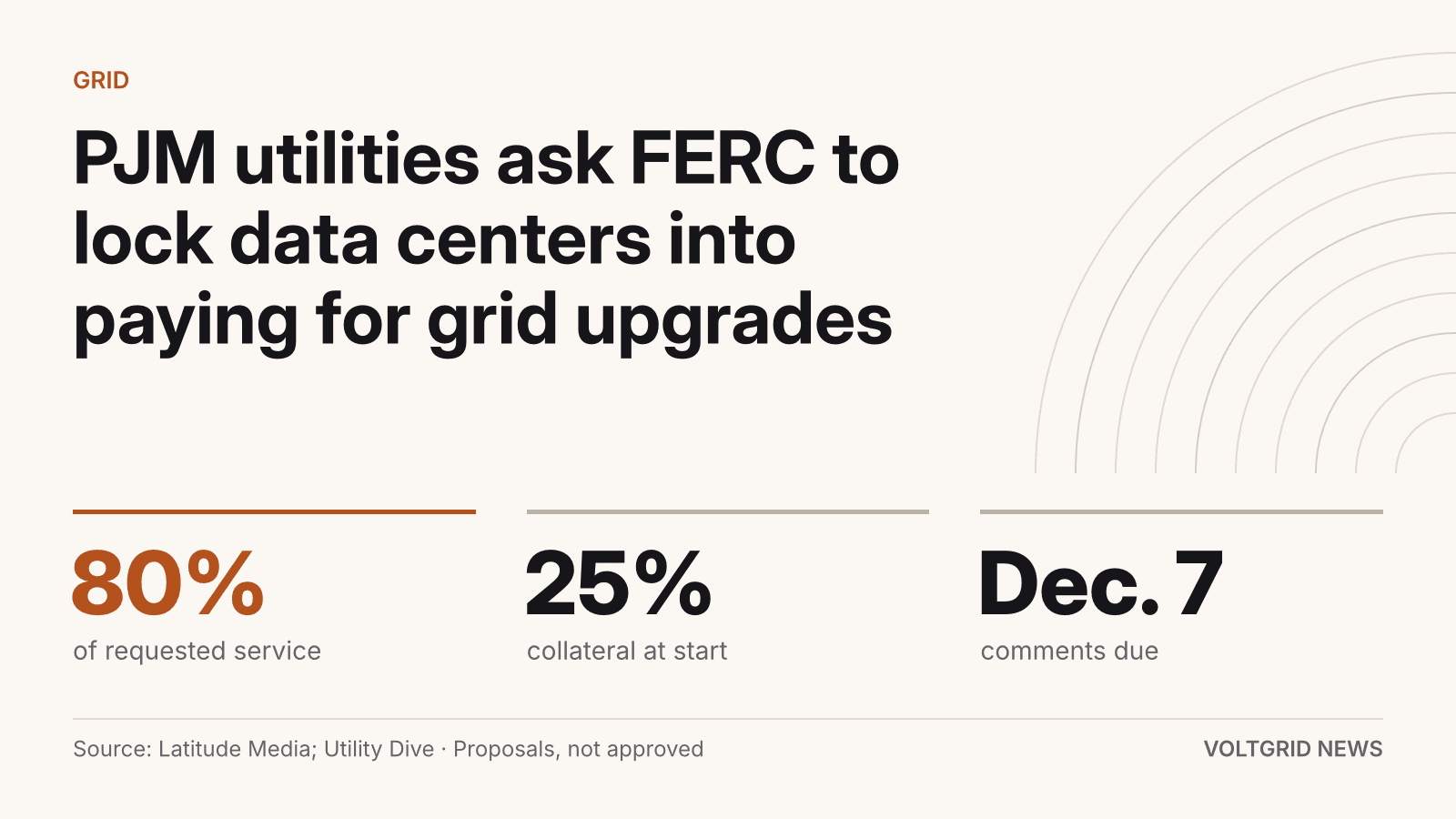
On payment, PJM's transmission owners propose revenue commitments of 80% to 100% of the firm-service benchmark, while MISO's 20-year agreement would make a customer pay the shortfall, for example $3 million when a $10 million commitment earns $7 million. The transmission owners' 10 to 20 year contract asks are covered separately.
PJM separately proposed ride-through rules for loads of 50 MW or more, with at least 25 MW of power-electronic load, effective Jan. 16, 2027, after about 3.9 GW of data center load switched to onsite generation on July 22. PJM serves about 10 GW of such load and forecasts up to 30 GW more by 2030.
What Is Not Confirmed Yet
FERC has accepted none of these proposals. Most take effect in 2027 or 2028, and MISO does not expect to run GRITS before Jan. 1, 2029 because of software work. CAISO, which won board approval in October, has set no cap on how long its interim arrangements may last. RTO Insider's Nov. 17 report on MISO's filing sits behind a login, so we relied on POWER for MISO's terms. POWER calls its account an initial analysis.
Sources
- 01Five Grid Operators Respond to FERC With Distinct Plans for Large-Load IntegrationPOWER Magazinepowermag.com
- 02PJM Plan Would Cut Interconnection Process Time in HalfPJM Inside Linesinsidelines.pjm.com
- 03PJM Proposes New Rules to Protect Grid Reliability as Data Center Demand GrowsPJM Inside Linesinsidelines.pjm.com
- Published
- Sources
- 3 cited