SECI Battery Peak Tender: CERC Adopts ₹6.27-6.28/kWh for 1,200 MW
SECI's battery peak tender cleared at ₹6.27-6.28/kWh: 1,200 MW of evening supply, 4,800 MWh a day, about 6.97% below the ₹6.74/kWh benchmark, with no buyers named yet.
2 min readAI-assisted
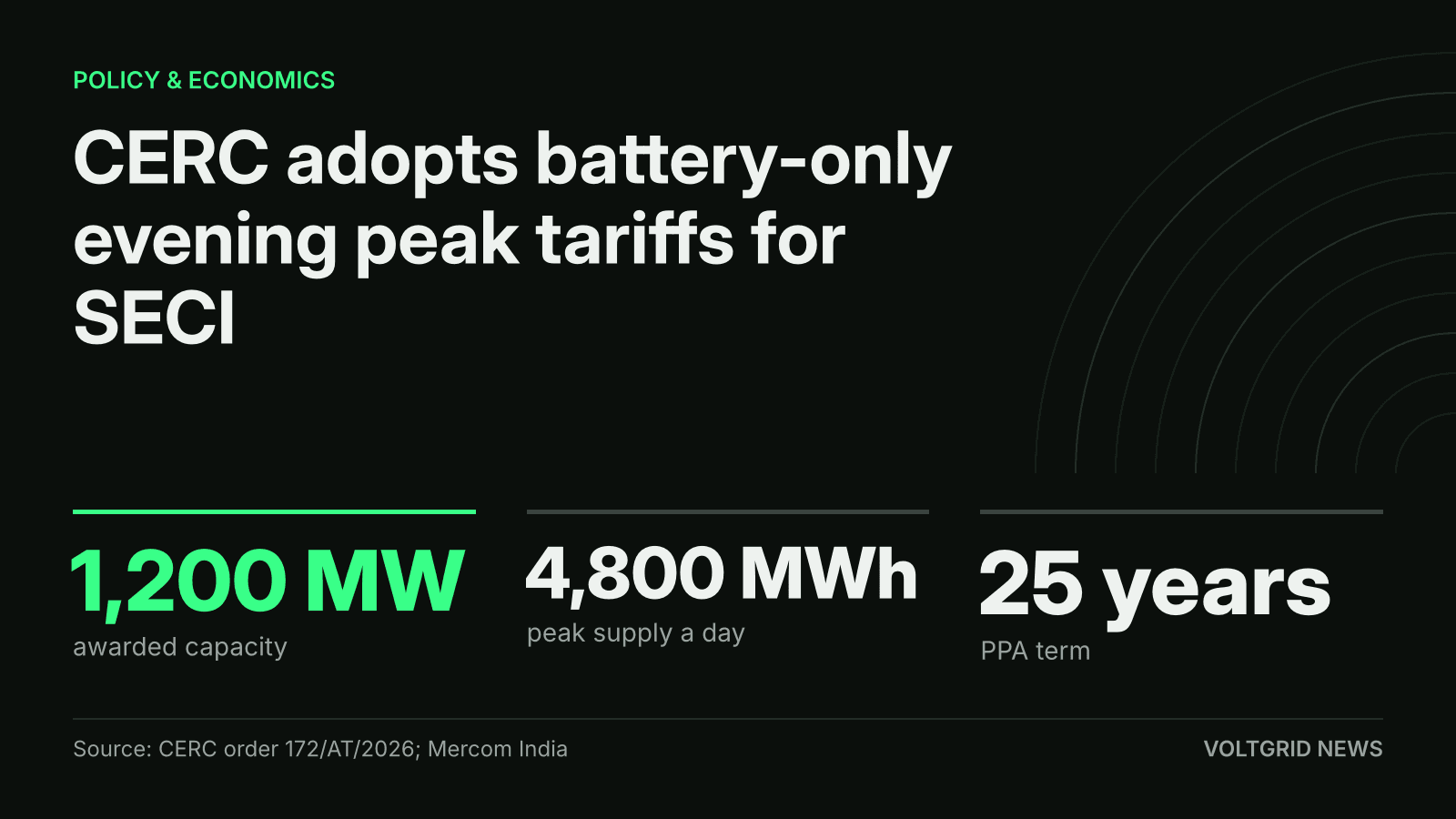
CERC adopted tariffs for 1,200 MW of battery-backed evening peak supply under SECI-FDRE-VII, 4,800 MWh a day.
Illustration (AI-generated)
India's Central Electricity Regulatory Commission (CERC) adopted tariffs of ₹6.27 and ₹6.28 per kWh on 26 October for the battery peak tender of Solar Energy Corporation of India (SECI), 1,200 MW of battery-backed renewable capacity for evening peak supply, according to the commission's order and Mercom India.
The projects, tendered as SECI-FDRE-VII, are meant to deliver 4,800 MWh a day (1,200 MW for four hours) from inter-state transmission-connected plants with energy storage. Adyant Enersol won 100 MW at ₹6.27/kWh. Serentica Renewables (600 MW), AMPIN Energy Utility Nine (199 MW) and ACME Solar Holdings (301 MW) won the remaining 1,100 MW at ₹6.28/kWh. Mercom puts the rates at about $0.0659 and $0.0660 per kWh; the order itself uses rupees only.
How the Evening Peak Product Works
This is a pure evening-peak product. The order says the tender requires 100% of contracted capacity to come from battery discharge in non-solar hours, with no daytime solar or wind injection, unlike earlier firm and dispatchable renewable energy (FDRE) tenders that mixed supply across the day. Charging power is the developer's responsibility. Each developer must supply 4,000 kWh per MW of rated capacity per day in four hours chosen by the buyer, and the buyer must take the stored energy daily.
Tariff Against the ₹6.74/kWh Benchmark
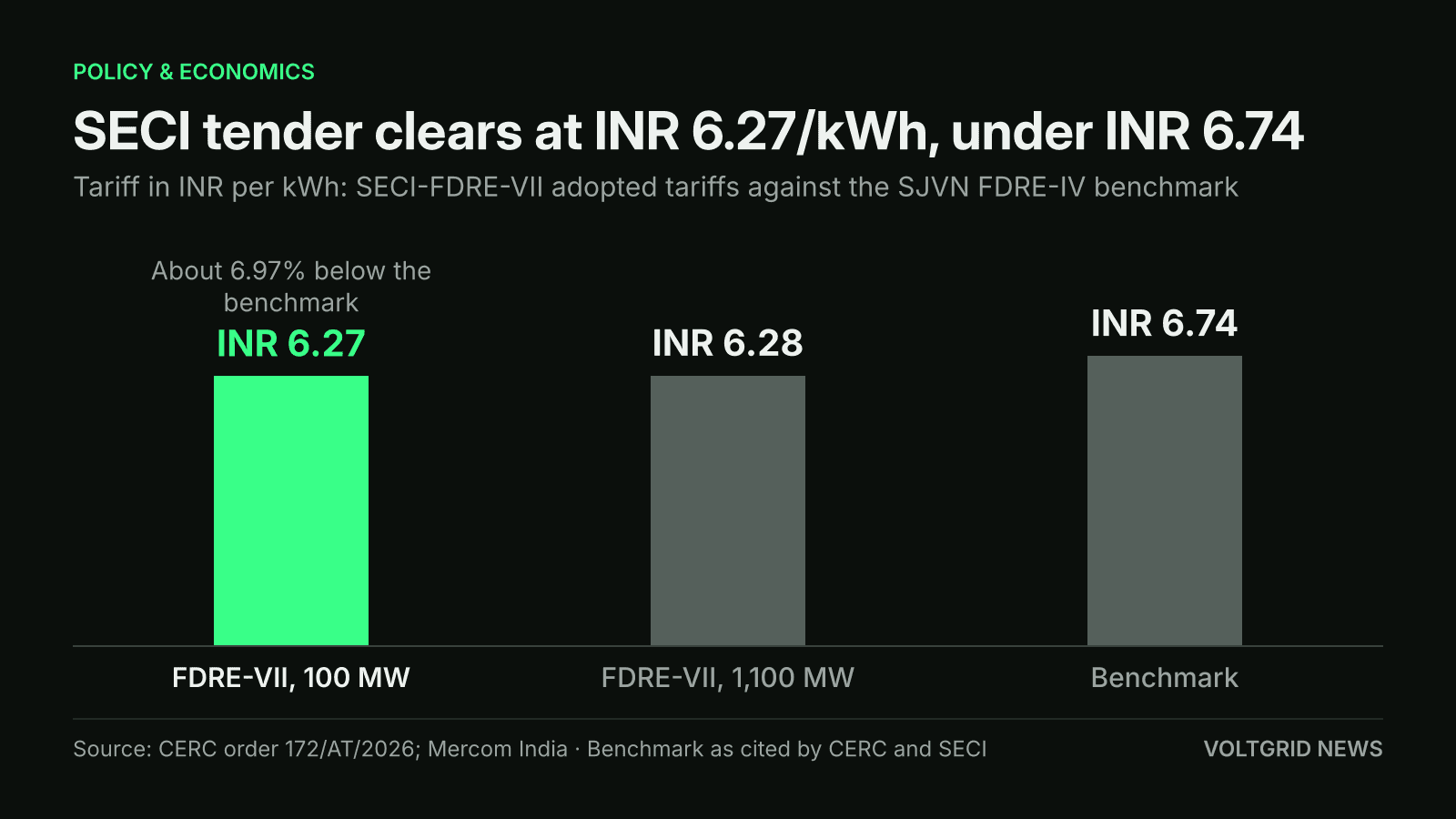
SECI told CERC the INR 6.27/kWh tariff is about 6.97% below the INR 6.74/kWh found in SJVN's FDRE-IV tender.
Illustration (AI-generated)
SECI told the commission that ₹6.27/kWh is about 6.97% below the ₹6.74/kWh found in SJVN's FDRE-IV tender in October 2025. The commission itself points to its 20 June 2026 order in Petition No. 31/AT/2026, which adopted ₹6.74/kWh for a similar 100% peak-supply project, and calls the new price competitive with similar FDRE projects. Bidding was crowded: 22 bids offering 6,145 MW arrived against 1,200 MW tendered, about five times the amount on offer, and 21 bids totalling 5,845 MW passed the technical and commercial check.
Who Pays and What Comes Next
The adoption is conditional. SECI must tie up the capacity under 25-year power purchase agreements with the developers and back-to-back power sale agreements with distribution companies or other buying entities, then file copies with the commission. The order names no buyer. SECI also sought a trading margin of ₹0.07/kWh on top of the tariff. The commission said that figure stands if the distribution companies agree to it, but that the margin is limited to ₹0.02/kWh if SECI gives the generators no escrow arrangement or irrevocable letter of credit.
For grid planners the structure matters more than the headline rate. A contract that pays only for four evening hours of stored power, with the buyer choosing the window, puts a separate price on evening peak supply instead of averaging it into a round-the-clock rate.
The next steps are commercial rather than regulatory. Letters of Award were issued on 10 February 2026, and the award terms require supply from the full capacity to start within 24 months of the power purchase agreement's effective date, with financial closure six months before the scheduled start. That clock runs from the agreement date, and the order still lists the buyer agreements as to be tied up. If the capacity does not turn into agreements, the commission requires SECI to say so on the record.