Supermicro SYS-E103-14P-H Fanless Settles at 22-25 W After 53-55 W Burst
ServeTheHome's Nov. 25 test found Supermicro's fanless box holds its Core Ultra X7 368H near the 25 W TDP the company lists, costing all-core scaling against a fan-cooled 358H system.
3 min read
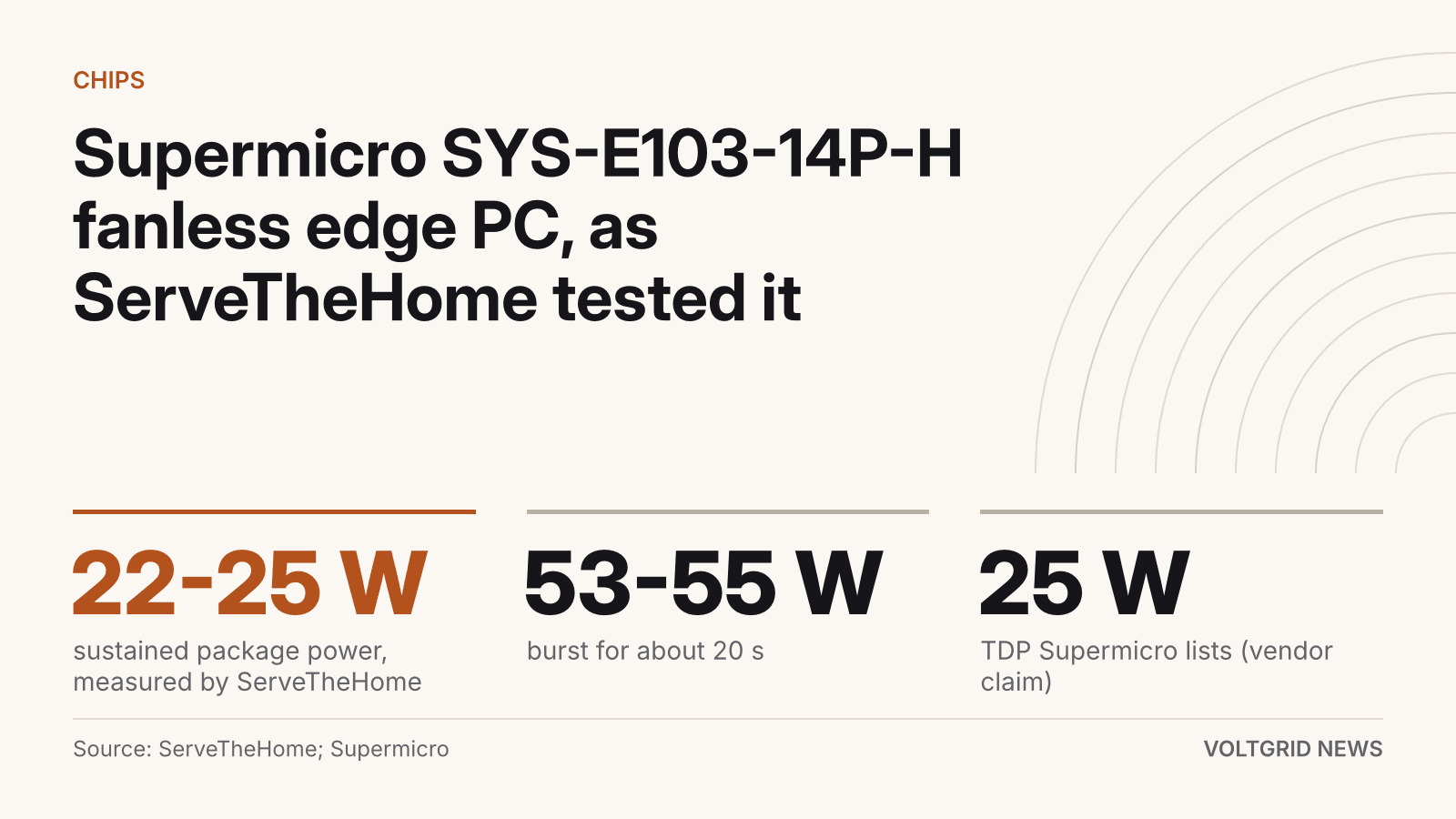
ServeTheHome measured 22-25 W sustained after a 53-55 W burst; Supermicro lists 25 W TDP.
Graphic: Voltgrid News
Supermicro's fanless SYS-E103-14P-H edge PC ran its Intel Core Ultra X7 368H at 53-55 W package power for about 20 seconds under an all-core load, then settled at 22-25 W, ServeTheHome reported in a Nov. 25 review.
That sustained band sits where Supermicro draws the line. The company's product page says the chassis supports processors up to 25 W TDP, air cooled, and lists the 368H as "up to 25W". ServeTheHome attributes the fall-off to the fanless chassis, though the plateau also matches the 25 W base-power rating Intel gives the chip, so the review does not separate the case from the silicon. ServeTheHome measured package power with stress-ng on Ubuntu 26.04 LTS, and logged 1.4-1.8 W at idle. It reported no wall-power figure, and Voltgrid did not test the system.
Sustained package power sat at 22-25 W, the 25 W Supermicro lists, after a 53-55 W burst; ServeTheHome's measurements against vendor labels. Voltgrid did not test the system.
Graphic: Voltgrid News
What a fanless chassis costs in throughput
The power ceiling shows up in ServeTheHome's own AgentSTH V7 index. With one worker, the 368H scored 843, against 738 for a Core Ultra X7 358H in ASRock Industrial's fan-cooled NUC BOX-358H, both on the outlet's scale where AMD's Ryzen 9 9950X3D2 equals 1,000. At 16 workers the Supermicro reached a 5.564x speedup over its own one-worker run, a scaling efficiency of 34.8%. The fan-cooled 358H system reached 46.6% under the same method.
ServeTheHome put the gap down to the fanned box holding a higher TDP for longer. The pattern is the one to plan around: one heavy thread, or one heavy thread with a few light ones, runs fast without a fan, while work that lights up all 16 cores runs into the chassis's thermal limit within seconds.
Memory was the other constraint. The review unit carried 32 GB of DDR5-5600 on two replaceable 16 GB SO-DIMMs. Split into 16 independent single-worker agents, the test ran the kernel out of memory, so ServeTheHome dropped that layout; eight groups of two gave the best aggregate score. Supermicro lists support for up to 128 GB of non-ECC DDR5-5600 across the two slots, so the 32 GB limit belongs to the tested configuration. That is the system maker's claim: Intel's spec page lists the 368H with LPDDR5X at up to 9600 MT/s and 96 GB, and does not list DDR5 SO-DIMMs.
Why a 25 W Chip Bursts Past 50 W
Intel rates the Core Ultra X7 368H at 25 W Processor Base Power and 80 W Maximum Turbo Power. Base power is what the chip is rated to sustain; turbo is a short excursion it takes while it has thermal headroom, which is why ServeTheHome saw 53-55 W for about 20 seconds before the package fell back to 22-25 W.
For buyers, that means bursts and single-thread work run fast in this box, while sustained 16-core loads sit near the base figure. Without a fan to move heat out of the finned case, the headroom for turbo runs out quickly.
SYS-E103-14P-H Specs, Ports and Power Input
The 368H is a 16-core part with four Performance, eight Efficient and four Low Power Efficient cores, no Hyper-Threading and up to 5.0 GHz, soldered as an FCBGA-2540 package, per the review. Supermicro rates the box for 0°C to 45°C operation, 12-36 V DC input, and ships a lockable 150 W, 12 V adapter. The front panel carries two 2.5GbE ports on Intel I226-IT controllers, one 1GbE port with vPro, two HDMI 2.1 outputs and two RS-232/422/485 serial ports. Supermicro also claims up to 180 TOPS of combined CPU, GPU and NPU AI performance, a platform figure of its own. Intel's spec page lists the NPU at 50 peak TOPS (INT8) and the Arc B390 graphics at 122 peak TOPS (INT8), and gives no platform total. ServeTheHome ran no AI or GPU workloads, so none of these figures has been tested.
The contrast with a laptop is instructive. Phoronix's Ubuntu tests of Dell's XPS 14, a Panther Lake laptop, put average CPU draw at 23 W with a 65 W peak, as Voltgrid reported. The two were measured by different outlets with different tools, so the numbers are context, not a head-to-head. Voltgrid News reported earlier on Supermicro's Super AI Station, another system ServeTheHome tested.
What is not confirmed yet
ServeTheHome gave no price or availability, and Supermicro's page lists none. There is still no independent measurement of the Arc B390 graphics, the NPU or wall power on this system, and no second review to confirm the burst-then-settle profile.
Sources
- Published
- Sources
- 2 cited