Switch's Tahoe-Reno Gas Plant: Nevada Approves Nominal 510 MW Permit
Nevada's PUCN approved the ASR-IX Tahoe-Reno gas plant permit on Nov. 10, the Las Vegas Review-Journal reported. A signed order is unconfirmed, and its gas pipeline still needs federal approval.
4 min read
Follows Switch-Backed 510 MW Tahoe-Reno Gas Plant Awaits Nevada Approval
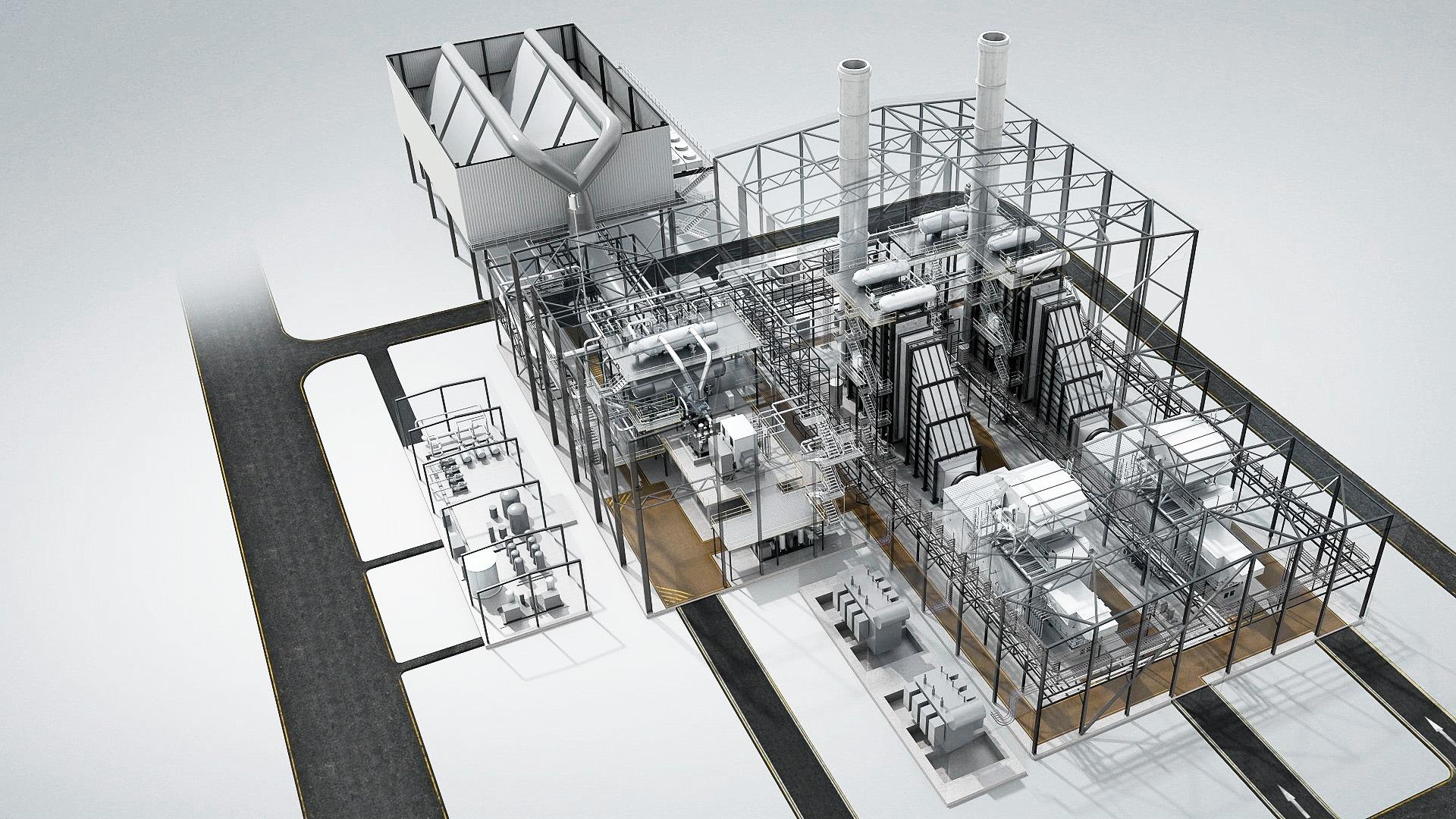
Illustrative Siemens Energy rendering of an SGT-800 power plant; it is not the ASR-IX site, which is planned with SGT-800 turbines in simple cycle.
Image: Siemens Energy
Source · Product image from the Siemens Energy website, used for news reporting.
Nevada regulators approved a permit on Tuesday, November 10, 2026, for ASR-IX, a nominal 510 MW gas plant at the Tahoe-Reno Industrial Center that Switch says it will own and buy power from.
The Public Utilities Commission of Nevada (PUCN) took the vote at its regular meeting, where the agenda listed Nexus Fulcrum LLC's application under the Utility Environmental Protection Act, the state's siting law, as Docket 26-06016, for a decision to grant or deny the application as filed or with modifications. The commission approved it at that meeting, the Las Vegas Review-Journal reported; Nevada News and Views said the motion was to approve it as modified. Nexus Fulcrum filed in June naming only a single unnamed off-taker; Switch later disclosed in a filing that it is both "the intended off-taker" and the "ultimate owner." As Voltgrid reported on October 28, the plant was then still waiting for this vote.
What Switch gets is a dedicated gas plant on about 20 acres of the former Sierra Biofuels refinery, sized at a nominal 510 MW, with construction targeted from the first quarter of 2027 to 2029. It is not firm yet. The state siting permit is one approval among several, and the gas it needs depends on a pipeline expansion that does not yet have federal approval.
Nine Gas Turbines in Simple Cycle
The Nevada Independent, reporting on the application, said the plant would use nine gas turbines of 56 MW to 57 MW each. New Project Media, also citing the application, named them as six Siemens SGT-800 units of 57 MW and three SGT-800 B4 units of 56 MW, running in simple cycle with selective catalytic reduction for emissions. Those ratings add up to the 510 MW nominal figure on the commission's agenda. Simple cycle means there is no steam stage to recover waste heat, so such plants typically burn more gas per megawatt-hour than combined-cycle plants. How much of the 510 MW could be delivered on site is not stated in any source we could verify.
The plant is gas generation dedicated to one customer. No source describes batteries, a controller or the ability to run islanded from the grid, so it is not a microgrid on the evidence available.
What Is Disclosed About the Deal
The parties are Nexus Fulcrum, the applicant, and Switch, the off-taker and ultimate owner. Nothing else about the deal is public. No capital cost, financing, power price or power purchase agreement (PPA) has been disclosed, and neither has the gas supply contract or the turbine purchase terms. Nevada Current reported that Great Basin Gas Transmission told federal regulators its shipper agreements are privileged and under non-disclosure. Nevada News and Views, which reviewed the draft order, said it found no binding terms on who pays for gas, water, roads or emergency services, and no cleanup bond among the conditions.
Whether the plant sits behind the meter or in front of it is also unsettled in public reporting. The Review-Journal and The Nevada Independent described it as behind-the-meter, power that does not use the utility's network. Nevada Current updated its October 26 report to say the plant is considered front-of-meter, not behind-the-meter. We could not find a commission document that settles it. The answer matters for three reasons. Behind-the-meter power gets less oversight from state energy regulators, The Nevada Independent reported. Private on-site plants are not required to follow Nevada's standard of 50% renewable energy by 2030, Nevada Current reported, though it was not clear whether this plant would have to. And the label decides whether the power travels on NV Energy's network, where energy researcher Jonathan Koomey told the Review-Journal a utility hookup can take two to three years or more if the utility must build infrastructure.
Permit Status and Timeline
The November 10 vote is an approval at the meeting. As of November 11, only a draft order was on the docket, according to Nevada News and Views, and we could not find a signed order as of November 19. That outlet said the draft lists 13 further approvals, including a Nevada Division of Environmental Protection air permit, with five years to obtain them; we could not confirm that list on the docket. The Nevada Independent reported in September that the air permit application was still under review by the state.
Gas is to arrive through a new lateral off Great Basin's 2028 expansion, which Nevada Current said is one of 12 new delivery points in that project. Great Basin targets service in November 2028, and the pipeline still needs formal approval from the Federal Energy Regulatory Commission (FERC). We found no report of a formal FERC application since the vote. Nevada Current also reported the plant's life at 30 years or more and its operating water use at 145 acre-feet a year.
What It Means for Nevada Data Centers
The plant is a measure of how short Northern Nevada's grid is. NV Energy told regulators that growth at and near the industrial center has outpaced regional generation, Nevada Current reported. The utility puts data centers at 5% of its electricity sales today and 64% by 2046, according to the Review-Journal. It is the third private gas plant for data centers that Nevada regulators have taken up, Nevada Current reported, after the commission approved two temporary plants for Fleet Data Centers totaling 362 MW in September. Emissions are the cost. Nevada Current, citing the application, said the plant could emit as much as 2 million metric tons of CO2 a year at its upper bound.
What to Watch Next
First comes a signed order in Docket 26-06016, for which no date has been published. Next are the state air permit and its public comment period, then Great Basin's formal FERC application, which has to clear in time for its November 2028 service target. Construction is targeted to start in the first quarter of 2027. Still missing is a filing that names which Switch campus the plant serves and says whether it connects to NV Energy's network.
The PUCN approval is done; the signed order and air permit have no dates, and the rest are targets.
Graphic: Voltgrid News
Sources
- 01Nevada Regulators Approve 510-Megawatt Gas Plant to Power Switch Data CentersNevada News and Viewsnevadanewsandviews.com
- 02Nevada data center rush drives request for a novel type of gas power plantThe Nevada Independentthenevadaindependent.com
- 03Public Utilities Commission of Nevada, Notice of Meeting, Agenda 21-26, Tuesday, November 10, 2026Public Utilities Commission of Nevadapucnv.granicus.comas read on Nov 19, 2026
- 04ORIGINATION: Developer seeks 510 MW gas plant at former Nevada biofuels site acquired by SwitchNew Project Medianewprojectmedia.comas read on Nov 19, 2026
- 05Massive natural gas plant from Switch approved by Nevada regulatorsLas Vegas Review-Journalreviewjournal.com
- 06Third data center gas plant seeks approval, as gas pipeline expansion advancesNevada Currentnevadacurrent.com
- Published
- Sources
- 6 cited