GE Vernova 122 GW, Siemens Energy 104 GW: Gas Turbine Queues, Used Prices
GE Vernova reports 122 GW of gas backlog and slot reservations and Siemens Energy 104 GW, counted on different bases; Mitsubishi has a 37 GW large-frame backlog. Reuters reports used turbines at $1.5M-$1.7M per MW.
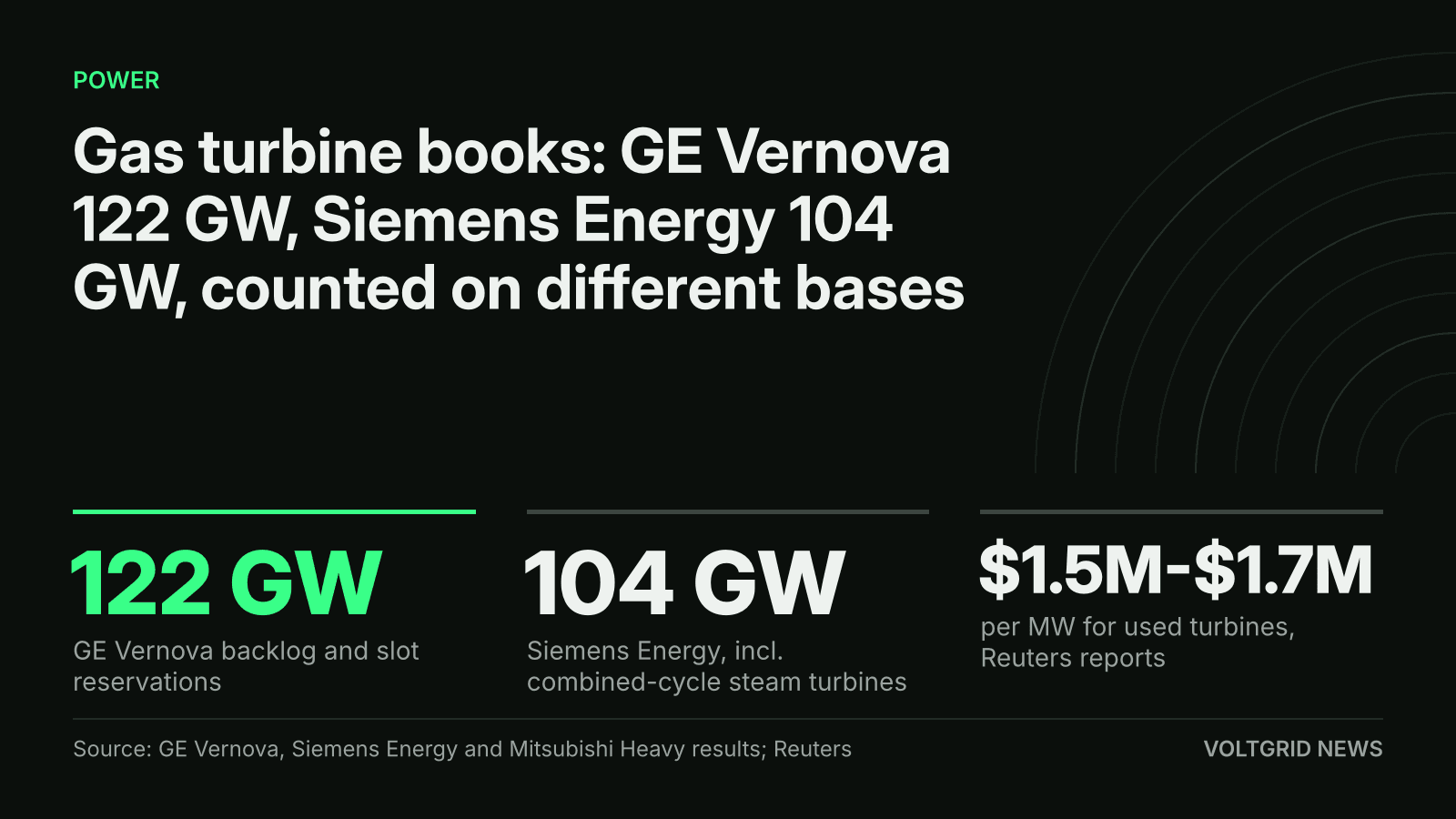
The two largest gas turbine makers count their books on different bases; used machines sell near new prices, Reuters reports.
Voltgrid News
Illustration (AI-generated)
GE Vernova reported 122 GW of gas equipment backlog and slot reservations at Sept. 30, and Siemens Energy 104 GW of gas-turbine commitments on the same date, according to their results. Siemens counts the steam-turbine capacity of combined-cycle plants and GE Vernova's release does not say it does, so the two only roughly add up. Mitsubishi Heavy Industries reported a 37 GW large-frame backlog on Nov. 6.
For a data center that wants its own power, the questions are the wait and the price. None of the makers publishes a lead-time table. Mitsubishi Power Asia Pacific's chief executive put new large-turbine delivery at around 2031, Bloomberg reported, and Reuters reported used units selling for $1.5 million to $1.7 million per MW.
The order books: 122 GW, 104 GW and 37 GW, on different bases
GE Vernova's third-quarter release, filed Oct. 28, put gas equipment backlog and slot reservation agreements at 122 GW, up from 116 GW a quarter earlier. The 122 GW is 64 GW of firm backlog and 58 GW of reservations. In the quarter GE Vernova signed 11 GW of new contracts (8 GW reservations, 3 GW orders), converted 13 GW of reservations into orders and shipped 5 GW. Its quarterly Power orders (not backlog) included 55 heavy-duty units, 21 of them HA turbines, and 57 aeroderivatives.
A turbine maker's gigawatt backlog is not one standard measure. A firm order is a signed equipment contract; a slot reservation agreement holds a place on the production line and may or may not become an order. Units differ too: Siemens Energy counts the steam turbine that a combined-cycle plant adds, GE Vernova's release does not say how it counts, and Mitsubishi reports only firm orders for its largest machines. Added together, they give only a rough total, not a like-for-like queue: GE Vernova and Siemens Energy hold 226 GW (122 plus 104), of which 97 GW (58 plus 39) is reservations and 129 GW (64 plus 65) firm backlog, so reservations are about 43%.
Reservations, which may or may not become firm orders, are 58 GW of GE Vernova's 122 GW and 39 GW of Siemens Energy's 104 GW. Siemens counts combined-cycle steam turbines.
Chart: Voltgrid News
Illustration (AI-generated)
Siemens Energy ended its fiscal year on Sept. 30 with total gas-turbine commitments of 104 GW, made of 65 GW in backlog and 39 GW in slot reservations, according to its Nov. 11 analyst presentation. It booked 42 GW of new-unit orders in fiscal 2026, also counting combined-cycle steam turbines. In the fourth quarter it booked about 2 GW of orders and 52 gas turbines, all small and medium-sized and none large, added 14 GW of reservations, converted none and shipped 6 GW. As Voltgrid reported, about €15bn of its €164bn group backlog is tied to data centers, across gas services and grid equipment; GE Vernova and Mitsubishi give no such split.
Mitsubishi Heavy Industries reported a large-frame gas-turbine backlog of 83 units, or 37 GW, at the end of September, up from 74 units (33 GW) at the end of fiscal 2025. Its half-year orders were 19 units (8 GW), against 23 units (10 GW) a year earlier.
At the third-quarter pace of 11 GW shipped (5 GW at GE Vernova, 6 GW at Siemens Energy), the 226 GW rough sum is about 20 quarters, or five years, of shipments (226 divided by 11): an illustration, not a forecast, since it uses one quarter and mixes reservations with orders. Wood Mackenzie, as reported by Reuters on Nov. 9, puts worldwide turbine orders above 100 GW against estimated annual manufacturing capacity of 60 GW to 70 GW; the makers' totals include reservations, so the two measure different things.
What a turbine costs: new, used and small-unit prices
Reuters reported on Nov. 9 that used turbines in good condition sell for about $1.5 million to $1.7 million per MW, refurbished units for about $1.3 million, and new units for $2 million to $2.5 million. The used and refurbished prices come from Origin Partners and the new range from Aurora Energy Research, so they are not one series. As Voltgrid reported, Wood Mackenzie's Aurora Tenorio said a new gas turbine now takes six years on average to arrive in the United States, where, the consultancy says, delivery talks focus on 2030 and 2031. That fits the around-2031 date Akihiro Ondo, chief executive of Mitsubishi Power Asia Pacific, gave for new large turbines at Singapore International Energy Week on Oct. 27, as quoted by Bloomberg, though it is one executive's statement, not a contract term.
Per gigawatt (1,000 MW times the per-MW price), that is $1.5 billion to $1.7 billion for used machines, $1.3 billion for refurbished and $2.0 billion to $2.5 billion for new, a gap of $0.3 billion to $1.0 billion per GW between new and used. Smaller machines cost less per MW: in one broker's example, ReflowX's Dan Poole told Reuters that two 14.5 MW Solar Turbines units sold for $12.5 million, about $431,000 per MW (12.5 divided by 29), against about $35 million, or roughly $1.2 million per MW, for new equivalents with five years of lead time.
Reported prices put used turbines at $1.5 million to $1.7 million per MW and new ones at $2 million to $2.5 million; per GW multiplies by 1,000 MW.
Chart: Voltgrid News
Illustration (AI-generated)
The workaround: engines, aeroderivatives and jet cores
Wärtsilä said on Oct. 5 that it will supply 15 of its 50SG engines, 282 MW in total, to a major US independent power producer's data center for delivery in 2028. It is the company's seventh US data-center order, taking such sales above 3 GW. INNIO said on Oct. 22 that it booked a 620 MW follow-on order for Jenbacher engines, taking one unnamed customer to about 1.72 GW.
Caterpillar's Oct. 29 results, as Utility Dive reported, showed Power & Energy sales up 18% to $8.8 billion and company-wide backlog of $78 billion, nearly double a year earlier. The Financial Times, as relayed by Investing.com, reported that Anthropic agreed to pay $3.4 billion for 1.7 GW of generators OnePWR had ordered from Caterpillar. That is about $2.0 billion per GW (3.4 divided by 1.7), but the price also covers engineering and construction, so it is not an equipment price, and the report is unconfirmed.
Aeroderivatives, built on aircraft engine cores, are the other quick route. Crusoe ordered 13 ProEnergy PE6000 units of 50 MW, based on GE Aerospace engines and 650 MW combined, in April, with delivery targeted by summer 2027, according to The Data Center Engineer citing ProEnergy. xAI installed eight converted jet-engine units of up to 50 MW each in Mississippi, about 400 MW if all run at that rating, as Tom's Hardware and TechCrunch reported, citing the New York Times. On Nov. 10 Mississippi's permit board denied an appeal of MZX Tech's air permit for 41 xAI turbines at Southaven, with a stated capacity of 1.2 GW.
The most modular case is El Paso Electric's McCloud plant for Meta's campus: 813 generators of 450 kW each, about 366 MW, with 225 MW of continuous bridge supply proposed, according to the administrative law judges' proposal. The proposed findings put El Paso Electric's estimate at $499.8 million, while the proposal's background section gives $551.8 million, or $1,609 per kW, and the two are not reconciled.
For engineers, the pattern is a speed-for-efficiency trade. On the dates above, an engine fleet or aeroderivative set can arrive three to four years before a large frame turbine ordered now. The cost is more machines per megawatt, more gas connections and, as Tenorio warned, uncertain service histories on used and converted units. For investors, the figure to track is conversion of reservations into firm orders: GE Vernova converted 13 GW in its third quarter, Siemens Energy none in its fourth.
Cost and emissions trade-offs
BloombergNEF's Nov. 11 report, Powering the Data Center Boom, tracks 181 GW of announced gas generation alongside data centers, 165 GW of it in the US, as an indication of scale, not a forecast. BNEF's scenario puts the announced US plants, run at 60% utilisation, at about 345 million metric tons of CO2-equivalent a year, 152 million tons more than the estimated 193 million tons from grid supply for the same load. Against 2025 US power-sector emissions of about 1,485 million tons, 152 million tons is about 10% (152 divided by 1,485).
BNEF's model, summarised by Poland Insight, puts full electricity cost including capital at $103.1 per MWh for gas engines, $106.0 for open-cycle turbines, $109.5 for combined-cycle and $139.8 for fuel cells, all above US industrial prices of $82.1 to $93.3 per MWh. Once a plant is built, though, its marginal cost of $21.5 (fuel cells) to $43.2 (engines) per MWh is well below grid tariffs, which is why BNEF warns that bridge plants may keep running for decades. On full cost, engines come out about $6 per MWh cheaper than combined-cycle (109.5 minus 103.1); on marginal cost they are about $15 dearer (43.2 minus 27.8).
BNEF also reports announced investment that could lift annual turbine manufacturing capacity from 67 GW in 2025 to 102 GW in 2030, excluding the extra output of combined-cycle configurations. Siemens Energy, which counts that steam-turbine output, puts global maker capacity at about 130 GW a year, on a different basis. Of the 181 GW tracked, about 85 GW is dated 2026 to 2029 and 84 GW has no date, per Poland Insight. With large-turbine books this full, much of the near-dated capacity would likely come from engines, aeroderivatives and secondhand machines.
What to watch
GE Vernova expects at least 130 GW of backlog and reservations at the end of 2026; its fourth-quarter report will show whether it got there. Siemens Energy expects its 39 GW of reservations to convert into firm orders during fiscal 2027, which runs to Sept. 30, 2027.
The Public Utility Commission of Texas has not ruled on McCloud (Docket 59076) and lists no vote date; El Paso Electric targets completion in May 2027. Crusoe's 650 MW of aeroderivatives is targeted for summer 2027 and Wärtsilä's 282 MW for delivery in 2028. HD Construction Equipment, which opened a gas-engine plant for AI data centers, plans mass production of its DX37 engine in the first half of 2027.
What is not known: only Siemens Energy gives a data-center share of its books. The price ranges are individual estimates quoted by Reuters, not a price index. The Reuters, Bloomberg and Financial Times figures are cited as carried by Decrypt, our earlier reports and Investing.com.
Sources
- 01MHI FY2026 first six months resultsMitsubishi Heavy Industriesmhi.com
- 02Siemens Energy Q4 FY26 earnings releaseSiemens Energyassets.siemens-energy.com
- 03Siemens Energy Q4 FY26 analyst presentationSiemens Energyassets.siemens-energy.com
- 04GE Vernova Q3 2026 results (SEC 8-K)GE Vernovasec.gov
- 05MHI FY2026 1H presentationMitsubishi Heavy Industriesmhi.com
- 06AI data centers buying used jet enginesDecrypt (citing Reuters)decrypt.co
- Editor
- Ege Erten
- Published
- Sources
- 6 cited
- Standards
- AI-assisted