HALEU Tonnes on Record: TerraPower Up to 150 t, Oklo 5 t, X-energy 4 t
Three HALEU tonnages are public: Oklo's 5 t DOE award, X-energy's conditional 4 t DOE award and up to 150 t TerraPower may buy from ASP Isotopes in 2028-37. No Centrus or Urenco contract states one.
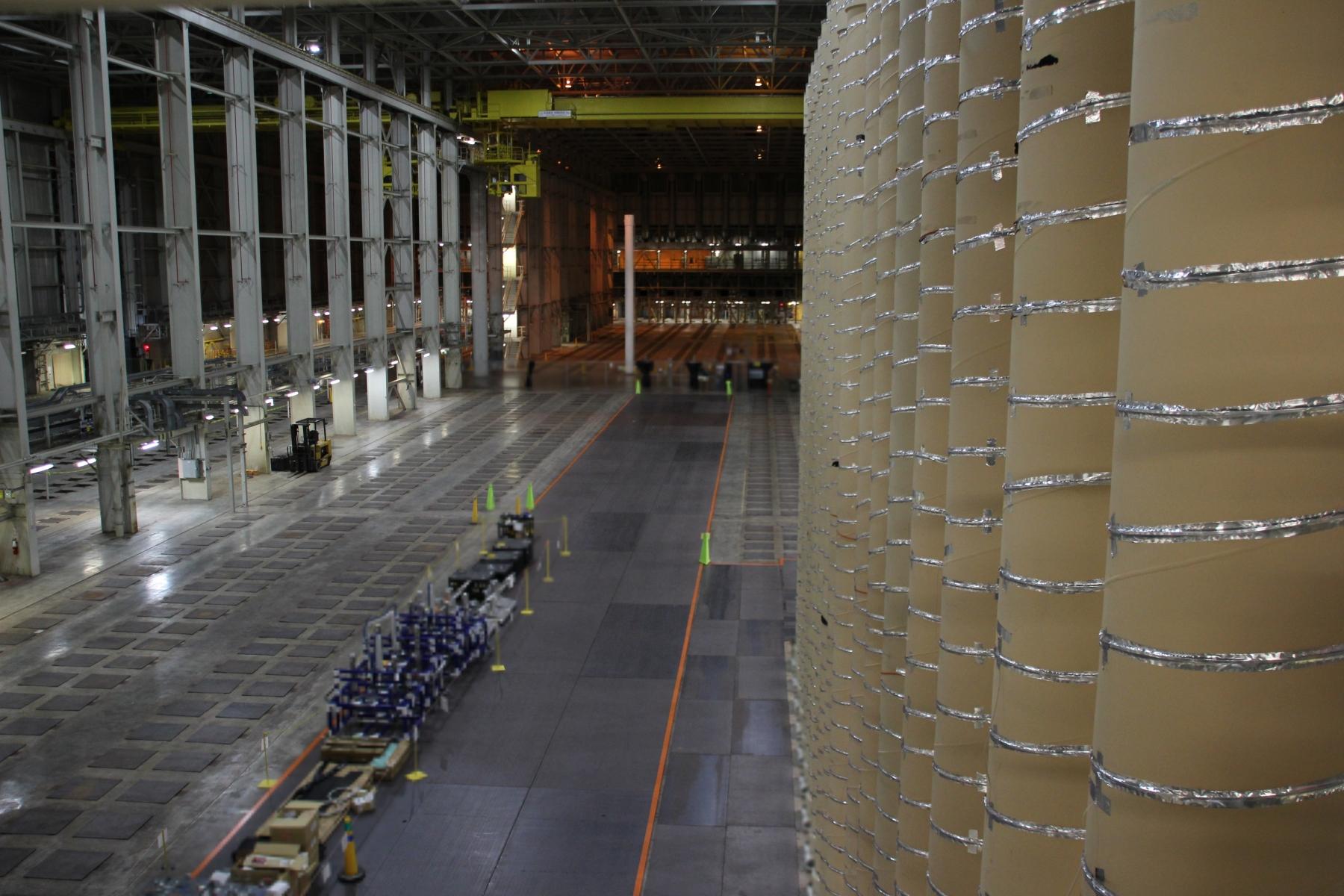
Centrus's 16-machine HALEU cascade at Piketon, Ohio, is the only US source of new HALEU today.
Image: Centrus Energy
Source · Press image from the Centrus Energy website, used for news reporting.
Three tonnages are public for the high-assay low-enriched uranium (HALEU) that US advanced reactor developers have lined up, and they are not the same kind of tonne. Oklo holds a Department of Energy (DOE) fuel award of 5 metric tons of HALEU made from recovered EBR-II uranium for its first Aurora, in Idaho, its latest 10-Q says. X-energy's fuel unit, TRISO-X, has a conditional DOE award of four metric tons, which an X-energy spokesperson told Utility Dive in April 2025 is more than half of the first core for Dow's Long Mott plant in Texas. And TerraPower may buy up to 150 metric tons from ASP Isotopes over 2028 to 2037 under definitive agreements signed in May 2025, ASP's SEC filings say.
The first two are government material allocated by DOE; the third is a commercial ceiling from a plant yet to enrich uranium. Every other deal is counted in reactors and years. The definitive contracts Oklo signed with Centrus Energy, announced on Nov. 12, cover fuel for up to five Aurora powerhouses from 2029 but give no tonnage, value or prepayment amount, as Voltgrid reported. Nor do Centrus's deals with X-energy, Radiant and Antares, or Urenco's with Antares.
The need: tonnes per first core
Nuclear fuel is counted by the weight of uranium it contains. HALEU is uranium enriched above 5% and below 20% uranium-235, under DOE and Nuclear Regulatory Commission (NRC) definitions, against under 5% for today's reactor fuel; Urenco counts only 10% to 20% as HALEU. A reactor's first core is the big up-front purchase: it must be fully loaded before the reactor makes any power, and later reloads are smaller. Weights also come in different forms: uranium hexafluoride gas (UF6) is heavier than the uranium it carries, so 900 kg of UF6 is not 900 kg of uranium.
Two first-core figures have been published. E&E News reported in May that TerraPower's Natrium reactor at Kemmerer, Wyoming, a 345 MWe sodium-cooled design, will need 15 to 20 tonnes of HALEU for its initial fueling and just under four tonnes a year after that; TerraPower and ASP have not published the figure, and E&E News did not give its basis. X-energy's statement sets a bound for its first plant: if 4 t is more than half, the first core of the four-reactor, 320 MWe Long Mott plant is under 8 t (4 × 2).
Oklo says its 5 t will enable the Aurora at Idaho National Laboratory and that it is securing enricher commitments for later units. Kairos Power lists 19.75% enrichment for its KP-FHR and says the design can run on LEU+, 5% to 10%, until HALEU is more widely available.
The aggregate need is DOE's. In its December 2024 record of decision on HALEU production, DOE projected that more than 40 metric tons will be needed by 2030, with more each year after.
Supply: DOE stock, one cascade and plants still to be built
Congress set DOE a goal, in the fiscal 2024 defense authorization, of making 21 metric tons available by June 30, 2026, in steps of 3, 8 and 10 tonnes, POWER Magazine reported. DOE has not reported whether it met that schedule. It has made conditional commitments in three rounds: to TRISO-X, TerraPower, Kairos, Radiant and Westinghouse in April 2025; to Antares Nuclear, Standard Nuclear and Abilene Christian University in August 2025; and to NASA and Radiant on July 23, 2026. DOE has not published per-company quantities; the 4 t figure came from X-energy. DOE's July release said HALEU "is not currently available from domestic suppliers." Russian imports are banned; DOE waivers for Russian low-enriched uranium end no later than Jan. 1, 2028.
The only US cascade making HALEU is Centrus's 16-machine unit at Piketon, Ohio. It delivered 900 kilograms of HALEU as UF6 to DOE over one production year, completed in June 2025, Centrus's 10-Q says, and now enriches for commercial buyers. Centrus took title to the stored government HALEU on Oct. 20 and holds it for resale to DOE on request, as we covered.
New capacity is all planned. DOE awarded three $900 million enrichment task orders in January: to Centrus's American Centrifuge Operating and to General Matter for HALEU, and to Orano for LEU only. Centrus's order pays for capacity and 1 metric ton of uranium as HALEU, at a nominal 19.75%, by July 2032, plus two DOE options of 5 MTU each. Centrus targets new cascades in 2029 but has not stated their HALEU output. General Matter's NRC application for Paducah, Kentucky, covers LEU only; the NRC estimates April 2028 to finish its review, and the company plans a HALEU amendment in 2027, as we reported. Urenco's Eunice, New Mexico, plant is licensed only to 10% U-235 (our Nov. 3 story). Its planned plant at Capenhurst in the UK is designed for up to 27 tonnes of HALEU a year, with potential to double, and is expected to start producing by the early 2030s, Urenco says.
Contracts: who has disclosed fuel, and how much
Oklo: a DOE fuel award of 5 t of EBR-II HALEU for its Idaho Aurora, not a purchase; definitive multi-year Centrus contracts for up to five powerhouses, deliveries scheduled to begin in 2029, supported by Meta's prepayment for future Oklo power production; no tonnage. X-energy: the conditional 4 t DOE award for Long Mott and a definitive Centrus agreement signed Aug. 6, 2026, which at full execution would secure HALEU for a portion of the initial fuel needs of its 11.5 GW pipeline; the Centrus deal gives no tonnage. TerraPower: a conditional DOE allocation of unpublished size, a Centrus partnership, and definitive May 2025 agreements with ASP Isotopes: a loan toward ASP's planned enrichment plant at Pelindaba, South Africa, an initial core supply agreement for the first Natrium cores in Wyoming, with no tonnage, and a 10-year supply agreement for up to 150 metric tons of HALEU from 2028 through 2037. Kairos: a conditional DOE allocation, size unpublished; no commercial contract with a tonnage. Radiant and Antares, both microreactor developers, signed Centrus HALEU supply agreements with prepayments in the third quarter, Centrus's 10-Q says, and Antares signed what Urenco calls the first long-term commercial HALEU supply contract in May 2026.
Oklo's and X-energy's tonnes are DOE awards; TerraPower's up to 150 t is a commercial ceiling. They are not added together.
Voltgrid News
Illustration (AI-generated)
ASP's own status is the caveat on the largest number. On Oct. 15 it said its subsidiary Quantum Leap Energy had signed a binding heads of agreement with South Africa's state nuclear company, Necsa, for a joint venture to build a test bench and a commercial-scale HALEU plant at Pelindaba, with TerraPower's offtake already in place. The same release says the company has not yet applied its enrichment technology to uranium-235 or received approval to test it on U-235, beyond work under its services contract with Necsa. "Up to" is a ceiling, not a minimum.
Centrus's contingent LEU and HALEU commitments reached $5.4 billion at Sept. 30, $5.1 billion of it definitive, as we reported, tied to potential Piketon construction and not split by product.
The gap, with the arithmetic
The disclosed tonnes come in two kinds that should not be added together. The comparisons assume the sources' tonnes share a basis, which E&E News's Natrium figure does not state.
DOE awards: 5 t for Oklo + 4 t for X-energy = 9 t of government-origin HALEU, the only per-company DOE quantities made public, one of them conditional.
Commercial ceiling: up to 150 t for TerraPower from ASP over 10 years, an average of up to 15 t a year (150 ÷ 10), from a plant still to be built.
DOE's 2026 goal against its 2030 need: 21 t ÷ more than 40 t = at most 52.5%. Even all 21 tonnes, whose delivery DOE has not reported, would cover about half its own 2030 estimate.
Published DOE awards (Oklo 5 t + X-energy 4 t) against DOE's own goal and 2030 need. DOE has not reported whether it met the goal.
Voltgrid News
Illustration (AI-generated)
ASP's yearly average against one Natrium core: up to 15 t a year is roughly one first core as E&E News reported it (15 to 20 t) each year, if the plant ran at the ceiling. TerraPower's first cores are contracted from ASP, not necessarily from DOE stock.
Centrus's DOE order against one Natrium core: 1 MTU ÷ 15–20 t = 5% to 6.7% by July 2032. With both options, 1 + 5 + 5 = 11 MTU, or 55% to 73%, and the options are DOE's to take or leave.
Urenco's planned plant against one core: up to 27 t a year exceeds one 15–20 t Natrium core, but only from the early 2030s and only in Urenco's 10% to 20% band.
For engineers and investors, the inference is that a target year is only as good as the fuel line behind it. Oklo's first Ohio phase is targeted as early as 2030 and Meta's first two Natrium units as early as 2032. The largest disclosed commercial volume, TerraPower's, starts in 2028 from a plant that has not yet enriched uranium, and Centrus's new cascades are a 2029 target. That suggests the first cores most at risk are those due before 2029, when only DOE stock and one cascade exist. The counter-case is real: the contracts are definitive, buyers are prepaying, and the House passed H.R. 9612, the American Enrichment Deployment Act, 394-3 on Nov. 9, which would let enrichers build at their own risk before a final NRC licence, as we reported. It has not passed the Senate.
What to watch
Dec. 31, 2026: DOE's stated aim to complete a long-term Piketon lease extension, with no obligation, per Centrus's 10-Q. 2027: General Matter's planned HALEU licence amendment, and the NRC's draft review of its LEU application in April. Oct. 1, 2027: the Piketon lease expires unless extended. Jan. 1, 2028: the last day any Russian LEU import waiver can run. 2028: the first year of TerraPower's up-to-150 t supply window with ASP. April 2028: the NRC's estimated completion of General Matter's review. 2029: Centrus's new cascades and Oklo's first deliveries, both targets. July 2032: Centrus's 1 MTU delivery to DOE falls due. H.R. 9612 has no Senate date. A DOE statement on the 21 t schedule or a TerraPower first-core tonnage would change these numbers.
Sources
- 01Energy Department to Distribute Third Round of HALEU to NASA and RadiantUS Department of Energyenergy.gov
- 02Urenco Advanced FuelsUrencourenco.com
- 03DOE awards $2.7 billion in LEU and HALEU enrichment task ordersUS Department of Energycontent.govdelivery.com
- 04Prohibiting Russian Uranium Imports Act waiver proceduresFederal Register (DOE)govinfo.gov
- 05Record of Decision for the HALEU EISUS Department of Energyenergy.gov
- 06ASP Isotopes Inc. Exhibit 99.1 (financial statements and business description, reissued July 16, 2026)ASP Isotopes (SEC)sec.gov
- Editor
- Ege Erten
- Published
- Sources
- 6 cited
- Standards
- AI-assisted