Urenco USA LEU+: First Commercial Cylinder, 5-10% U-235, at Eunice
Urenco said on Nov. 2 it completed the first commercial LEU+ cylinder in the Western world at Eunice, New Mexico, but has named no customer, quantity or delivery date.
Chips & Power DeskEdited by Ege Erten
3 min readAI-assisted
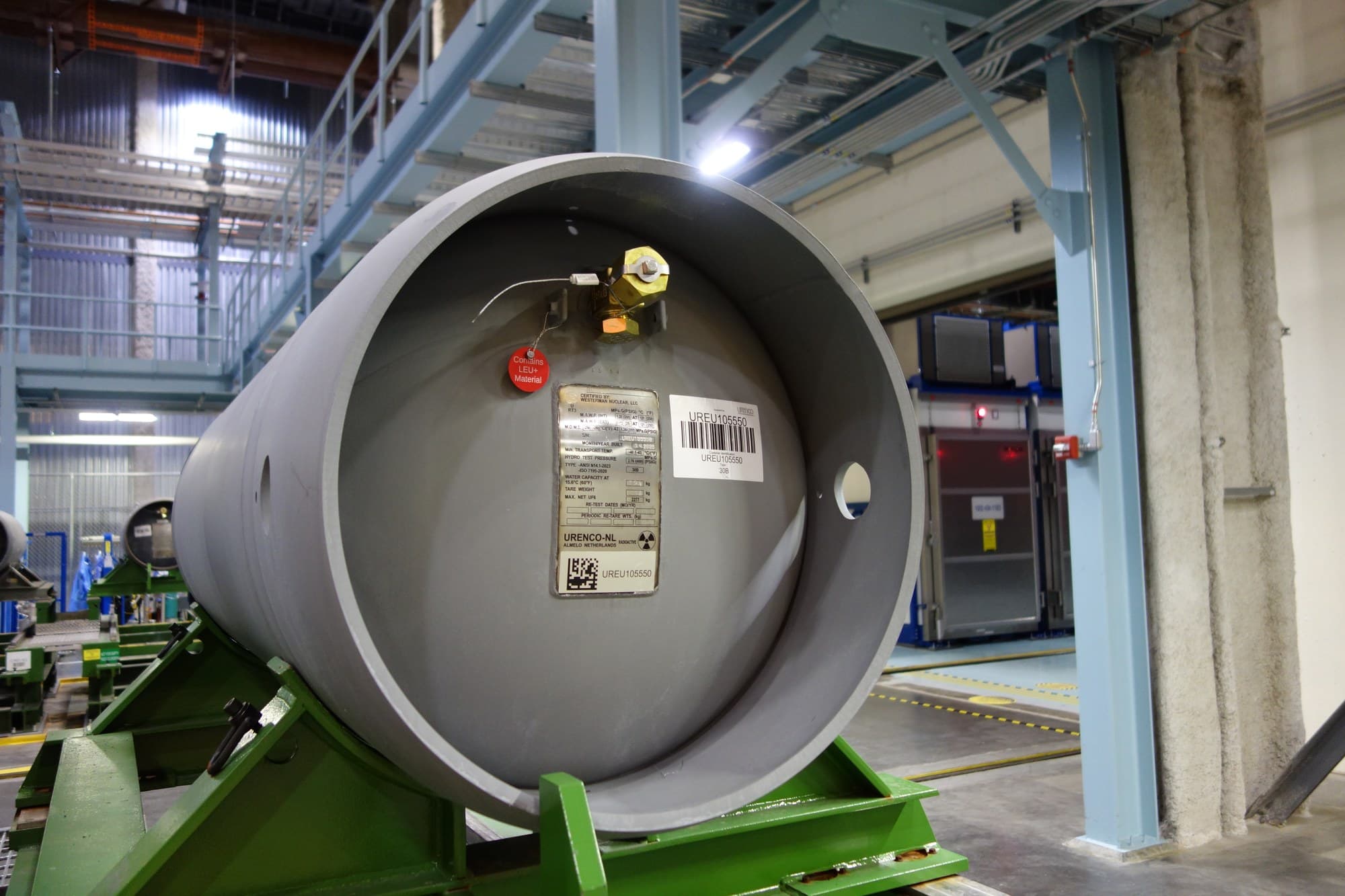
A product cylinder tagged as containing LEU+ material at Urenco USA's Eunice, New Mexico plant. The photo is from Urenco's release; Urenco has not said what quantity the first commercial cylinder holds.
Image: Urenco
Source · Press image from the Urenco newsroom, used for news reporting.
Urenco USA said on Nov. 2 that it had completed its first commercial LEU+ product cylinder, uranium enriched to between 5% and 10% U-235, at its enrichment plant in Eunice, New Mexico.
The company calls it the first commercial production of LEU+ in the Western world. The US Nuclear Regulatory Commission (NRC) authorized the plant in September 2025 to enrich uranium up to 10% U-235, and Urenco says every gas centrifuge cascade at the site is licensed to make LEU+. World Nuclear News reported the milestone on Nov. 3. Urenco has not named a customer for the cylinder, the quantity it holds or a delivery date.
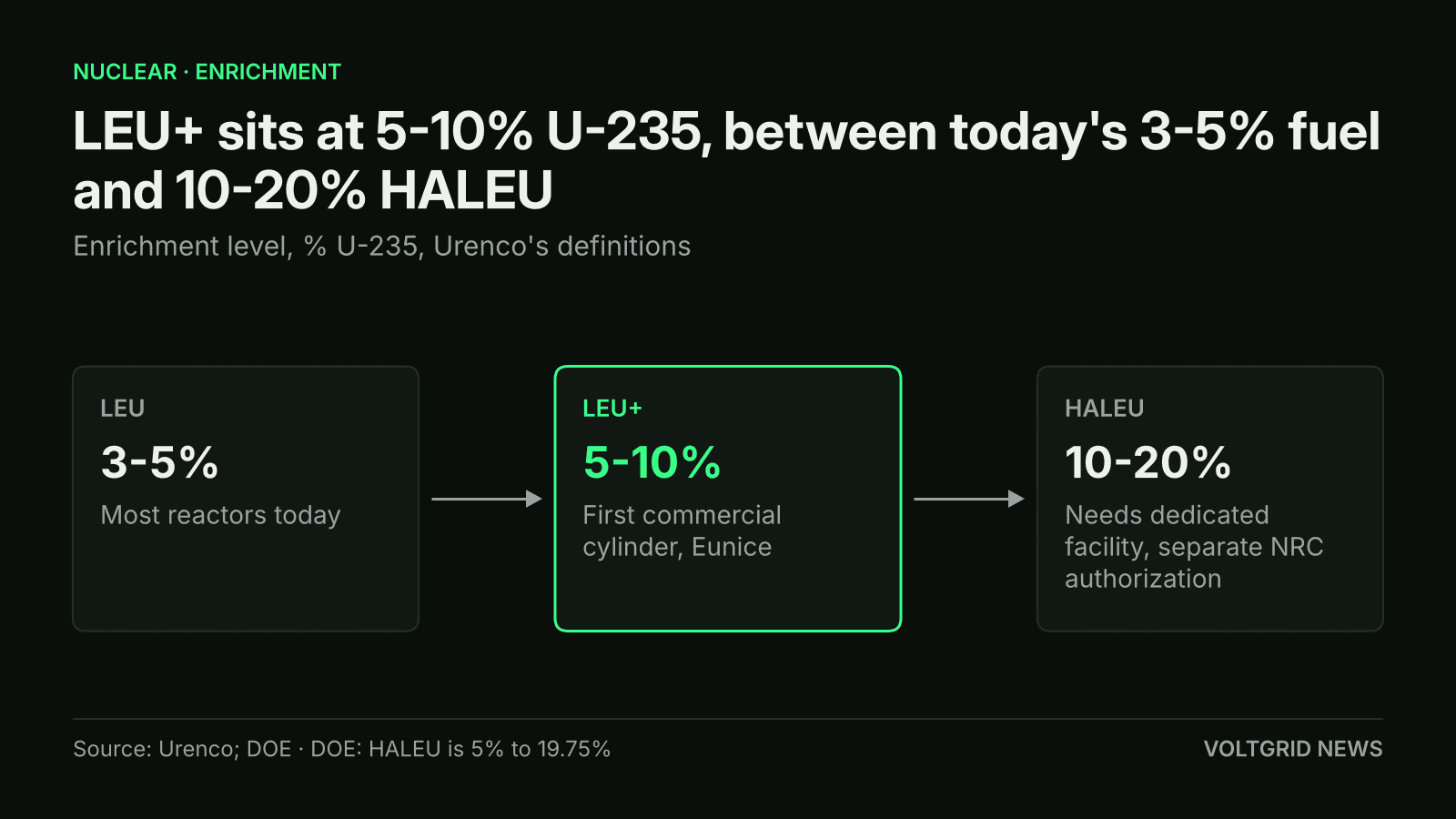
Urenco places LEU+ at 5-10% U-235, above the 3-5% LEU most reactors use and below the 10-20% it calls HALEU; DOE defines HALEU more broadly, as 5% to 19.75%.
Illustration (AI-generated)
What LEU+ Means for Existing Reactors
Most reactors operating today burn low-enriched uranium (LEU) enriched to about 3% to 5% U-235, Urenco says. Urenco says fuel made from LEU+ lets existing light-water reactors run longer cycles with fewer refuelling outages, cutting operating and maintenance costs, and that several advanced reactor designs in development will use it. For data-center buyers, the near-term gain is more running hours from reactors already on the grid; LEU+ adds no new reactor. Fuel makers are preparing for it: Westinghouse plans a $1 billion LEU+ fuel factory in South Carolina, targeted for 2030.
Where LEU+ Ends and HALEU Begins
Urenco counts only uranium enriched from 10% to 20% U-235 as high-assay low-enriched uranium (HALEU) and treats 5% to 10% as LEU+. The US Department of Energy and the NRC use a wider definition, above 5% and below 20% U-235, so DOE's definition takes in LEU+. Either way, Urenco says its Eunice plant is licensed only up to 10% and that production above 10% needs a dedicated facility and a separate NRC authorization. The Eunice output therefore does not by itself fuel the advanced reactors designed around fuel enriched above 10%, Urenco says, though some advanced designs will use LEU+ itself. What Eunice can do, according to Urenco, is serve as feedstock that raises how much a dedicated HALEU plant can produce. That plant is what Centrus is building in Ohio: Centrus shipped the first new centrifuge for its Piketon expansion on Oct. 29 and targets new cascades there in 2029, under a Department of Energy contract that specifies HALEU at a nominal 19.75%.
Enrichment capacity is measured in separative work units (SWU), a gauge of the effort needed to raise the U-235 share. Eunice has 4.3 million SWU a year today, which Urenco says can cover about one-third of current US demand for LEU. The plant began operating in 2010, and Urenco describes it as the only commercial-scale enricher in the country.
Eunice Expansion Targets and Open Questions
Urenco USA is installing 700,000 SWU of new centrifuge capacity at Eunice, World Nuclear News reported, a programme it said in December 2025 runs to 2027. Beyond that, Urenco targets more than 7 million SWU of US capacity over the next decade. It plans to start building a new enrichment plant at the site in 2029, adding 2.1 million SWU, with the first cascades producing in 2032 and more installed through 2036; all of these dates are Urenco's own targets. The company says the new capacity will also be able to make LEU+.
The commercial cylinder comes later than Urenco's earlier aim. The plant finished an initial LEU+ production run on Dec. 11, 2025, and the company then aimed to supply commercial quantities from mid-2026, World Nuclear News reported at the time. Still undisclosed are the buyer, the volumes and which advanced designs will take the fuel. Centrus reports third-quarter results after the market closes on Nov. 4, the next read on US enrichment beyond Eunice.