California Resources, Bloom Energy Sign Non-Binding MOU to Study 1 GW+ of Fuel Cells
California Resources and Bloom Energy signed a non-binding MOU to evaluate 1 GW or more of solid-oxide fuel cells with carbon capture, per CRC's Nov. 2 filing. Data centers are among prospective buyers, DCD reported; no site, buyer or date is set.
Chips & Power DeskEdited by Ege Erten
3 min readAI-assisted
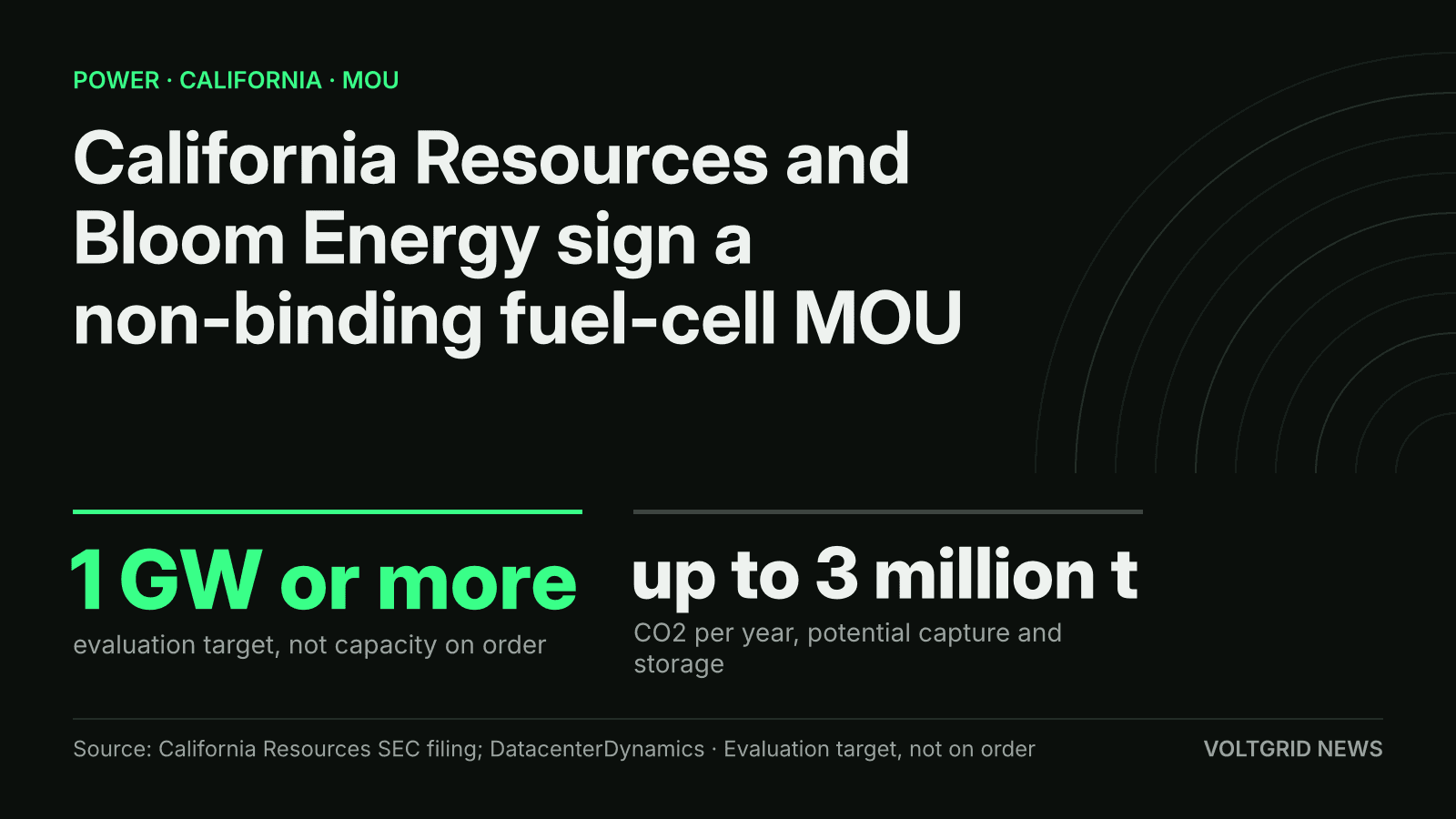
Key facts of the proposed California Resources and Bloom Energy fuel-cell plan: 1 GW or more is an evaluation target under a non-binding MOU, not capacity on order.
Illustration (AI-generated)
California Resources Corporation (CRC) has signed a non-binding memorandum of understanding (MOU) with Bloom Energy to evaluate 1 gigawatt (GW) or more of solid-oxide fuel-cell generation paired with carbon capture and storage (CCS), the independent energy and carbon-management company said in its third-quarter results, dated Nov. 2 and furnished with an 8-K.
The filing, an exhibit to CRC's 8-K, describes the MOU as an agreement to jointly evaluate and target the potential development of that capacity. A footnote states that MOUs are non-binding and that the projects and transactions they describe are subject to conditions precedent, typically including definitive documents, a final investment decision (FID) by the parties and receipt of Environmental Protection Agency (EPA) Class VI permits and other regulatory approvals. Class VI wells inject carbon dioxide (CO2) for long-term storage. CRC also lists its ability to develop and finance the projects contemplated by the Bloom MOU among its forward-looking risks.
For data centers, the 1 GW figure is a target to evaluate, not capacity on order. No site, offtaker, megawatts per project, cost or schedule has been disclosed. What the MOU does add is a partner with land and CO2 storage in California. If definitive agreements follow, the plan is for fuel-cell power on or near buyers' sites with some of the CO2 captured and stored. Neither company has stated a capture rate or named a capture technology vendor.
Who would do what
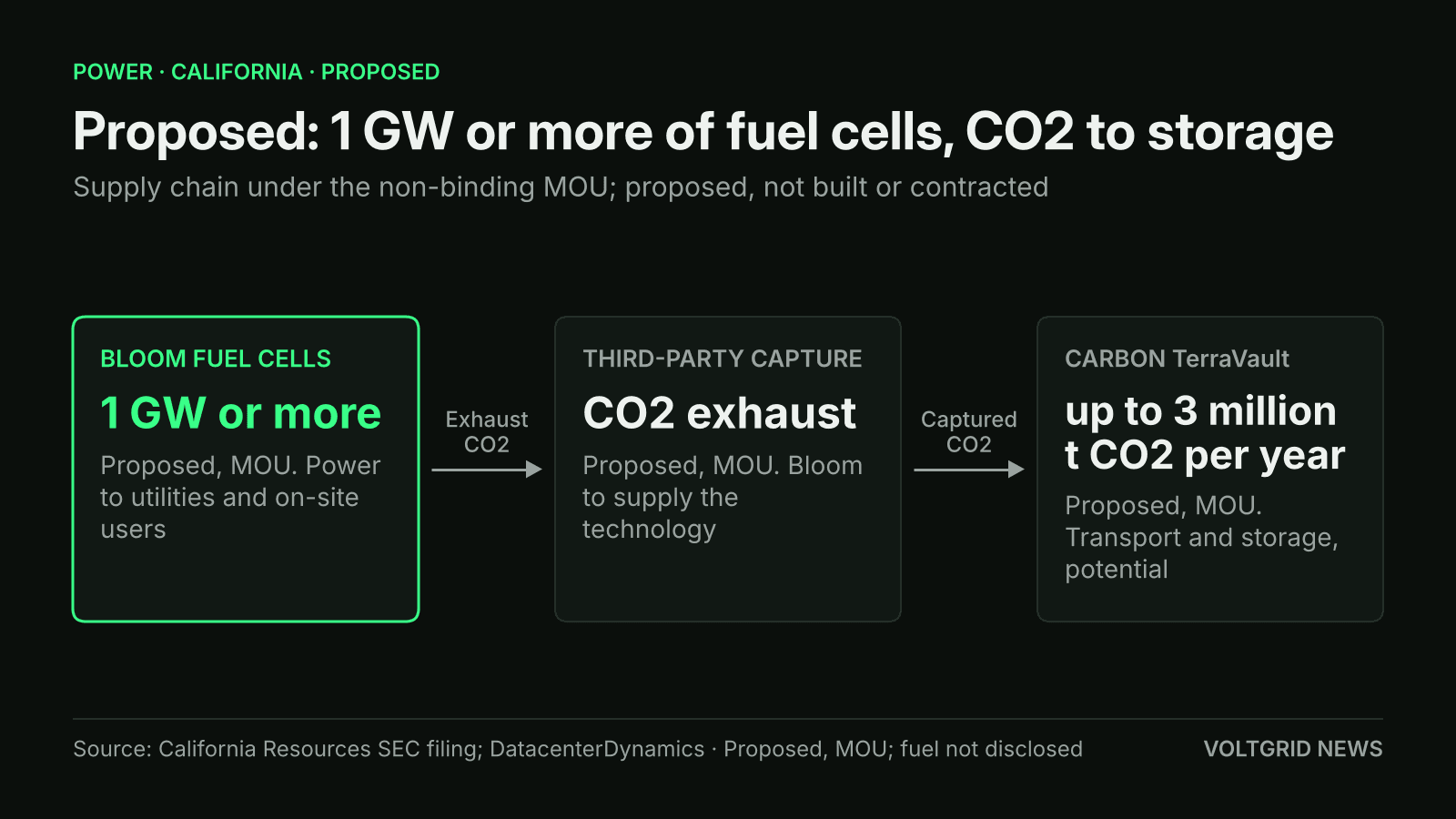
The proposed chain runs from Bloom fuel cells through third-party capture to Carbon TerraVault storage; every step is proposed under the MOU, and the fuel is not disclosed.
Illustration (AI-generated)
According to DatacenterDynamics (DCD), Bloom would supply the fuel cells and third-party carbon capture equipment. CRC's carbon management business, Carbon TerraVault, would transport and store the CO2, and CRC would manage the projects. The partners say the fuel cells' exhaust carries CO2 in high concentration, which they argue makes capture cheaper; they put the potential at up to 3 million metric tons of CO2 a year.
The plan covers both sides of the meter in Central and Northern California, DCD reported. Front-of-the-meter projects would sell power to utilities. Behind-the-meter projects, on land across CRC's Central Valley footprint, would serve industrial users seeking on-site power. The prospective buyers named are data centers, utilities, community choice aggregators, municipalities and other industrial users, and the companies say they will handle interconnection and permitting. None has been named. The filing does not name the fuel either; DCD notes that Bloom's cells can run on hydrogen but most today use natural gas.
CRC already runs CCS at home. Its results describe the project at the Elk Hills Cryogenic Gas Plant as California's first, and say Carbon TerraVault's CTV I is injecting CO2 into a depleted reservoir.
What a Non-Binding MOU Commits the Parties To
A memorandum of understanding records an intent to study a project. It creates no duty to build or to buy. California Resources says in its filing that MOUs are non-binding and that the projects they describe typically need definitive documents, a final investment decision and EPA Class VI permits before anything is built.
That is why the 1 GW or more here is an evaluation target. Oracle's Bloom agreement shows the difference: a ceiling of up to 2.8 GW and a contracted 1.2 GW are different numbers, and only a signed supply contract or power purchase agreement turns either into power for a data center.
How it compares, and what is open
Bloom's other large data-center agreements go further than an evaluation. Bloom said in April 2026 that Oracle intends to procure up to 2.8 GW of its fuel cells, with 1.2 GW contracted. American Electric Power's agreement with Bloom, announced in November 2024, is for up to 1 GW, with 100 MW ordered at the outset. Google has a 20-year power purchase agreement (PPA) for the 702 MW Bloom fuel-cell plant near Cheyenne, Wyoming, which AEP, through Cheyenne Fuel Cell, LLC, is building; AEP targets full operation by the end of 2028, and carbon capture there is planned, not committed. Bloom said in February 2025 that its collaboration with Equinix exceeds 100 MW across 19 US data centers. Bloom's growth has been tied to data-center demand, as Voltgrid reported on its third-quarter results.
What would make the California plan concrete is a first named site and offtaker, a definitive agreement, and the EPA Class VI permits that the MOU's footnote lists among the typical conditions. Neither company has given a date for any of them.