UK Data Centre Covenant Offers Priority Grid Access to Strategic Sites
Chancellor John Healey's Oct. 28 Budget ties priority grid connections and interim on-site power to local-benefit tests, as the UK targets 6 GW of AI data centre capacity by 2030.
2 min readAI-assisted
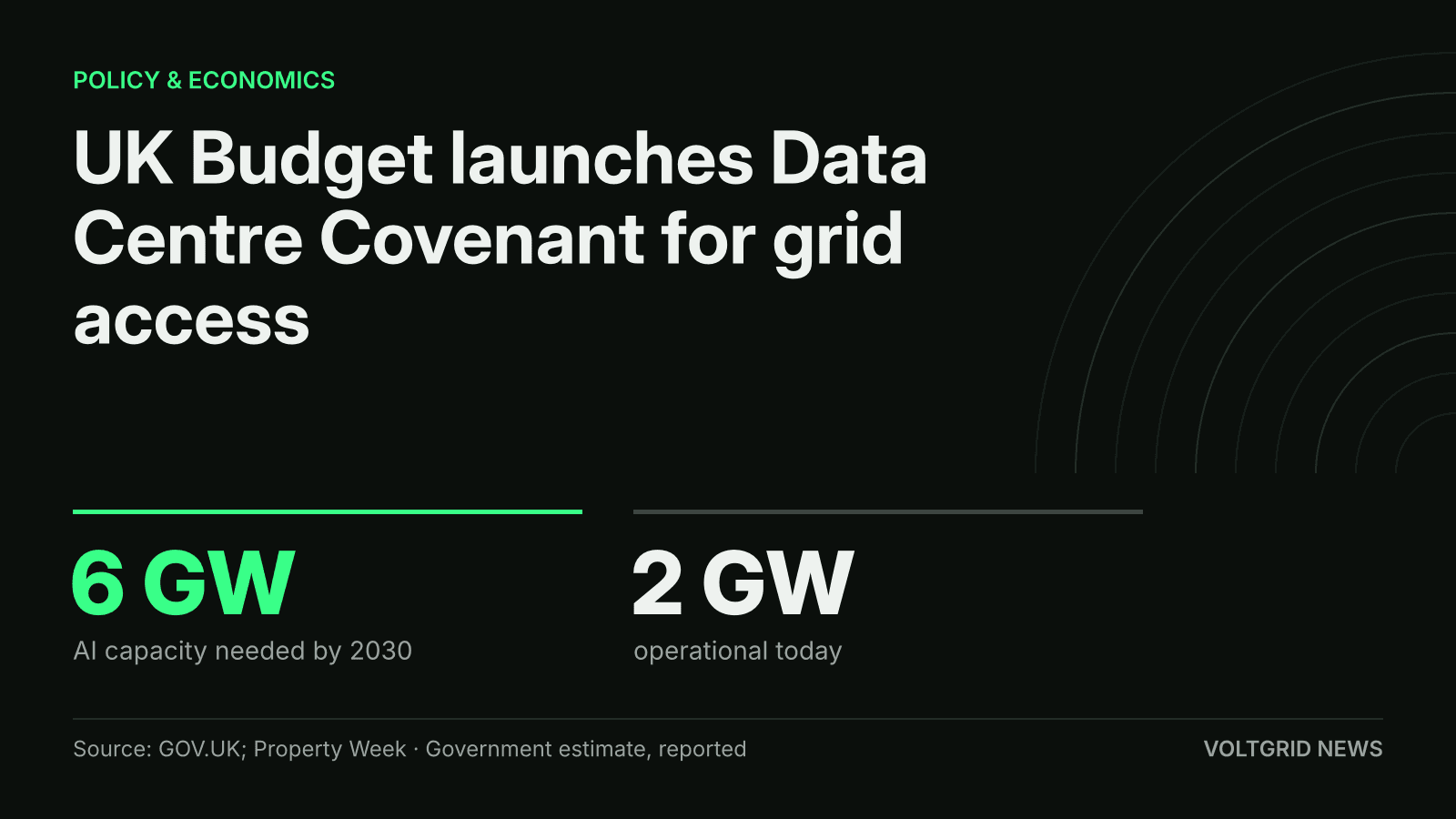
The Data Centre Covenant targets a gap between about 2 GW operational and a government estimate of 6 GW needed by 2030, as reported by Property Week.
Illustration (AI-generated)
UK Chancellor of the Exchequer John Healey launched a British Data Centre Covenant in his Oct. 28 Budget, offering critical data centres the grid connections they need and, where necessary, permission to build on-site generation while they wait.
According to the Budget speech text on GOV.UK, the covenant sets "strict tests" that data centres must meet: investing in local communities, creating local jobs and protecting local water supplies. Property Week adds that the tests also cover environmental standards, apprenticeships and UK procurement, and that a new government body would "accelerate time to power" and speed planning for sites that qualify as strategic.
The covenant puts a number on the gap it is meant to close. Property Week reported that the government estimates the UK needs 6 GW of national AI data centre capacity by 2030 to protect its data sovereignty, against around 2 GW operational today. Healey framed the policy as a sovereignty measure, saying data from the NHS and the armed forces should stay in Britain.
What the covenant changes for grid access
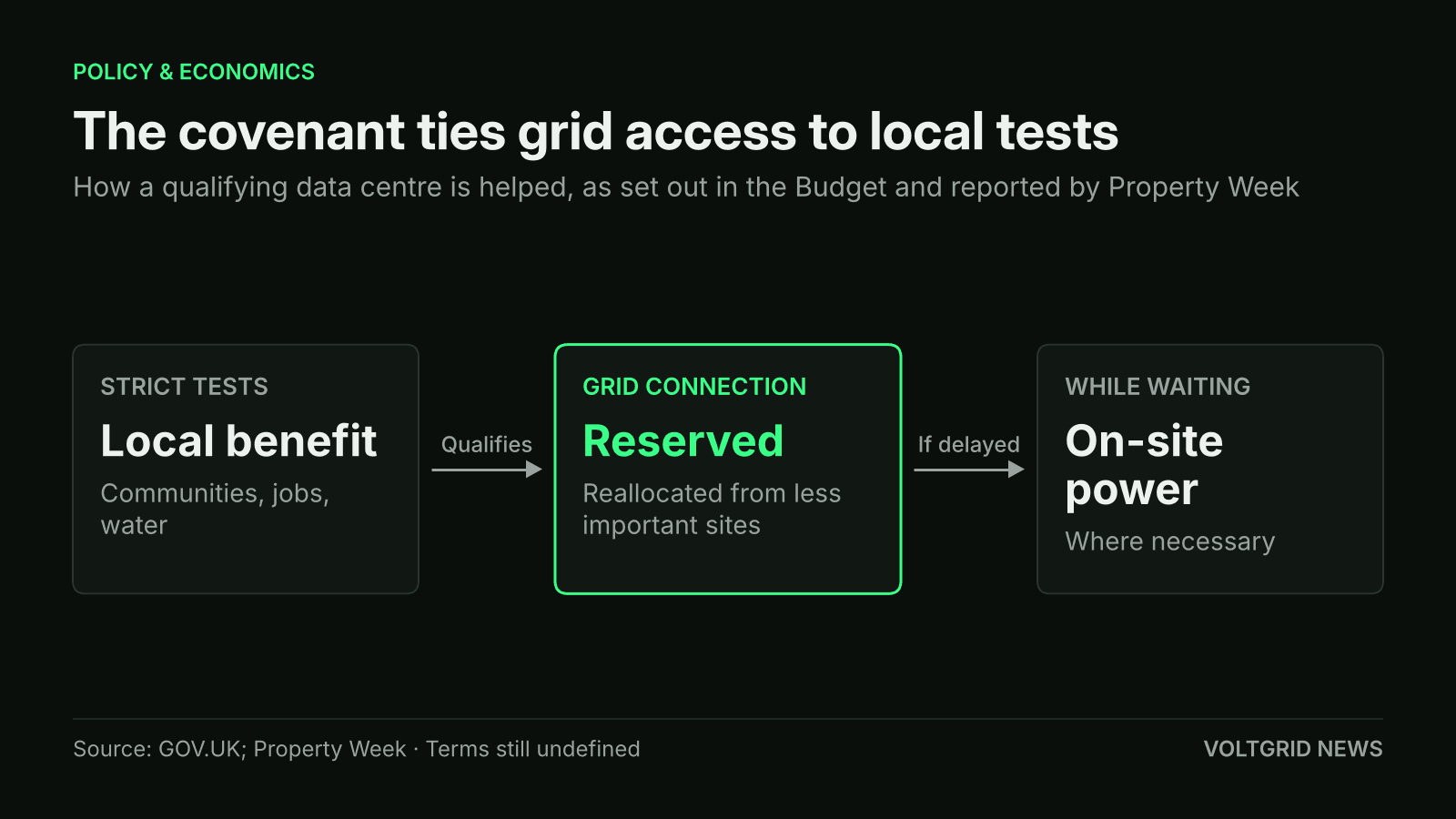
Qualifying data centres get a reserved grid connection and, where necessary, on-site generation while they wait, according to the Budget speech and Property Week.
Illustration (AI-generated)
For developers that qualify, Property Week said, the government will reserve and reallocate grid connections, identify extra capacity when it becomes available and transfer connections away from less important data centres. That makes grid access conditional on meeting the tests rather than on queue position alone, and it creates two tiers of projects: strategic sites with state help and everything else.
The power shortage is the backdrop. City AM reported that Microsoft withdrew last week from plans for what would have been Britain's largest AI data centre with Nscale, after grid capacity problems stopped the Essex site getting power in time for its planned 2026 launch. Voltgrid News covered that withdrawal in Microsoft's decision to drop the Nscale site and the grid timeline behind it.
What is not defined yet
The text published so far leaves the decisive terms open. Law firm partners quoted by Property Week said the key question is how the government defines a "strategic" project, what the tests will require in practice, and whether the covenant sits outside the planning system or is imposed through it. HSF Kramer's Naomi Hoggett also warned that it must fit alongside Section 106 planning agreements, so developers are not asked to meet overlapping conditions.
Industry reaction so far is supportive but conditional. Gary Watson of data centre firm Stellanor told City AM the tests must recognise regional and urban sites, not only the largest campuses, while Pure Data Centres Group's Gary Wojtaszek welcomed a framework that recognises work developers already do.
The Budget also gave another £140m to the Sovereign AI Unit, which channels government investment into British AI companies. None of the sources read gives a connection date, a capacity figure for covenant sites or a start date for the tests, so developers cannot yet tell how much power the covenant would release or when.