Western Australia Plug-In Solar Rule: 2 kW Panels, 800 VA Inverters
Western Australia opened consultation on Oct. 28 to legalise plug-in solar and batteries, the first Australian state to do so, with no proposed cap on battery size and no electrician required.
3 min readAI-assisted
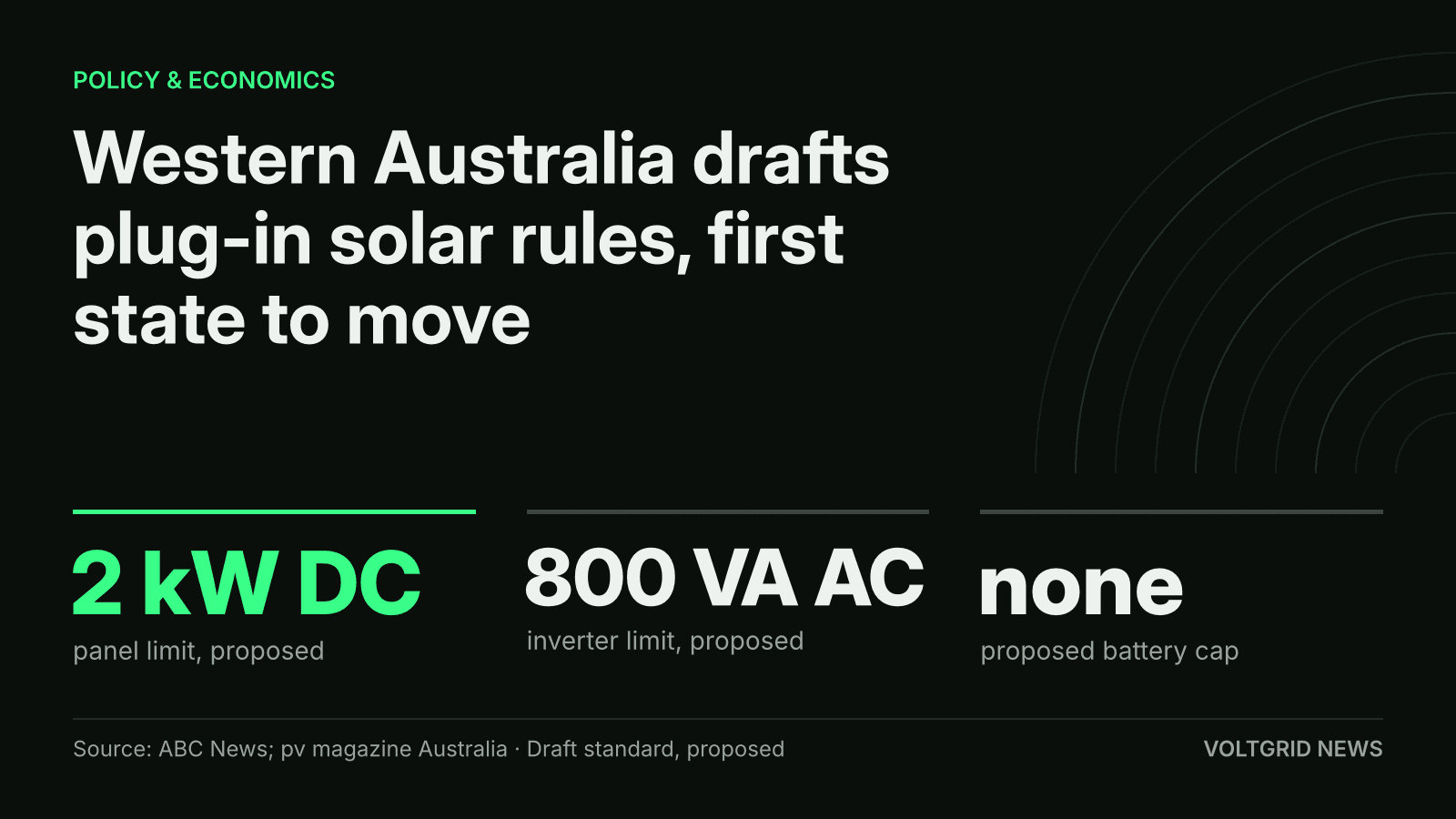
The draft standard is a proposal; Western Australia would be the first Australian state to legalise plug-in solar and batteries.
Illustration (AI-generated)
Western Australia opened consultation on Oct. 28 on a safety standard that would legalise plug-in solar panels and batteries, making it the first Australian state or territory to move, according to ABC News and pv magazine Australia.
Under the draft Technical Bridging Standard, plug-in systems would be classed as standard electrical appliances. Solar panel combinations would be limited to a rated 2 kW (DC), and inverters to 800 VA (AC). The standard proposes no upper limit on plug-in battery storage capacity, pv magazine Australia reported. The systems plug into an ordinary wall outlet and need no electrician to install.
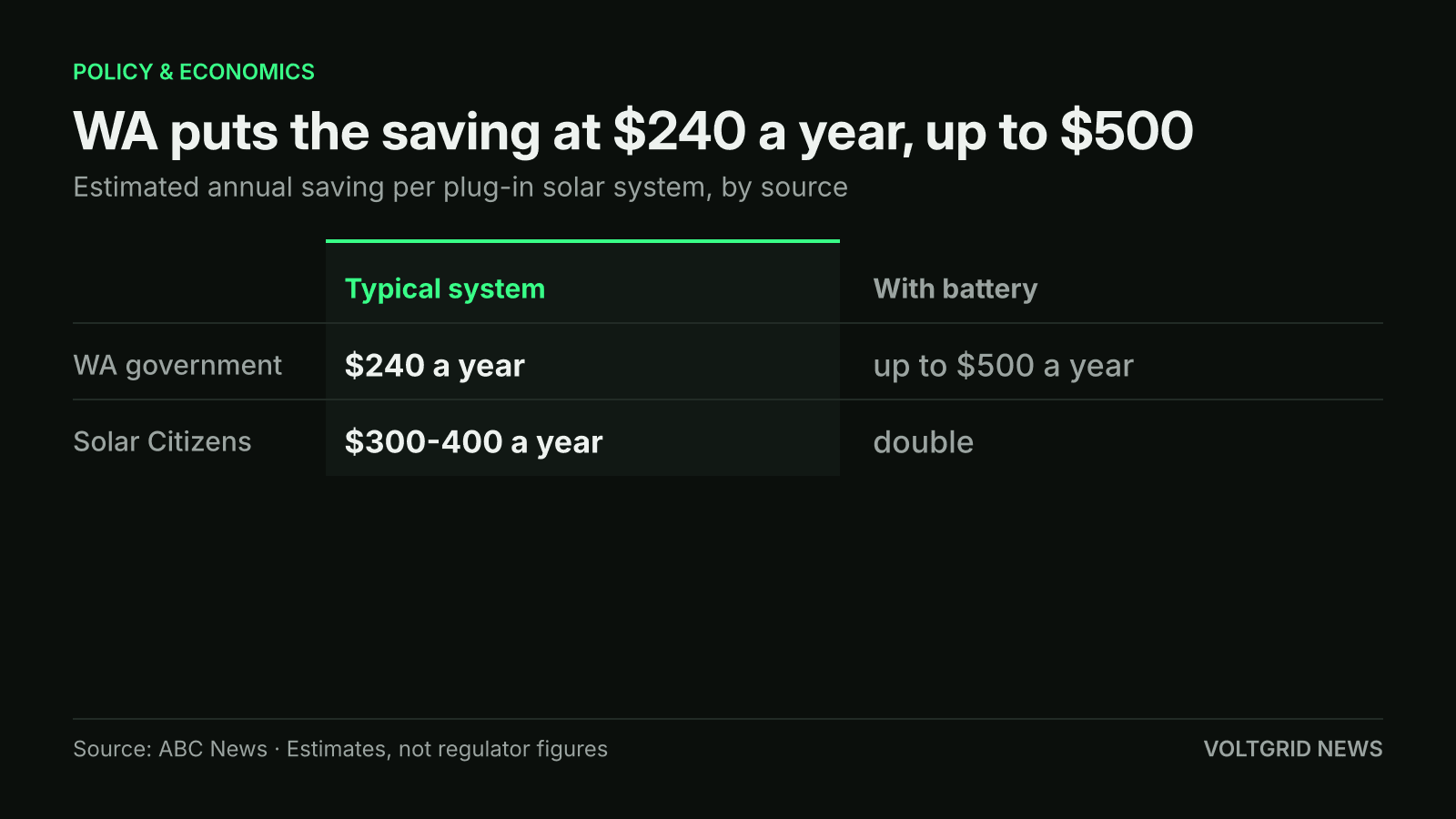
The WA government estimate sits below the Solar Citizens advocacy estimate; both are estimates, according to ABC News.
Illustration (AI-generated)
For power markets, the missing battery cap is the notable detail. The 800 VA inverter limit bounds how much a system can feed in at any moment, while the open battery limit leaves room to shift stored solar into the evening. The state's own savings estimate shows the economics: the WA government estimates a typical plug-in solar system saves a household $240 a year on its electricity bill, and up to $500 a year with a battery, ABC reported.
What the standard changes
The consultation is run by the Department of Energy and Economic Diversification and the Building and Energy Division. The standard is modelled on German rules, where ABC says an estimated one in 10 households has a system. The UK legalised plug-in solar earlier this year, though without storage, and New Zealand is looking to do the same within 12 months, ABC reported. Solar Citizens, an advocacy group, says the devices are already legal in Germany, the UK and 10 US states.
The department says the final standard is likely to have two parts, one for product requirements and one for installation requirements, to match Australian and New Zealand technical standards. It also said it would work on other changes needed for renters to use the systems.
Who pays and who gains
Industry experts quoted by ABC put the payback period for plug-in solar at four to 10 years. Solar Citizens, which has campaigned for legalisation, estimates an average panel saves $300 to $400 a year, and about double that with a battery. Those are advocacy and expert estimates, not regulator figures, and they differ from the state's own $240 and $500. ABC said overseas systems typically cost up to $1,300, plus extra for a battery.
The target group is households that cannot use rooftop solar. More than 40 per cent of homes on the South West Interconnected System, WA's main grid, already have solar panels, ABC reported, so the new rule reaches renters and apartment dwellers who have been excluded.
What is not settled yet
The standard is a proposal, and the systems are not yet legal to plug in. Energy and Decarbonisation Minister Amber-Jade Sanderson said the state intends to lead the nation. Federal energy minister Chris Bowen warned in September, when energy ministers agreed to explore national pathways, that the process would not happen "overnight" and needs changes to state safety standards, RenewEconomy reported.
ABC said the state government must still bring landlords and body corporates on board before panels can be hung on balconies. Solar Citizens is asking Canberra for a nationally coordinated approach by July 2027.
Elsewhere in the region, governments are using rooftop solar rules as a demand tool. Voltgrid reported that Vietnam ordered provinces to set rooftop solar incentives by December 2026, and that Gujarat added a Rs 1,000 crore rooftop subsidy. WA's approach differs in that it removes an installation barrier rather than paying a subsidy.