US Energy Storage Tops 200 GWh as Q3 Adds 14.3 GWh
SEIA and Benchmark say US storage installs passed 200 GWh, with 48.3 GWh added in nine months, up 20%, led by Texas utility-scale; the 2030 forecast rose to 708 GWh.
3 min read
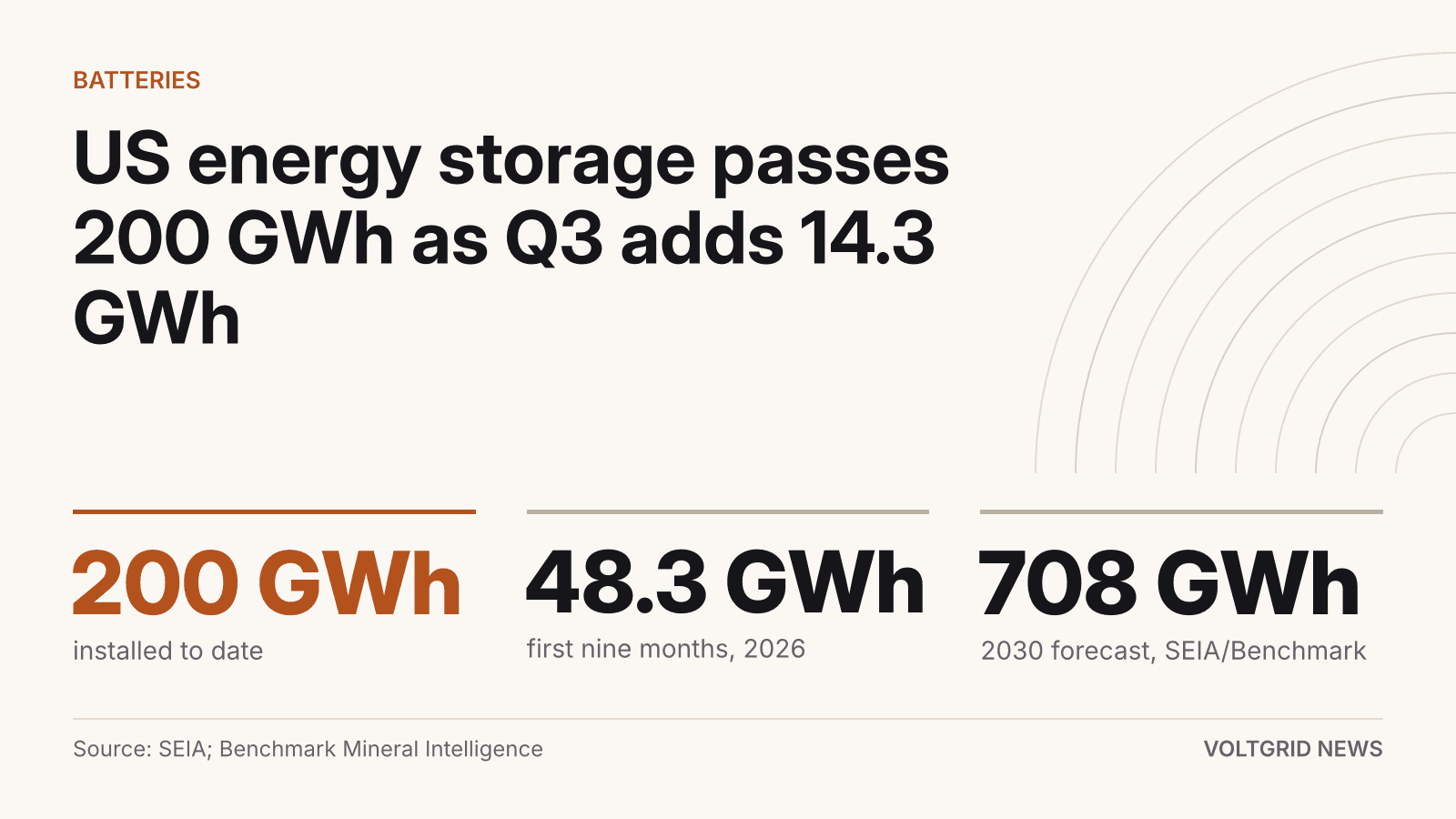
SEIA and Benchmark: US installed storage has passed 200 GWh; the 2030 figure is a SEIA/Benchmark forecast.
Graphic: Voltgrid News
The US has installed more than 200 GWh of energy storage, SEIA and Benchmark Mineral Intelligence said on Nov. 17, with 14.3 GWh added in Q3 and 48.3 GWh in the first nine months of 2026.
The Solar Energy Industries Association (SEIA) published the figures in its U.S. Energy Storage Market Outlook Q4 2026, released at the RE+ conference in Las Vegas, according to POWER Magazine. Installations through September are up 20% from the same period of 2025, SEIA said. Electrek, citing the same report, adds that Q3 on its own was down 1% year over year. SEIA's release gives no cumulative total beyond "exceeded 200 GWh."
Utility-scale projects supplied most of the quarter. They accounted for 12.2 GWh of the 14.3 GWh, followed by 1.3 GWh of commercial and industrial storage and 746 MWh of residential storage, per SEIA. Voltgrid's arithmetic: utility-scale was about 85% of Q3 installs, and Q3 was about 30% of the nine-month total. Electrek reports that residential installs set a Q3 record but are still down 12% for the year to date, after some homeowners moved up projects before the federal residential tax credit ended.
Utility-scale projects supplied 12.2 GWh of the 14.3 GWh installed in Q3 2026, per SEIA.
Graphic: Voltgrid News
For grid planners, the mix matters more than the headline. Utility-scale batteries are where the new gigawatt-hours are landing, and Electrek notes that batteries with power to spare at peak let grid operators call on expensive plants less often. As Voltgrid reported, LG Energy Solution said on Nov. 3 that its energy-storage backlog is about 160 GWh, and most of its North American volume through 2028 is already committed.
Where the Gigawatt-Hours Went
Texas led utility-scale deployment through Q3 with 12.3 GWh, ahead of Arizona at 7.7 GWh and California at 6.8 GWh, SEIA said. Eleven states passed their previous full-year storage installation record in Q3 with three months still to go: Colorado, Massachusetts, Utah, Michigan, Georgia, Mississippi, Virginia, Iowa, Montana, Alabama and Illinois.
"States are moving from targets to centralized procurements," said Pete Tillotson, a senior analyst at Benchmark. Electrek points to New York, which in September awarded contracts for eight battery projects that can deliver about 950 MW combined. That figure is power, not energy, and is not part of the GWh totals above.
SEIA also credits solar and storage with lower wholesale prices: its analysis found average prices fell 42% in Texas and 51% in California from summer 2021 to summer 2026. Electrek notes that residential bills still rose, 22% at two California utilities and 3% across a Texas utility sample, because delivery costs climbed.
Cell Capacity and the 2030 Forecast
The outlook raises the 2030 cumulative US forecast by 3.7% to 708 GWh across grid and behind-the-meter systems, roughly 3.5 times today's 200 GWh milestone by Voltgrid's arithmetic. On the supply side, a battery cell plant opened in Tennessee in July and another in Indiana in October, lifting US cell manufacturing capacity to 92.4 GWh, up 50%, per SEIA. As Voltgrid reported, Samsung SDI America will supply 16 GWh of Indiana-made LFP cells to Jupiter Power from 2029. Investors are also buying into the pipeline: EQT agreed to buy Flatiron Energy, a 24 GWh US storage portfolio, on Nov. 17.
What is not confirmed yet
The release does not say whether the 92.4 GWh of cell capacity is annual or operating, and it does not name the two new plants. The Q3 year-over-year decline and the residential figures come from Electrek, not from SEIA's release. The report's underlying tables were not part of the release.
Sources
- Published
- Sources
- 3 cited