AI Agent Token Cost: $610-$3,650 a Month at List Price, Under $7 of Power
A heavy AI agent month costs three to 18 times a $200 plan at API list prices, Voltgrid calculates, yet uses 5 to 90 kWh. Chips, not power, are why Claude and ChatGPT limits keep moving.
Hardware & Analysis DeskEdited by Ege Erten
12 min readAI-assisted
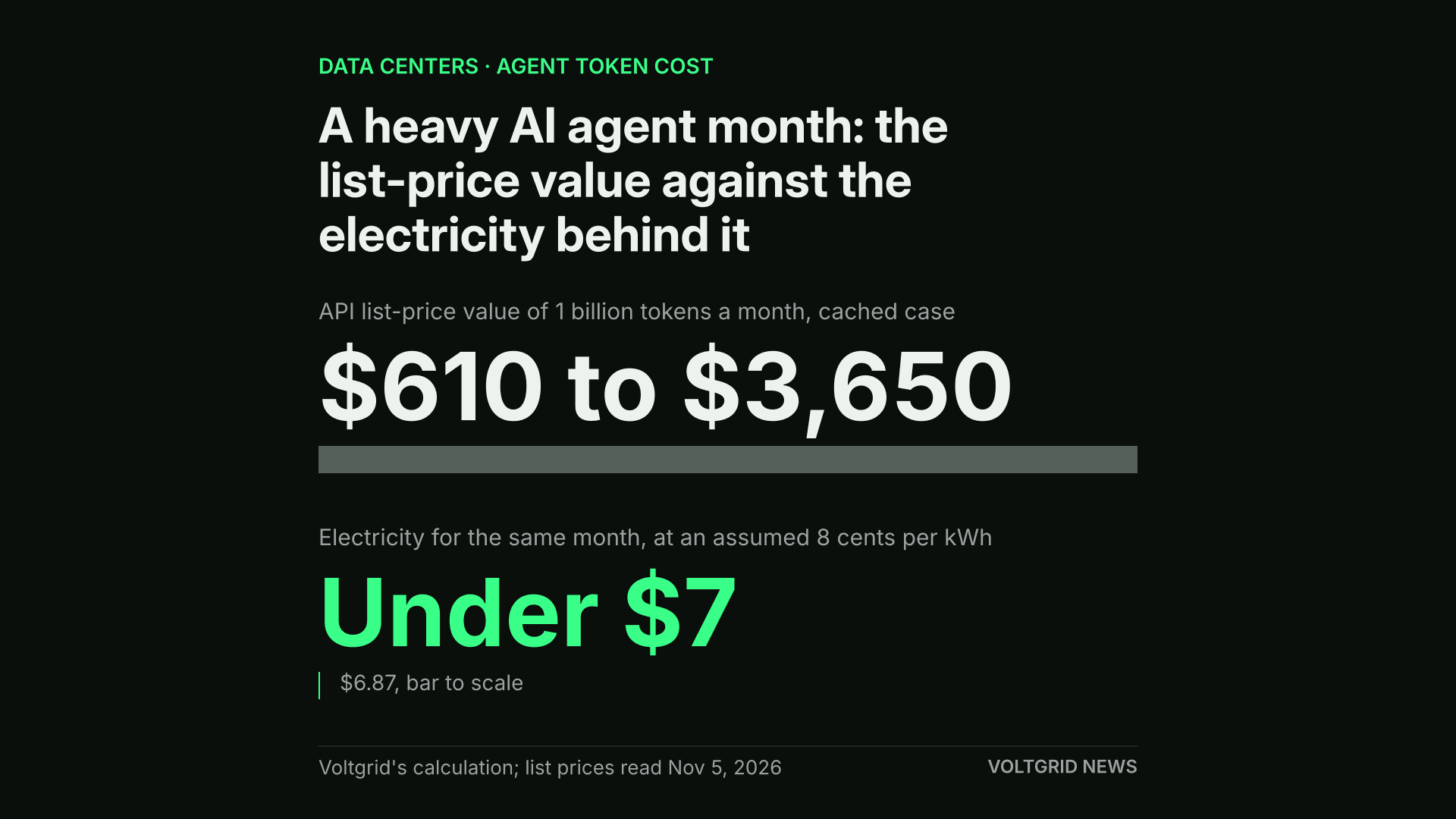
Generated graphic, not a photo. List-price value of a 1-billion-token month (cached case) set against its electricity at an assumed 8 cents per kWh; both Voltgrid's calculation. List prices read Nov 5, 2026.
Illustration (AI-generated)
By Voltgrid's calculation, the AI agent token cost of a month at 1 billion tokens is $610 to $3,650 at API list prices, three to 18 times a $200 plan, yet it uses under $7 of electricity at an assumed 8 cents per kWh.
A token is a small piece of text, a word or part of one, that an AI model reads or writes; Epoch AI, a research group, counts 500 tokens as about 400 words. Developers buy tokens by the million through an API. Subscribers pay a flat fee instead, such as $200 a month for Anthropic's Claude Ultra or OpenAI's ChatGPT Pro 200, for an allowance that no provider states in tokens.
For someone typing questions, the flat fee goes a long way. An agent is different. It works in a loop, sending the model its instructions, its files and everything it has done so far at every step, hundreds of times a day, and some never stop: OpenAI introduced always-on agents it calls dots on Sept. 29, 2026. All that re-sent context is why one month of agent work can be worth three to 18 times the plan price when billed per token, and why every flat-rate plan comes with a limit.
The electricity is the small part. On our assumptions the month uses roughly 5 to 90 kWh, under $7 at an assumed 8 cents per kWh. The scarce input is time on accelerator chips, and the data centers and grid connections needed to run more of them. Anthropic said in its Oct. 26 IPO filing that it has "historically operated in a compute-constrained environment," one in which demand for compute exceeded supply. Multiplied across millions of users, that demand is what pushes data-center power use up, and it is why providers keep moving their limits.
What a Heavy AI Agent Month Costs at API List Prices
The scenario is ours, not a disclosure. We assumed 20,000 model calls in a month, about 650 a day, each writing 2,000 tokens and reading about 48,000. That makes 40 million output tokens (4% of the total), 60 million fresh input tokens (6%) and 900 million input tokens served from the provider's prompt cache (90%). Agents re-send the same context again and again, and providers store it so a repeat read costs a fraction of the input price; the 90% share is our assumption. We billed fresh input at each provider's cache-write rate and used standard list prices read on Nov. 5, 2026, with no batch discount, fast mode or surcharge. Gemini 4 Argon lists implicit caching only, so its fresh input is billed at the input rate.
The arithmetic is short. Anthropic's price page lists Claude Sonnet 5.5 at $10 per million output tokens, $2.50 per million cache-write tokens and $0.10 per million cache reads, a price Anthropic cut from $0.20 on Oct. 7, 2026. The month comes to $400 plus $150 plus $90, or $640. OpenAI's GPT-6.1 Sol carries the same three rates on its API price page and lands on the same $640. OpenAI lists a 30-minute cache-write rate where Anthropic lists a 5-minute one; we used each provider's shortest write rate. Claude Opus 5.5, at $20 output, $5 cache write and $0.20 cache read, comes to $1,280.
The top models cost most. Claude Fable 5.1, at $50 output, $12.50 cache write and $0.25 cache read, reaches $2,975. OpenAI's GPT-6 Astra has the same output and cache-write prices but charges $1.00 per million cached tokens, so it reaches $3,650. Google's top-listed Gemini API model sits in the middle and is about to move: its Gemini API price page lists Gemini 4 Argon at $2 input, $10 output and $0.10 cached through Nov. 30, 2026, then $4, $20 and $0.20 from Dec. 1. Our month costs $610 at the current Argon rates and $1,220 after the change.
Against a $200 plan, the cached month is worth 3.1 to 18.3 times the fee. Without caching, with all 960 million input tokens billed at the full input price, it would cost $2,320 to $11,600. Caching works because a model keeps a memory of the tokens it has already read, the key-value cache that Voltgrid sized for DeepSeek's V4.1 Flash model, so it does not recompute them. That memory has a cost of its own: long agent sessions can push it out of GPU memory and into system RAM.

Cached case for 1 billion tokens a month (4% output, 6% fresh input, 90% cached), Voltgrid's calculation and scenario. Without caching: $2,320 to $11,600. Vendor list prices read Nov 5, 2026: Anthropic, OpenAI, Google.
Illustration (AI-generated)
These are list-price values, not the providers' costs, which none of them publishes. The nearest public figures are in Anthropic's S-1. Compute and infrastructure expense was $8.945 billion in the six months to June 30, 2026, or 55% of revenue, against 201% a year earlier, as Voltgrid reported from the filing; that line covers research, model development and Anthropic's own use of Claude as well as serving customers. A breakdown in the filing's notes puts cost of revenue, which it says is substantially all compute and infrastructure for serving customers, at $2.38 billion, about 15% of revenue by our arithmetic. Neither is a cost per token.
AI Agent Electricity Use: 5 to 90 kWh a Month
Only Google has published a measured energy figure for serving its model in production. Its researchers reported on Aug. 21, 2025 that the median Gemini Apps text prompt used 0.24 Wh in May 2025, counting the whole serving stack: 0.14 Wh for the AI accelerators, 0.06 Wh for host processors and memory, 0.02 Wh for idle machines held in reserve and 0.02 Wh for data-center overhead such as cooling. Google compares that with less than nine seconds of television. Measured the narrower way other studies use, counting only active chips on more highly utilized machines, the figure was 0.10 Wh, 2.4 times lower, and Google says per-prompt energy fell 33 times in the year to May 2025. The paper does not give the prompt's length in tokens, and it covers chat, not agents.
Sam Altman, OpenAI's chief executive, wrote in June 2025 that the average ChatGPT query uses about 0.34 Wh, without giving a method. Epoch AI estimated on Feb. 7, 2025 that a GPT-4o query writing 500 tokens uses about 0.3 Wh on NVIDIA H100 chips, a figure it calls pessimistic, and modeled, assuming 100 billion active parameters, that long inputs cost far more: about 2.5 Wh with 10,000 input tokens and almost 40 Wh with 100,000. A January 2026 arXiv paper measured open-weight models on NVIDIA B200 chips, each in its lowest-energy setting. On average, a chat answer averaging 717 output tokens took 184 joules of GPU energy, and a reasoning answer averaging 6,988 tokens took 4,625 joules. The authors count only the GPUs, which they say account for 50% to 70% of data-center energy.
We built five cases on those numbers. Treating each of our 20,000 calls as one median prompt gives a floor of 4.8 kWh on Google's figure and 6.8 kWh on Altman's; both understate a call that reads 48,000 tokens. The other three start from energy per output token: 0.071 mWh from the arXiv chat measurement and 0.184 mWh from its reasoning measurement, each multiplied by 1.72 to add host, idle and overhead energy to the chips (Google's fleet figures give 0.24 Wh against 0.14 Wh for the accelerators alone; applying that factor to GPU-only measurements on other hardware is our assumption), and 0.6 mWh from Epoch, whose estimate already includes server and data-center overhead. We assumed a fresh input token takes one-twentieth (low case), one-fifth (mid) or two-thirds (high) of an output token's energy, the last matching Epoch's 100,000-token figure, and a cached token a tenth of a fresh one. No provider discloses those factors.
The result is 5.8 kWh in the low case, 22.1 kWh in the mid case and 85.9 kWh in the high case: roughly 5 to 90 kWh for the month, with 6 to 22 kWh the central range. Spread over a 730-hour month, that is an average draw of about 7 to 118 watts. At an assumed 8 cents per kWh, the electricity costs about 40 cents to $6.90. Even the high case is about 1% of the cheapest list-price bill above at that price, and about 2% at double the rate; the central cases are a small fraction of 1%.

Voltgrid's calculation at an assumed 8 cents per kWh (Voltgrid's assumption). None of these measures Claude, GPT-6 or Gemini 4. Inputs: Google's 0.24 Wh median Gemini Apps prompt, OpenAI's 0.34 Wh figure, Epoch AI, arXiv 2601.22076.
Illustration (AI-generated)
Why Power Is Cheap and Chip Time Is Scarce
Electricity is billed by the kilowatt-hour, and a chip draws it only while it works. That is why a heavy agent month adds so little: on Voltgrid's cases the 1-billion-token month uses roughly 5 to 90 kWh, which costs under $7 at an assumed 8 cents per kWh.
The expensive part is the machine, not the current it draws. Accelerators, the servers around them and the data halls that house them are bought or leased long before they are used, and the bill is mostly the same whether they are busy or idle. Anthropic's S-1 says most of its compute is under multi-year commitments typically procured 12 to 18 months before it is available. The same 1-billion-token month is worth $610 to $3,650 at list prices, so a token's price mostly pays for time on that hardware.
That is the reading behind this story: a provider that is short of accelerators rations accelerator time, through limits and prices, rather than kilowatt-hours. The electricity matters in aggregate, as grid connections and generation for the whole fleet, but not as one subscriber's bill.
Why ChatGPT Pro, Claude Max and Gemini Limits Keep Moving
The latest move was a loosening. On Oct. 29, 2026, OpenAI doubled the Work and Codex allowance in its Pro 100 and Pro 500 plans, its release notes say. It also cancelled a cut to Pro 200 that it had announced by email on Sept. 29 and raised Pro 200 subscribers on the lower allowance to the higher one. Prices stayed at $100, $200 and $500 a month. OpenAI's Pro help page adds that a larger allowance "does not guarantee twice as many completed tasks", that Fast mode uses the allowance 2.5 times as quickly and Ultrafast, available only on Pro 500, eight times, and that any unlimited access is subject to abuse guardrails. On Oct. 28, it offered eligible Pro and Business subscribers promotional API credits. When it introduced dots on Sept. 29, it said their usage would not count against plan allowances for a month, with usage terms for each plan to follow.
Google is moving its metered price up. The Gemini 4 Argon price doubling on Dec. 1 comes seven weeks after the model became generally available on Oct. 13. On Oct. 28, chief executive Sundar Pichai told analysts Alphabet was seeing strong demand for Argon, and finance chief Anat Ashkenazi said capital spending would "increase significantly in 2027" after the company held its 2026 forecast at $195 billion to $205 billion, CNBC reported. Google's Gemini Apps help page describes consumer limits as compute-based, refreshing every five hours up to a weekly limit, with no token count.
Anthropic's filing is the plainest account of the pressure. Its S-1, filed on Oct. 26, 2026, describes a company that has long been short of compute, and says Anthropic has changed usage limits and rate limits and may change them again. Subscriptions "are subject to usage limits that reset over short periods". Metered, consumption-based revenue was $13.1 billion, or 80% of the $16.3 billion total, in the six months to June 30, 2026; subscriptions brought in $3.2 billion, or 20%. Anthropic's plans page says Max at $100 a month gives five times Pro's usage every five hours and every week, and Ultra at $200 gives ten times Pro's weekly usage with no five-hour limit for verified accounts. There is "no fixed message count", and to manage capacity the company may add weekly and monthly caps at its discretion. Since Oct. 7, Max and Ultra have included $100 and $200 a month of API credits, which do not cover Claude Code.
The terms also limit how a plan is used. Anthropic's consumer terms, effective Oct. 8, 2025, bar accessing the service through bots or scripts except with an Anthropic API key or the company's explicit permission. Its plans page says Claude Code draws on the same usage pool as chat, so agent work inside Anthropic's own tools counts against the plan; it is scripted access to the consumer service that the terms limit. OpenAI's Pro page says Pro use is bound by its terms of use and bans shared logins, resold access and automated data extraction.
What It Means for Data-Center Power Demand
One heavy user does not move a grid. A hypothetical million users each running our month would draw about 0.06 to 1.0 TWh a year, by our arithmetic, against the 415 TWh that the International Energy Agency (IEA) estimates all data centers used in 2024, about 1.5% of world electricity. Even the high case is about a quarter of one percent of that total.
The total is what matters. In its Energy and AI report of April 2025, the IEA's Base Case has data-center demand roughly doubling to about 945 TWh by 2030, just under 3% of global electricity, with power use in accelerated servers growing about 30% a year and accounting for almost half the increase. In the United States, a Lawrence Berkeley National Laboratory report released by the Department of Energy on Dec. 20, 2024 put data-center use at 176 TWh in 2023, 4.4% of the country's electricity, and projected 325 to 580 TWh by 2028, or 6.7% to 12%.

US and world figures are estimates by LBNL (via DOE) and the IEA Base Case; 2028 and 2030 are projections. Anthropic's six months to June 30, 2026, from its S-1: revenue $16.286 billion, compute $8.945 billion (55%), subscriptions $3.2 billion (20%).
Illustration (AI-generated)
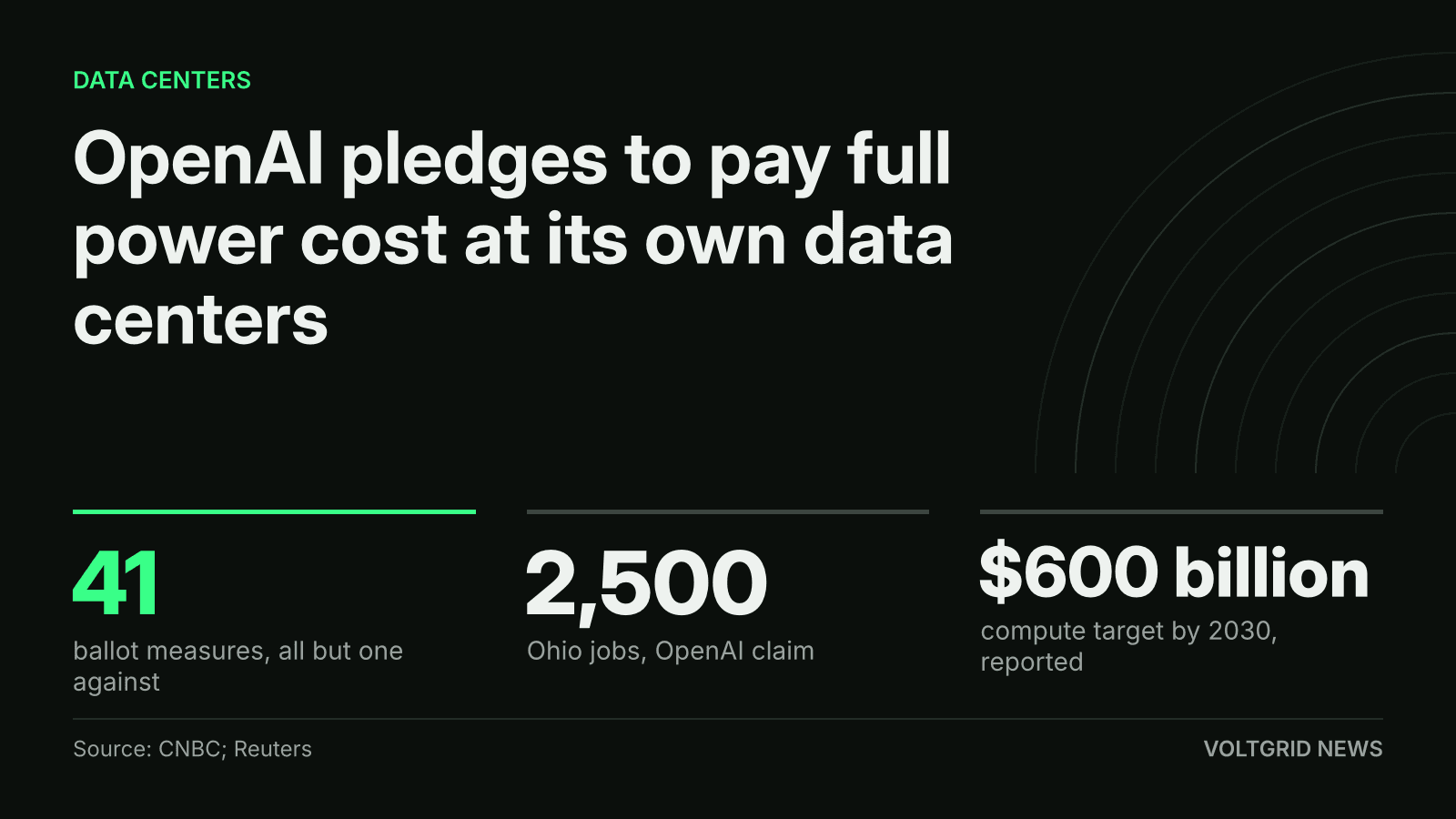
Anthropic's filing ties the two together. It lists limits on the availability of power and data-center capacity among the factors that set when it gets compute and what it pays. The scramble shows up in the deals Voltgrid tracks, from Broadcom's $63 billion chip lease for Anthropic, starting in 2027, to Anthropic reportedly being in talks over an Edmonton campus with a 920 MW gas plant (nothing is signed), to OpenAI's Nov. 5 pledge to pay the full cost of power at the data centers it owns and operates.
Voltgrid's Reading: Limits Ration Chips, Not Kilowatt-Hours
This section is our interpretation, not a provider's statement. The electricity behind a heavy agent month is cheap, a few dollars at most on our numbers, too small to explain a cap, and we found no provider that ties a limit to its power bill. What a cap rations is accelerator time: the chips, memory, data halls and grid connections that take years to add. When accelerators are short, a flat-rate plan that lets one subscriber use several times its price in list-value compute is the obvious place to tighten. Anthropic's S-1 points the same way: it says agentic work consumes significantly more compute per interaction than chat or single-turn calls. OpenAI's notes give no reason for its Oct. 29 increase; we read it as capacity pressure easing. Google's Argon price rise is consistent with the same pressure on the metered side, though Google has not said why it is raising the price. For grid planners, the signal is not one user's 22 kWh but the sum: every allowance increase is a bet that the accelerators, and the power to run them, will be there.
What We Don't Know Yet
No provider publishes how many tokens a subscription includes. Anthropic, OpenAI and Google describe their plans as multiples of another plan or as compute-based limits, so we cannot say whether a 1-billion-token month fits under any $200 plan. None discloses energy per token for its frontier models. Google's 0.24 Wh covers a median chat prompt of unstated length, OpenAI's 0.34 Wh comes without a method, and the Epoch and arXiv figures are an estimate and a measurement on open models; none measures Claude, GPT-6 or Gemini 4. The input and cache energy factors in our cases are our assumptions. What it costs a provider to serve a token is not public. Anthropic's total compute expense mixes model development with serving; its filing's cost of revenue line, $2.38 billion, is mostly serving but is not split by token. OpenAI has not yet said, in the pages we read, how dots usage will count against Pro allowances now that the first month has passed.
Sources
- 01Anthropic PBC Form S-1SEC EDGAR · sec.gov
- 02Measuring the environmental impact of delivering AI at Google ScaleGoogle (arXiv) · arxiv.org
- 03ChatGPT release notesOpenAI Help Center · help.openai.com
- 04Pricing - Claude Platform DocsAnthropic · platform.claude.com
- 05Gemini Developer API pricingGoogle · ai.google.dev
- 06Energy demand from AIInternational Energy Agency · iea.org