AMD Ryzen AI vs RTX Spark: 14% Cinebench Claim, No Test Systems Named
AMD's Ryzen AI vs RTX Spark pitch claims a 14% Cinebench lead, nearly 50% longer gaming battery and 17% lower prices, but names no test systems. Notebookcheck's lab scored the 20-core N1X at 1,726 points against 1,673 for the Ryzen AI Max+ 395.
Chips & Power DeskEdited by Ege Erten
3 min readAI-assisted
Follows our story: NVIDIA RTX Spark Laptops Start at $2,599, 128GB Models in Stock
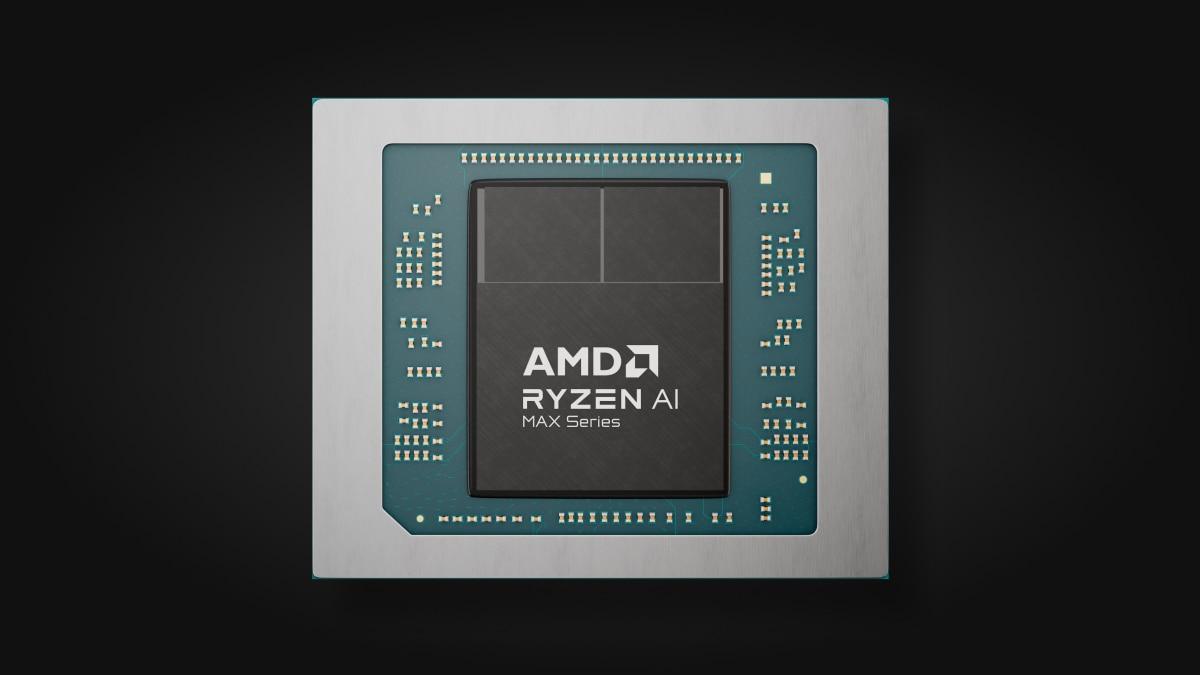
AMD's Ryzen AI Max Series chip. AMD did not name the product it compared with RTX Spark.
Image: AMD
Source · Press image from the AMD website, used for news reporting.
In a Ryzen AI vs RTX Spark comparison on Nov. 4, AMD said its chip beats NVIDIA's RTX Spark by 14% in Cinebench 2024 multi-core, a claim that Notebookcheck's lab results, published Oct. 15 on different systems, do not match.
Alexey Navolokin, AMD's senior director of commercial sales for Asia-Pacific, made the comparison at AMD Advancing AI Seoul 2026, according to TheElec. He also said AMD systems last nearly 50% longer on battery while gaming, measured with PCMark 10 Gaming, and that AMD laptops and workstations cost about 17% less. TheElec's report names neither the chip nor the test systems behind any of the three figures. TheElec believes the AMD part was the Ryzen AI Max+ 395 (Strix Halo), which pairs up to 16 CPU cores with a Radeon 8060S GPU and up to 128GB of LPDDR5X. AMD did not compare graphics performance.
The claim lands about a week after NVIDIA said on Oct. 28 that RTX Spark laptops were on sale, and three weeks after the Oct. 15 reviews. As Voltgrid reported, RTX Spark laptops start at $2,599 with 128GB models in stock. AMD's numbers are a pitch to buyers choosing between those machines and Strix Halo laptops, and none of them can be checked yet.
What the labs measured
Notebookcheck ran Cinebench 2024 multi-core on both chips with its standard method. The 20-core RTX Spark N1X scored 1,726 points in the ASUS ProArt P16, in a Performance mode where the chip drew up to 85 W before settling at 70 W, and 1,682 in the Surface Laptop Ultra. The Ryzen AI Max+ 395 scored 1,673 in the ASUS ProArt PX13 and 1,648 in the ROG Flow Z13. The best Strix Halo result, 1,673 points, sits below the best N1X result, 1,726 points, the reverse of AMD's claim.
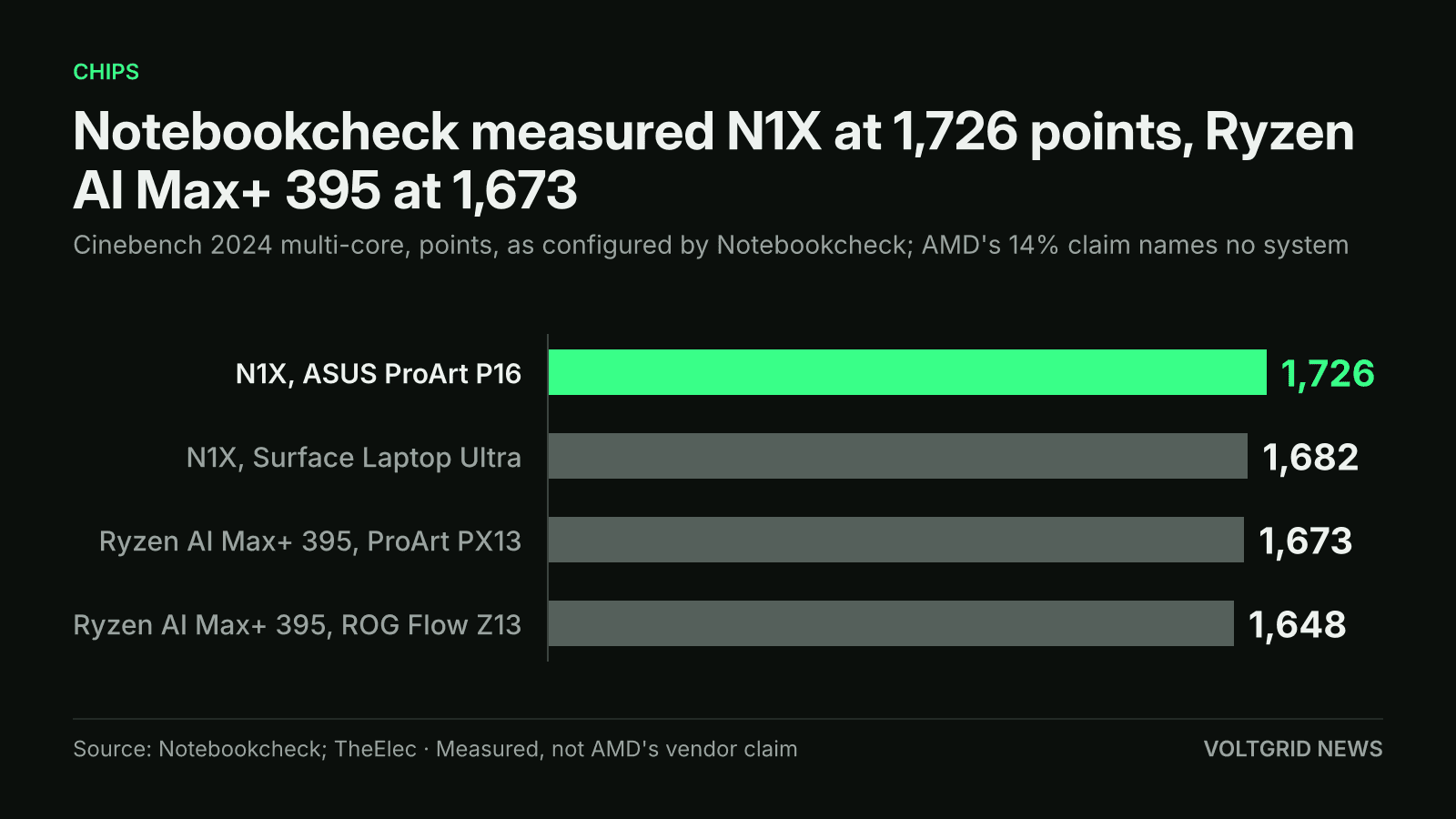
Notebookcheck's measured scores sit within 1,648 to 1,726 points; AMD's 14% claim names no test system.
Illustration (AI-generated)
Those figures do not disprove AMD's number, because AMD's setup is unknown. RTX Spark ships in a 20-core version and an 18-core version under the same name, and laptop power modes move these scores. ServeTheHome found a 44% spread across four boxes built on the same Ryzen AI Max+ 395, which it attributed, as a best guess it did not test, to cooling and power settings (an estimated SPEC CPU2026 integer test). A 14% lead could come from the 18-core part or a different power mode; AMD has not said.
Windows Central, testing the 20-core part, measured 6,885 points in the newer Cinebench 2026 on a Surface Laptop Ultra. That is a different benchmark version, so it cannot be set against AMD's Cinebench 2024 figure.
Why Power Modes Decide Laptop CPU Scores
A laptop chip's benchmark score depends on how many watts the maker lets it draw, not only on its core count. NVIDIA lists RTX Spark laptops at 45 to 80 W, and Notebookcheck saw the N1X in the ASUS ProArt P16 draw up to 85 W before settling at 70 W. AMD lists the Ryzen AI Max+ 395 at a 55 W default, configurable from 45 to 120 W.
That range is why one chip can post different scores. ServeTheHome found a 44% spread across four Ryzen AI Max+ 395 boxes and guessed that cooling and power settings explain it. Notebookcheck's four laptops scored between 1,648 and 1,726 points in Cinebench 2024 multi-core, so AMD's 14% lead cannot be placed until AMD names its systems and power modes.
The battery, price and games claims
Voltgrid found no outlet that ran PCMark 10 Gaming on both platforms as of Nov. 8. PC Gamer ran it on one RTX Spark laptop, the ASUS ProArt P16, and got 86 minutes; it published no Strix Halo result in that test. Notebookcheck's closest data is efficiency, not battery life: it rated N1X multi-core efficiency roughly on par with Strix Halo systems, and its text says N1X beats Strix Halo in Cyberpunk 2077 frames per watt (an x64 game under emulation), but its chart is mixed: the ProArt PX13 (Ryzen AI Max+ 395) logged 0.66 against 0.654 and 0.585 for the two N1X laptops, and the ROG Flow Z13 0.562.
On games, AMD said RTX Spark does not properly support popular online titles, which TheElec attributed to some anti-cheat software not supporting the Arm-based CPU. Windows Central reported that most mainstream anti-cheat software now works on Windows on Arm, with exceptions. On price, Windows Central found that Intel or AMD laptops with a dedicated NVIDIA GPU often cost less than the cheapest RTX Spark models, which fits AMD's direction but does not confirm its 17% figure.
What is not confirmed yet
AMD has not said which RTX Spark system, core count or power mode it tested, or which prices produced its 17% figure. Until it publishes the configurations, or an outlet runs PCMark 10 Gaming on matched laptops, all three numbers remain AMD's claims.